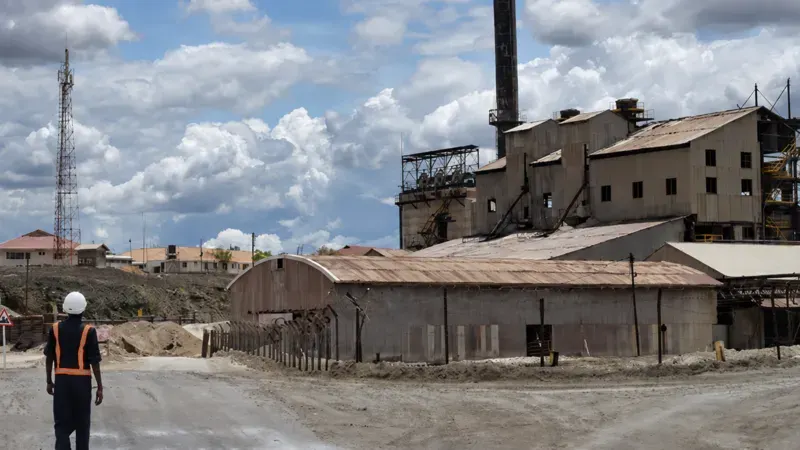
President William Ruto has ordered Tata Chemicals Magadi Limited to end its operations at Lake Magadi, escalating a dispute that began when the government suspended the company’s mining activities in late July over alleged regulatory non-compliance. The September 3 announcement marks the strongest signal yet that the government intends to replace the long-standing soda ash operator and push more mineral processing into Kajiado County.
Ruto says future investors should use locally mined soda ash to manufacture higher-value products such as glass and industrial chemicals inside Kenya. Tata Chemicals, however, maintains that its Kenyan subsidiary has complied with regulatory requirements and says it is awaiting further direction from the mining authorities.
Key Overview
- President Ruto has ordered Tata Chemicals Magadi Limited to exit its Kenya operations.
- The company’s mining activities had already been suspended in late July 2026 over alleged compliance failures.
- The government cited unresolved issues involving royalties, export reporting, value addition, community agreements, local procurement and environmental compliance.
- Ruto says replacement investors should establish glass and chemical manufacturing facilities in Kajiado.
- Tata says it submitted the requested documentation on August 11, 2026 and considers itself compliant.
- Tata Chemicals has controlled the Magadi business since 2005, although commercial soda ash production at Lake Magadi dates back to 1911.
Government Pushes Tata Out After July Suspension
The latest order follows the government’s July intervention in Tata’s Lake Magadi operation. Mining Cabinet Secretary Hassan Joho suspended all mining operations after officials said several statutory and commercial issues remained unresolved.
The concerns included mineral beneficiation and value addition, reconciliation and payment of royalties, export reporting, implementation of Community Development Agreements, employment and skills transfer for Kenyans, procurement of local goods and services and environmental compliance.
The company subsequently shut down mining operations in line with the directive. The government said activity could resume only after Tata demonstrated full compliance with Kenya’s mining laws and addressed outstanding obligations.
Ruto’s September remarks go further than that original suspension. During a visit to Kajiado, he said Tata should leave and that the government would bring in replacement investors capable of turning soda ash into finished products within the county.
Kenya Wants More Value Added Around Lake Magadi
At the centre of the dispute is the government’s argument that Kenya should capture more value from its mineral resources before they are exported.
Lake Magadi contains trona, a naturally occurring mineral processed into soda ash. Soda ash is widely used in glass manufacturing, detergents, chemicals and other industrial applications. Tata says more than 95% of output from the Magadi operation has historically been exported.
Ruto has argued that this export-oriented model has delivered too little industrial development in Kajiado despite more than a century of soda ash production. The government now wants incoming investors to develop glass and chemical manufacturing facilities close to the mineral source.
Industrialisation officials say the strategy could create a broader manufacturing cluster around Magadi, supporting industries such as packaging, construction materials, engineering, transport, laboratories and equipment supply.
The shift also aligns with Kenya’s wider policy of moving away from exporting raw or lightly processed materials and toward domestic beneficiation, which can create more employment and retain a larger share of the value chain locally.

Context is everything. Stay ahead of shifting trends with today’s market updates, and uncover emerging opportunities using the Serrari Group Market Index and Marketplace. Then, take control of your own financial future by exploring our Money & Life Reset Transformation Blueprint ™ to build stronger habits, create better systems, and design a path toward lasting wealth.
Tata Disputes the Compliance Narrative
Tata Chemicals has pushed back against the government’s position. The company says its subsidiary submitted all information, reports and documentation requested by the mining ministry on August 11 and remains fully compliant with regulatory requirements.
Following Ruto’s exit order, Tata reiterated that it respects the Kenyan government’s regulatory authority and remains committed to resolving outstanding issues through appropriate legal and regulatory channels.
That response means the situation remains more complex than a simple completed corporate exit. Operations are suspended, Ruto has publicly ordered the company out, and the government is discussing replacement investors, but Tata maintains that it has fulfilled the ministry’s documentation requirements and is awaiting a formal review.
This distinction matters because any transfer of operating rights, mining licences, land interests and associated infrastructure could involve additional administrative or legal processes.
A Century-Old Operation Faces Its Biggest Reset
Commercial soda ash production at Lake Magadi began in 1911, long before Tata entered the business. Tata Chemicals acquired the operation in 2005 after buying Brunner Mond, whose assets included the Kenyan soda ash business.
The underlying mineral rights also have deep historical roots. A Court of Appeal judgment records a government lease dating to 1928 covering the extraction of Magadi deposits in the Lake Magadi and Lake Natron areas.
The operation remains economically important. In the year to July 2025, Kenya exported about 254,779 tonnes of soda ash worth $56.9 million, illustrating the scale of the trade at stake.
Tata also says the Magadi operation directly employs hundreds of people and supports surrounding communities through health, education, water and enterprise programmes. Those economic links mean any transition to a replacement operator will need to address employment, community services, export revenue and continuity of production.
For the government, however, the strategic question is no longer simply whether soda ash should continue to be mined. Ruto’s position is that future operators must help convert the resource into a deeper domestic industrial base.
If replacement investors follow through with glass and chemical plants, the Magadi dispute could become a major test of Kenya’s mineral value-addition strategy. But the immediate next step will depend on how the government formally implements Ruto’s exit order and resolves Tata’s assertion that it has already met the regulatory requirements placed before it.
Sources: Reuters / Kenya News Agency / Tata Chemicals / Associated Press / Kenya Law
Your financial future isn’t something you wait for—it’s something you build.
The real question is: when do you begin?
Move beyond simply staying informed.
Navigate the markets with clarity—track trends through the Serrari Group Market Index, uncover opportunities in the Serrari Marketplace, and build practical knowledge with our Curated Wealth Builder Platform.
Stay connected to what truly matters.
Get daily insights on macro trends and financial movements across Kenya, Africa, and global markets—delivered through the Serrari Newsletter.
Growth opens doors.
Advance your career through professional programs including ACCA, HESI A2, ATI TEAS 7 , HESI EXIT , NCLEX – RN and NCLEX – PN, Financial Literacy!🌟—designed to move you forward with confidence.
See where money is flowing—clearly and in real time.
Track Money Market Funds, Treasury Bills, Treasury Bonds, Green Bonds, and Fixed Deposits, alongside global and African indexes, key economic indicators, and the evolving Crypto and stablecoin landscape—all within Serrari’s Market Index.