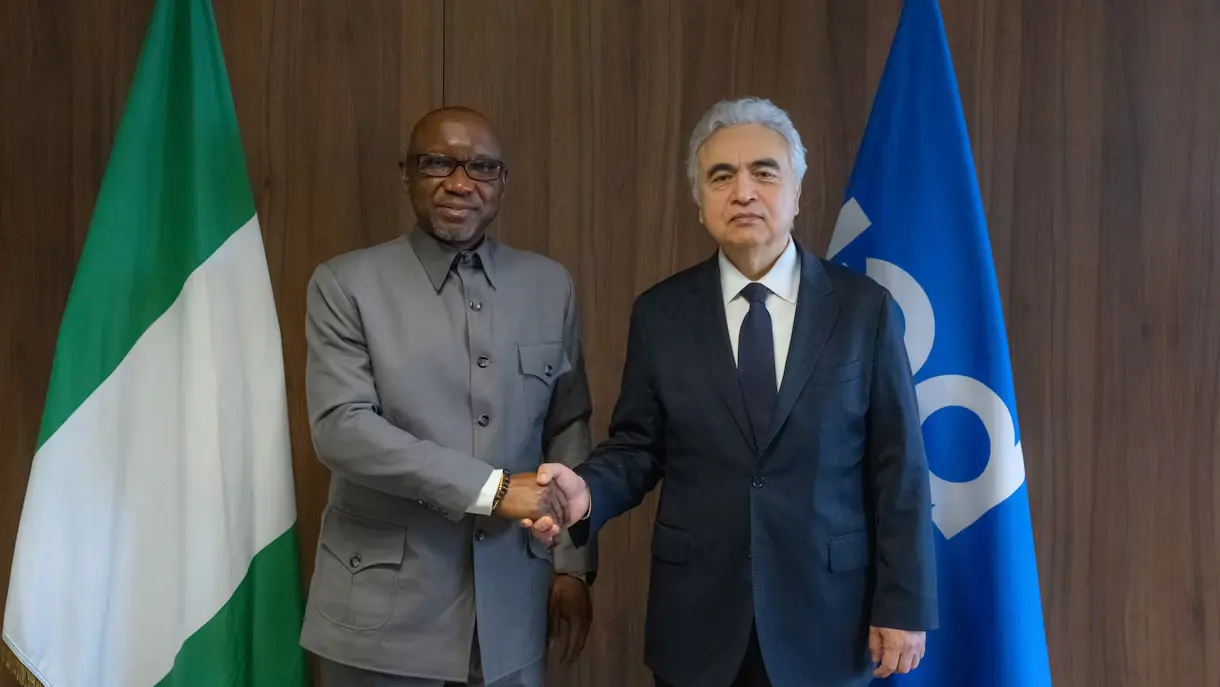
Nigeria has formally entered the International Energy Agency’s Association framework and signed its first Joint Work Programme with the agency, creating a structured platform for cooperation on energy security, investment, data, efficiency and clean cooking. The new partnership roadmap was signed in Abuja after the IEA’s Governing Board unanimously approved Nigeria’s entry as an Association country earlier in 2026.
The agreement is expected to deepen technical cooperation between Nigerian institutions and IEA experts while improving the quality of energy data used for policymaking and investment decisions. It also gives Africa’s largest oil producer a stronger platform in global energy discussions at a time when supply security, affordability and investment are becoming increasingly important.
Key Overview
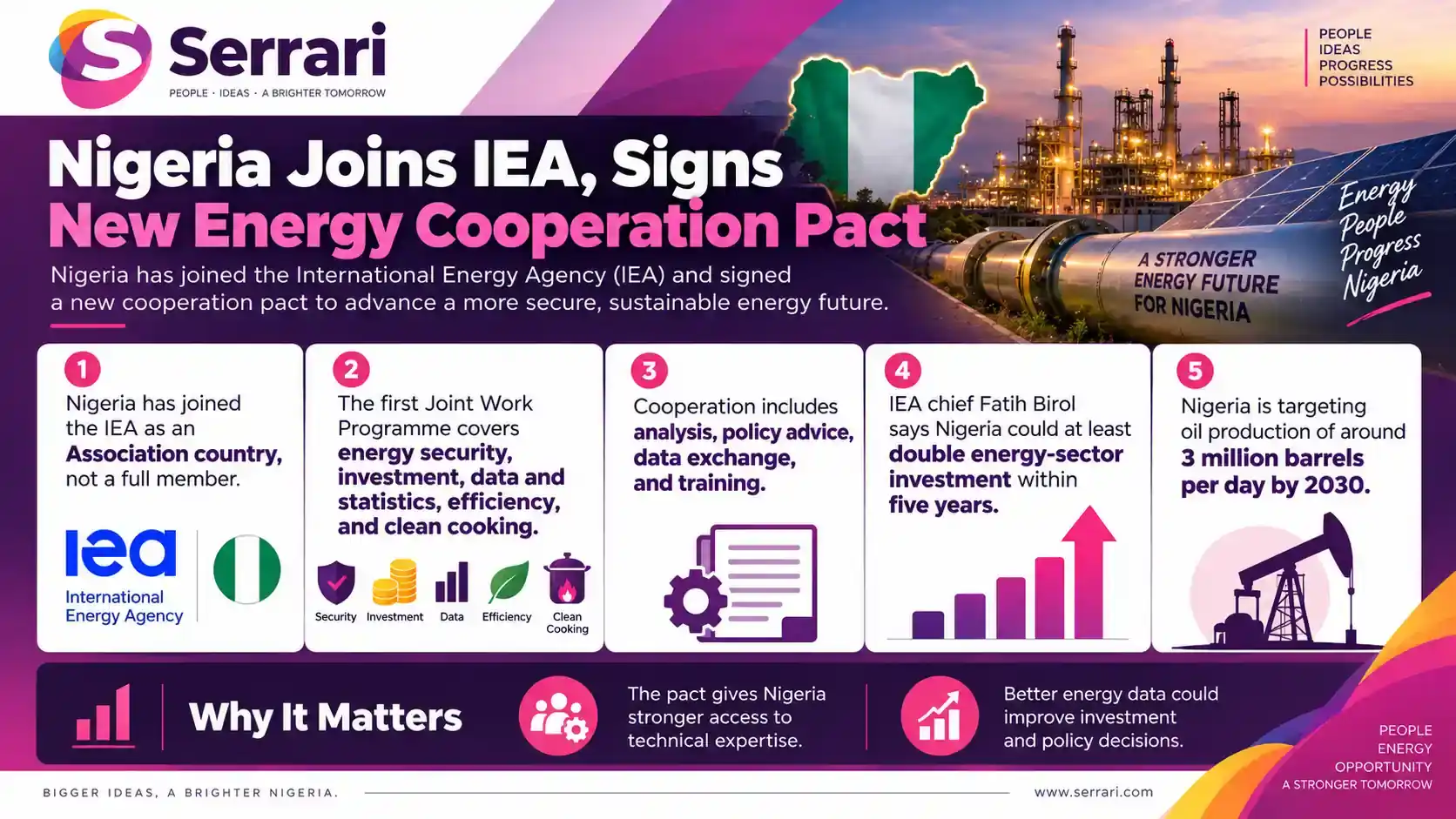
- Nigeria has joined the IEA Family as an Association country, rather than as a full member.
- The first IEA-Nigeria Joint Work Programme covers energy security, investment, data and statistics, energy efficiency and clean cooking.
- Cooperation will include analysis, data exchange, policy advice and training for Nigerian institutions.
- IEA Executive Director Fatih Birol says Nigeria could at least double energy-sector investment within five years.
- Nigeria is targeting oil production of about 3 million barrels per day by 2030 while also expanding gas, electricity and renewable-energy investment.
- Nigeria’s inclusion means the wider IEA Family now represents more than 80% of global energy demand.
Joint Work Programme Gives the Partnership Structure
The agreement signed in Abuja formalises a relationship that has been developing for more than a decade. According to the official cooperation framework, the programme was developed with Nigerian ministries, regulators and other energy institutions and is intended to guide cooperation over the coming years.
Its priorities include improving energy data and statistics, strengthening energy security, attracting investment, raising energy efficiency and expanding access to cleaner cooking solutions. Nigerian officials will also work more closely with IEA specialists through technical analysis, policy advice, capacity-building and professional training.
This is especially important for Nigeria because gaps in consistent energy data have long made it harder for investors, policymakers and market participants to assess production, exports, consumption and infrastructure needs. Better reporting could improve both government planning and private-sector investment decisions.
The new programme builds on an earlier memorandum of understanding signed in February 2026 covering policy dialogue, data exchange, capacity building and international engagement.
Context is everything. Stay ahead of shifting trends with today’s market updates, and uncover emerging opportunities using the Serrari Group Market Index and Marketplace. Then, take control of your own financial future by exploring our Money & Life Reset Transformation Blueprint ™ to build stronger habits, create better systems, and design a path toward lasting wealth.
Association Status Expands Nigeria’s Global Energy Role
Nigeria’s new status does not make it a full IEA member. Instead, it joins the agency’s Association framework, which allows major emerging and developing economies to participate more closely in IEA activities and policy cooperation.
The Governing Board unanimously approved Nigeria’s admission earlier this year, adding Africa’s most populous country and one of its largest oil and gas producers to the IEA Family. Nigeria joins South Africa, Kenya and Senegal among the agency’s Association countries in sub-Saharan Africa.
The move gives Nigeria greater access to technical expertise while also bringing its experience as a major producer and fast-growing energy market into international discussions. With Nigeria included, the IEA says its broader family of members and Association countries now represents more than 80% of global energy demand, compared with around 40% in 2015.
Vice President Kashim Shettima described the admission as recognition of Nigeria’s strategic importance in global energy markets and said the country would benefit from the agency’s institutional knowledge and international reach.
Investment, Gas and Energy Access Become Key Priorities
Nigeria needs large amounts of capital to expand oil and gas output, strengthen electricity supply and develop renewable energy. During his Abuja visit, Birol said his objective was to see the country at least double energy investment within five years.
Nigeria is seeking to raise oil production toward 3 million barrels per day by 2030, while reforms, infrastructure upgrades and stronger security are expected to support new investment. Gas development is another major focus because the country holds some of Africa’s largest reserves but still faces infrastructure and domestic supply constraints.
The cooperation programme also places electricity access and clean cooking alongside hydrocarbons. Nigeria still faces major energy-access challenges despite its resource wealth, making affordability and household energy use central to the partnership.
Birol has said the IEA will provide policy support across areas ranging from clean cooking to gas markets while also training Nigerian experts. That broad mandate reflects the country’s dual challenge of expanding conventional energy production while improving access to modern, lower-emission energy services.
Better Data Could Improve Investment Decisions
One of the most practical outcomes of the partnership may be stronger energy statistics. Investors frequently rely on credible information about production, demand, exports, infrastructure and market conditions before committing capital.
The new programme will involve IEA technical teams working with Nigerian institutions to improve the collection and use of energy data across the value chain. More reliable statistics could reduce uncertainty around investment decisions and strengthen the government’s ability to measure whether reforms are delivering higher production, greater energy access and improved efficiency.
The partnership does not by itself guarantee new investment or solve Nigeria’s infrastructure challenges. Its value will depend on whether technical cooperation translates into better policy execution, transparent data and investable projects.
Still, Nigeria’s entry into the IEA Association framework gives the country a more formal role in global energy cooperation at a time when governments and companies are reassessing supply chains and looking for reliable energy partners. If implemented effectively, the Joint Work Programme could strengthen both Nigeria’s domestic energy planning and its position in international markets.
Sources: International Energy Agency / Reuters / State House Nigeria / TheCable / Nairametrics
Your financial future isn’t something you wait for—it’s something you build.
The real question is: when do you begin?
Move beyond simply staying informed.
Navigate the markets with clarity—track trends through the Serrari Group Market Index, uncover opportunities in the Serrari Marketplace, and build practical knowledge with our Curated Wealth Builder Platform.
Stay connected to what truly matters.
Get daily insights on macro trends and financial movements across Kenya, Africa, and global markets—delivered through the Serrari Newsletter.
Growth opens doors.
Advance your career through professional programs including ACCA, HESI A2, ATI TEAS 7 , HESI EXIT , NCLEX – RN and NCLEX – PN, Financial Literacy!🌟—designed to move you forward with confidence.
See where money is flowing—clearly and in real time.
Track Money Market Funds, Treasury Bills, Treasury Bonds, Green Bonds, and Fixed Deposits, alongside global and African indexes, key economic indicators, and the evolving Crypto and stablecoin landscape—all within Serrari’s Market Index.