


















Kenya has clarified that visa-free entry and exemptions from the Electronic Travel Authorisation system do not automatically give foreign nationals permission to work, trade or operate businesses in the country. The clarification follows concerns over President William Ruto’s recent comments on foreigners engaged in hawking and small-scale retail activities.
Investments, Trade and Industry Cabinet Secretary Lee Kinyanjui said foreigners carrying out economic activities must hold the relevant immigration permits, business licences and regulatory approvals. At the same time, senior government officials have stressed that foreign traders with valid documentation remain legally entitled to operate in Kenya.
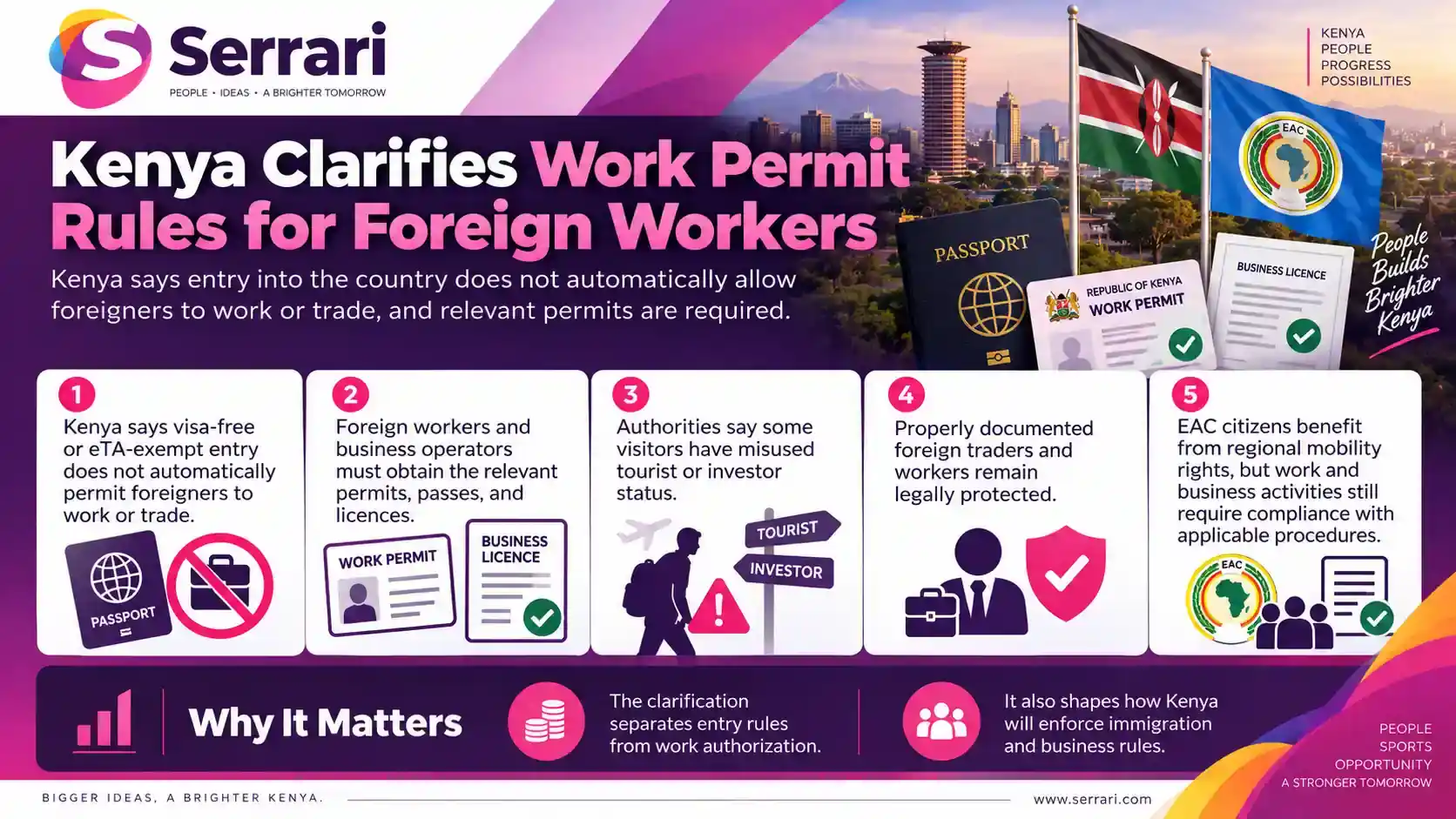
Key Overview
- Visa-free or eTA-exempt entry does not grant permission to work or trade in Kenya.
- Foreign employees must obtain the appropriate work authorisation, while traders and business operators require the relevant permits and licences.
- Kenya says some visitors have been using tourist or investor status to undertake activities outside the conditions under which they entered.
- Foreigners who violate immigration conditions may face revocation of their immigration status or other enforcement action.
- Citizens of several East African Community partner states are exempt from Kenya’s eTA for stays of up to 180 days, but work and business activities remain subject to applicable procedures.
- Government officials have clarified that properly documented foreign workers and traders are not subject to a blanket ban.
Entry Permission Is Different From Permission to Work
The government’s central message is that permission to enter Kenya should not be confused with permission to earn income in the country.
Kenya replaced its conventional visa system for most short-term visitors with an Electronic Travel Authorisation regime in 2024 and later expanded exemptions in 2025. Under the current immigration rules, holders of valid Kenyan work permits and passes are exempt from obtaining an eTA, while citizens of Burundi, the Democratic Republic of Congo, Rwanda, South Sudan, Tanzania and Uganda are also exempt for stays of up to 180 days.
That exemption governs entry, not employment. Kenya’s immigration regulations separately require foreigners intending to work or conduct business to obtain the appropriate permit or pass.
For salaried employment, the Class D permit covers foreigners offered specific employment by a specific employer where the applicant has skills or qualifications considered beneficial to Kenya. People intending to operate a trade, business or consultancy generally fall under the separate Class G framework and may also need sector-specific and county licences.
Context is everything. Stay ahead of shifting trends with today’s market updates, and uncover emerging opportunities using the Serrari Group Market Index and Marketplace. Then, take control of your own financial future by exploring our Money & Life Reset Transformation Blueprint ™ to build stronger habits, create better systems, and design a path toward lasting wealth.
Government Targets Misuse of Tourist and Investor Status
Kinyanjui’s clarification follows government concern that some foreign nationals have entered Kenya under one immigration category but subsequently engaged in activities outside the conditions attached to that status.
The Trade CS said authorities had identified cases involving foreigners in retail and local trade and warned that visa-free entry does not confer economic rights. Where individuals are working or trading without the required authorization, immigration authorities can take action under existing law.
The statement came after Ruto directed authorities to act against foreigners involved in hawking and other small businesses. His September 2 remarks prompted concern that Kenya was preparing a broad ban on foreign participation in small-scale commerce.
Foreign Affairs Principal Secretary Korir Sing’Oei subsequently said the President’s remarks had been taken out of context and clarified that small and large foreign businesses remain protected where their owners hold the required work permits, licences and approvals.
That clarification is significant because it shifts the immediate enforcement focus from nationality alone toward immigration and licensing compliance.
EAC Citizens Have Mobility Rights but Must Follow Procedures
The issue is particularly sensitive for citizens of neighbouring East African Community countries because Kenya participates in the EAC Common Market, which provides for the free movement of persons, workers, services and capital.
Under the Common Market framework, workers from participating partner states have rights to seek and accept employment across the region, subject to the national laws and administrative procedures of the host country.
Regional guidance also makes clear that these freedoms do not eliminate immigration formalities. An EAC worker taking employment for more than 90 days is expected to obtain the appropriate work permit, while shorter employment may require a special pass. Kenya has historically waived work-permit fees for qualifying East African nationals, although the authorization process itself still applies.
The distinction means an EAC citizen may enter Kenya without an eTA and still need employment or business documentation depending on the activity being undertaken.
Enforcement Raises Questions for Foreign-Owned Small Businesses
The government says implementation will be conducted lawfully, transparently and in line with Kenya’s EAC commitments. However, uncertainty remains over how enforcement will distinguish between undocumented traders and foreign-owned small businesses that already hold valid permits and licences.
Ruto’s original comments suggested that certain low-capital activities, including hawking and small retail, should primarily benefit Kenyans. Yet the subsequent government clarification states that foreigners who meet existing legal requirements remain entitled to operate.
That leaves the broader policy question unresolved: whether Kenya will eventually create new statutory restrictions on specific categories of small business or simply enforce existing immigration and licensing rules more aggressively.
For now, the legal position is clearer than the political debate. Foreign nationals can visit Kenya under the applicable entry regime, but anyone seeking to work, trade or run a business must separately comply with immigration, employment and commercial licensing requirements. Visa-free entry makes travel easier; it does not create an automatic right to participate in Kenya’s labour market or commercial economy.
Sources: Directorate of Immigration Services / Kenya Law / East African Community / People Daily / Citizen Digital
Your financial future isn’t something you wait for—it’s something you build.
The real question is: when do you begin?
Move beyond simply staying informed.
Navigate the markets with clarity—track trends through the Serrari Group Market Index, uncover opportunities in the Serrari Marketplace, and build practical knowledge with our Curated Wealth Builder Platform.
Stay connected to what truly matters.
Get daily insights on macro trends and financial movements across Kenya, Africa, and global markets—delivered through the Serrari Newsletter.
Growth opens doors.
Advance your career through professional programs including ACCA, HESI A2, ATI TEAS 7 , HESI EXIT , NCLEX – RN and NCLEX – PN, Financial Literacy!🌟—designed to move you forward with confidence.
See where money is flowing—clearly and in real time.
Track Money Market Funds, Treasury Bills, Treasury Bonds, Green Bonds, and Fixed Deposits, alongside global and African indexes, key economic indicators, and the evolving Crypto and stablecoin landscape—all within Serrari’s Market Index.