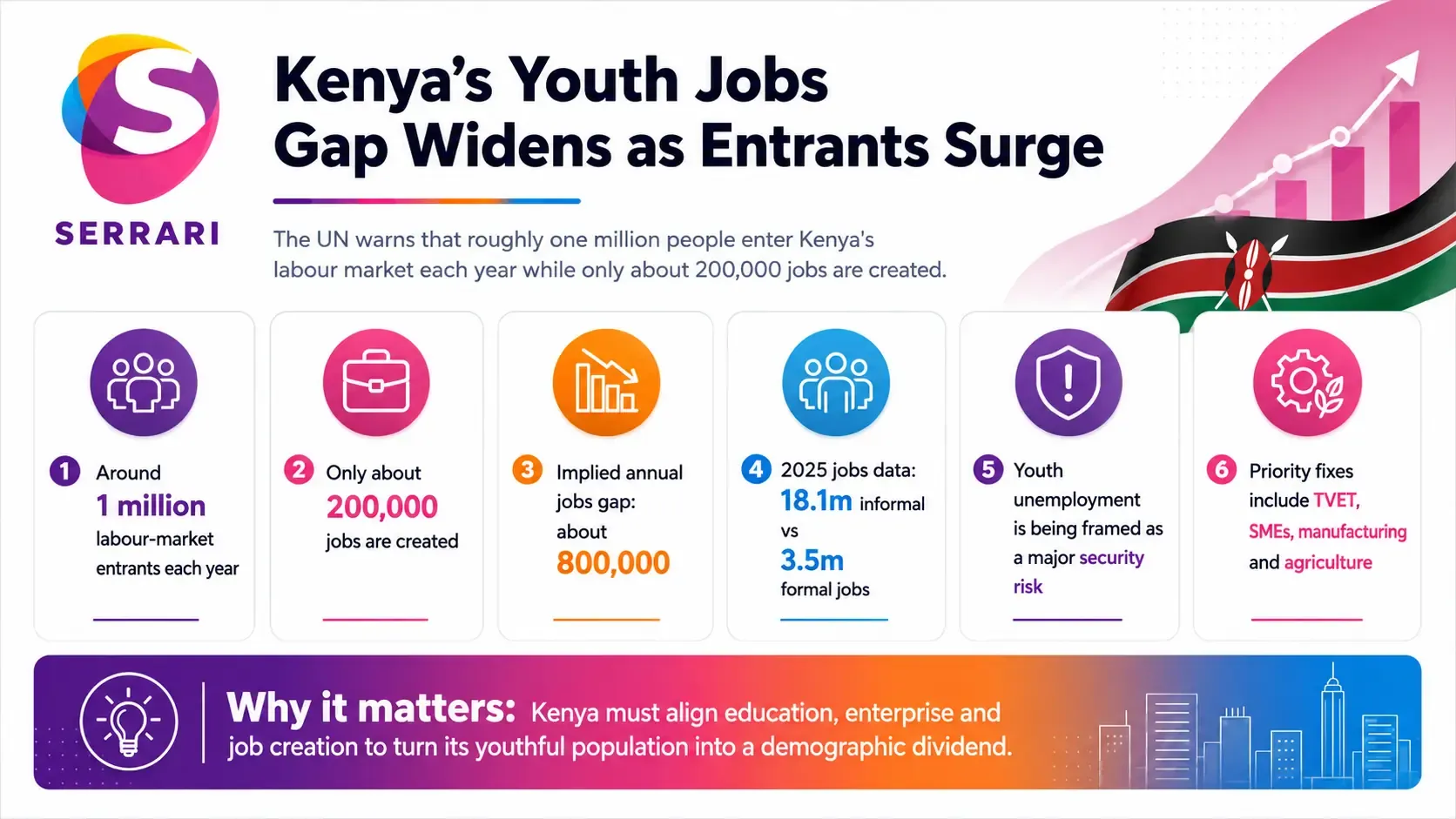
Kenya faces a widening employment challenge as roughly one million people enter the labour market each year while the economy creates only about 200,000 jobs, leaving an implied annual gap of around 800,000 opportunities.
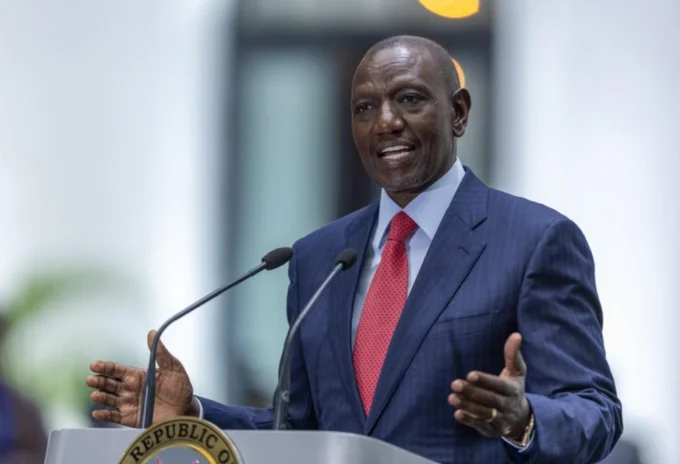
In a recent discussion on Kenya’s development challenges, United Nations Resident Coordinator Garry Conille described youth job creation as one of the country’s most urgent development challenges and a significant potential threat to security. The warning highlights a fundamental problem: Kenya’s young population is expanding faster than the economy’s ability to generate stable and productive employment.
Key Overview
- About one million people enter Kenya’s labour market annually.
- The economy creates only about 200,000 jobs, according to the UN Resident Coordinator.
- The implied employment deficit is approximately 800,000 opportunities each year.
- Kenya had roughly 18.1 million informal workers against about 3.5 million formal workers in 2025.
- Skills mismatches, limited formal employment and weak SME growth remain major obstacles.
- Manufacturing, agriculture, technology and small businesses could play a larger role in absorbing new workers.
- Education reform will have limited impact unless accompanied by stronger private-sector job creation.
Kenya’s Labour Market Is Dominated by Informal Work
Kenya is creating employment, but the quality and structure of those opportunities matter.
The country’s latest national employment figures show that approximately 83.8% of employment was informal in 2025, equivalent to about 18.1 million workers, compared with only around 3.5 million in formal employment.
Modern-sector employment excluding self-employment stood at roughly 3.3 million, illustrating how difficult it remains for new labour-market entrants to secure salaried positions with predictable income and employment protections.
This means Kenya’s jobs problem cannot be measured purely by unemployment. Millions of people may technically be working but remain in low-productivity, irregular or poorly paid activities.
The demographic pressure is also not new. Earlier analysis of Kenya’s expanding workforce projected that the country’s working-age population could increase by about one million people annually, making the creation of productive jobs essential if Kenya is to benefit from its demographic dividend.
Education Must Connect More Closely With Employment
Kenya has made significant investments in expanding education, universities and technical training. The challenge is increasingly what happens after students complete that education.
Training institutions need stronger connections with industries that are actually expanding. Digital skills, technical trades, financial literacy, entrepreneurship and problem-solving therefore need to complement traditional academic qualifications.
Competency-Based Education could help strengthen this connection if implementation focuses not only on assessment but also on practical skills and employability.
Universities and TVET institutions will also need deeper partnerships with employers through internships, apprenticeships and industry-designed courses. Students require credible labour-market information before choosing programmes, particularly as technology transforms the types of skills employers need.
However, education reform alone cannot solve the employment gap. Training one million highly skilled people each year would still leave a major problem if businesses are unable to create enough productive opportunities for them.
Context is everything. Stay ahead of shifting trends with today’s market updates, and uncover emerging opportunities using the Serrari Group Market Index and Marketplace. Then, take control of your own financial future by exploring our Money & Life Reset Transformation Blueprint ™ to build stronger habits, create better systems, and design a path toward lasting wealth.
SMEs Could Become Kenya’s Biggest Jobs Engine
Small and medium-sized businesses already provide livelihoods for millions of Kenyans, making their ability to grow critical to employment creation.
Yet many enterprises continue to face expensive financing, regulatory costs, unpredictable taxation, infrastructure constraints and difficulty accessing larger markets. These challenges can prevent small firms from expanding into employers capable of hiring dozens or hundreds of workers.
Entrepreneurship programmes can help. Previous youth employment and enterprise interventions supported more than 145,000 young Kenyans and generated approximately 125,000 direct and 30,000 indirect jobs, demonstrating that structured skills, finance and business-development programmes can produce meaningful employment outcomes.
The next challenge is achieving this impact at a much larger scale while developing businesses that can survive beyond government or donor support.
Manufacturing and Agriculture Need to Create More Work
Closing an annual employment gap approaching 800,000 jobs will require growth across multiple sectors rather than reliance on one industry.
Manufacturing remains particularly important because industrial businesses can generate employment across production, transport, logistics, distribution and supporting services. Kenya will need to improve competitiveness in areas such as energy costs, taxation, infrastructure and access to capital if manufacturers are to expand significantly.
Agriculture offers similar potential when viewed beyond farming. Processing, storage, logistics, agricultural technology, export distribution and food manufacturing can turn primary production into broader employment ecosystems.
ICT, renewable energy, healthcare, construction, tourism, the creative economy and the blue economy can provide additional pathways, particularly where training programmes are closely aligned with employer requirements.
Youth Employment Is Becoming a Strategic Economic Issue
Conille’s warning goes beyond employment statistics. Large numbers of young people unable to secure stable incomes can increase economic frustration, dependency and vulnerability to crime, political manipulation and other forms of exploitation.
With Kenya approaching its August 2027 general election, employment opportunities for young people are likely to become an increasingly important economic and political issue.
The long-term solution requires more than temporary employment programmes. Kenya needs an economy capable of continuously creating businesses, industries and productive lielihoods at a pace closer to the growth of its workforce.
The country’s youthful population could still become a major economic advantage. But achieving that demographic dividend will depend on whether education, investment, enterprise policy and industrial development ultimately translate into enough productive work for the generation entering the labour market.
Sources: United Nations / Kenya National Bureau of Statistics / World Bank / Education News
Your financial future isn’t something you wait for—it’s something you build.
The real question is: when do you begin?
Move beyond simply staying informed.
Navigate the markets with clarity—track trends through the Serrari Group Market Index, uncover opportunities in the Serrari Marketplace, and build practical knowledge with our Curated Wealth Builder Platform.
Stay connected to what truly matters.
Get daily insights on macro trends and financial movements across Kenya, Africa, and global markets—delivered through the Serrari Newsletter.
Growth opens doors.
Advance your career through professional programs including ACCA, HESI A2, ATI TEAS 7 , HESI EXIT , NCLEX – RN and NCLEX – PN, Financial Literacy!🌟—designed to move you forward with confidence.
See where money is flowing—clearly and in real time.
Track Money Market Funds, Treasury Bills, Treasury Bonds, Green Bonds, and Fixed Deposits, alongside global and African indexes, key economic indicators, and the evolving Crypto and stablecoin landscape—all within Serrari’s Market Index.