U.S. Treasury Secretary Scott Bessent says the European Union has joined Washington’s Operation Economic Outcast, a campaign launched in August to intensify economic pressure on Iran and restrict financial channels supporting the Iranian government and Islamic Revolutionary Guard Corps.
Bessent’s declaration followed the bloc’s August 31 statement at the G20 finance meetings, which welcomed additional economic pressure on Iran, including through the U.S.-led initiative. Brussels simultaneously stressed that diplomatic efforts remain necessary to secure a peace settlement, restore regional stability and protect freedom of navigation through the Strait of Hormuz.
Key Overview
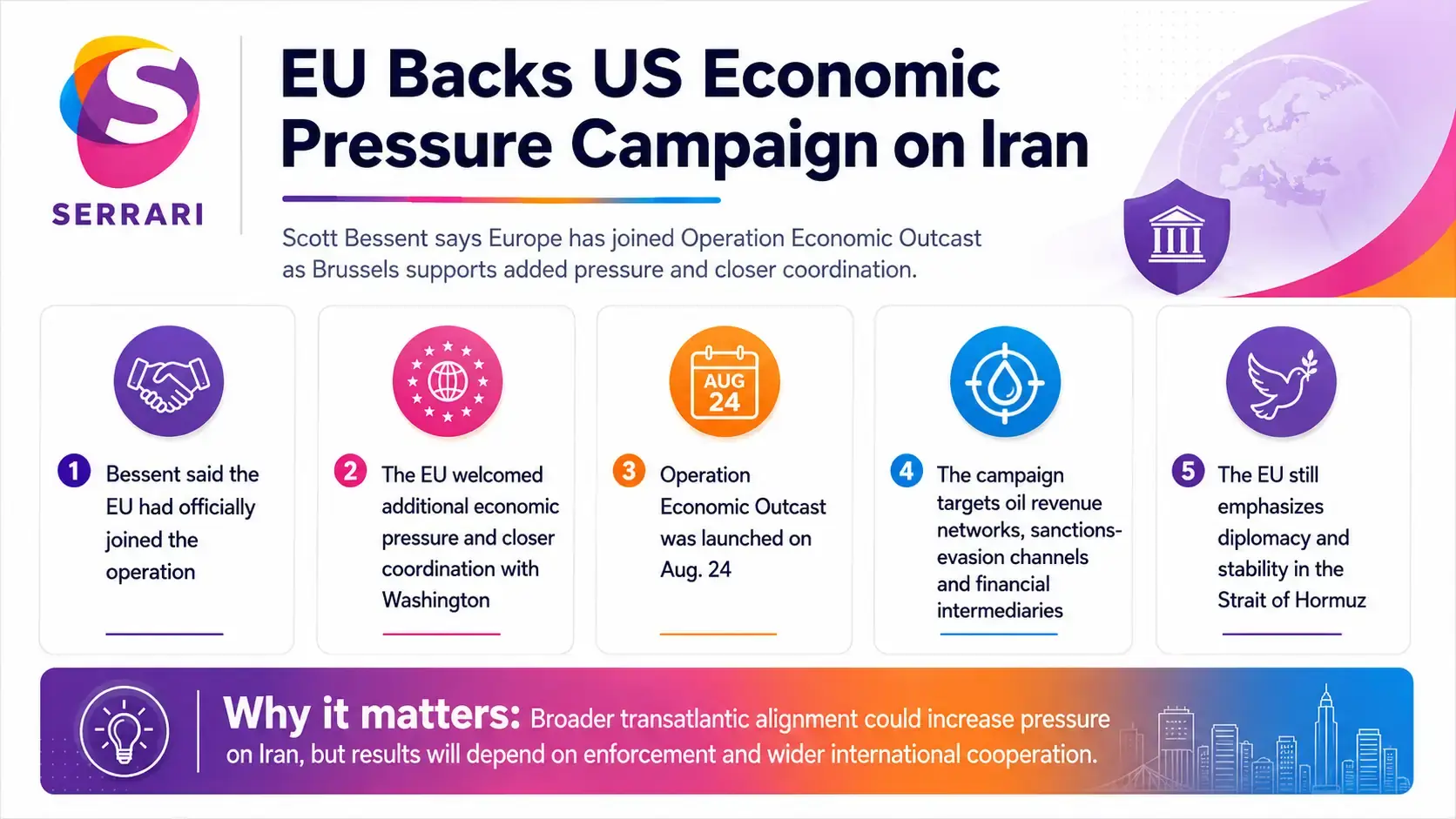
- Bessent said on September 3 that the EU had “officially joined” Operation Economic Outcast.
- The EU itself welcomed additional economic pressure through the U.S.-led operation and pledged closer coordination with Washington and other international partners.
- Washington launched Operation Economic Outcast on August 24 as a sustained economic campaign targeting Iran’s international financial and commercial connections.
- The strategy incorporates sanctions, greater secondary-sanctions risk and pressure on foreign entities that continue certain economic dealings with Iran.
- The EU continues to combine economic pressure with calls for diplomacy, de-escalation and secure navigation through the Strait of Hormuz.
EU Support Broadens Washington’s Iran Campaign
Bessent welcomed what he called Europe’s “strong and early stance” after the bloc publicly backed further economic pressure against Tehran. The EU said it would work closely with the United States, other G7 countries and international partners to maintain pressure while pursuing de-escalation and regional stability.
That support matters because Washington’s strategy relies partly on cooperation beyond U.S. jurisdiction. Iran’s oil sales, shipping operations, banking relationships and commercial networks span several markets, making coordinated international restrictions more consequential than unilateral measures alone.
There is, however, an important distinction between Bessent’s description and the EU’s official wording. While the Treasury secretary characterized Europe as having officially joined the operation, the EU statement itself said it welcomed additional economic pressure “including through” Operation Economic Outcast and would coordinate with Washington. It did not announce that European sanctions automatically become identical to U.S. measures.
The distinction is important because EU sanctions are adopted and implemented under Europe’s own legal framework rather than automatically following U.S. sanctions decisions.
Context is everything. Stay ahead of shifting trends with today’s market updates, and uncover emerging opportunities using the Serrari Group Market Index and Marketplace. Then, take control of your own financial future by exploring our Money & Life Reset Transformation Blueprint ™ to build stronger habits, create better systems, and design a path toward lasting wealth.
What Operation Economic Outcast Targets
The U.S. Treasury described the initiative as a whole-of-government campaign intended to sever the financial connections sustaining the Iranian government. Its targets include oil-revenue networks, sanctions-evasion channels, financial intermediaries and other entities Washington says facilitate Iranian economic activity.
At the operation’s launch, U.S. authorities also announced sanctions against more than 60 entities, individuals and vessels linked to activities ranging from oil revenue generation to procurement for nuclear and missile programmes and cyber operations.
The campaign goes beyond directly sanctioning Iranian entities. Washington has also emphasized the potential use of secondary sanctions against foreign companies and intermediaries continuing prohibited dealings with Tehran, potentially putting their access to the U.S. financial system at risk.
Subsequent enforcement has demonstrated how the strategy can extend beyond Iran itself. U.S. authorities have already targeted Iran-linked banking activity in the UAE as the administration attempts to disrupt access to overseas financial channels.
Europe Still Emphasises Diplomacy
European support for greater financial pressure does not mean Brussels has abandoned negotiations. Its G20 statement said continued diplomatic engagement remains necessary to achieve a peaceful settlement and restore regional stability.
The bloc has also linked its position to the Strait of Hormuz, where disruptions threaten international energy markets and commercial shipping. The strategic waterway remains central to the dispute because reduced maritime traffic can affect oil supply, freight costs and inflation well beyond the Middle East.
The EU said it remains prepared to take further measures where necessary to safeguard its interests while calling on Iran to end what it describes as destabilising activities and participate in peace negotiations in good faith.
That creates a two-track European approach: supporting stronger economic leverage while retaining diplomacy as the stated route toward a longer-term settlement.
China Remains the Biggest Challenge
Even with greater European support, isolating Iran economically will depend heavily on countries outside the Western sanctions coalition. China is particularly significant because it remains Iran’s largest oil customer and one of its most important international economic relationships.
The challenge has already emerged as a central weakness in Washington’s strategy. Analysis of the U.S. pressure campaign and its dependence on Beijing highlights the difficulty of fully severing Iran’s trade connections without confronting Chinese firms and financial intermediaries.
Aggressively imposing secondary sanctions on major Chinese entities could increase pressure on Tehran, but it could also complicate wider U.S.-China economic negotiations. That leaves Washington balancing the goal of maximum economic isolation against broader strategic interests.
Recent reporting on the combined economic and military pressure on Iran also indicates that the campaign has yet to fully sever Tehran’s remaining external trade connections.
The EU’s backing therefore strengthens the transatlantic front against Iran, but it does not guarantee complete economic isolation. The campaign’s effectiveness will ultimately depend on enforcement, cooperation from major trading partners and Iran’s ability to redirect trade through alternative fiancial, shipping and energy networks.
For now, Bessent’s announcement represents a significant political expansion of Washington’s pressure campaign. The next test is whether European support produces additional coordinated sanctions and enforcement measures capable of materially restricting Iran’s remaining access to international trade and finance.
Sources: U.S. Department of the Treasury / European External Action Service / Associated Press / Financial Times / The National
Your financial future isn’t something you wait for—it’s something you build.
The real question is: when do you begin?
Move beyond simply staying informed.
Navigate the markets with clarity—track trends through the Serrari Group Market Index, uncover opportunities in the Serrari Marketplace, and build practical knowledge with our Curated Wealth Builder Platform.
Stay connected to what truly matters.
Get daily insights on macro trends and financial movements across Kenya, Africa, and global markets—delivered through the Serrari Newsletter.
Growth opens doors.
Advance your career through professional programs including ACCA, HESI A2, ATI TEAS 7 , HESI EXIT , NCLEX – RN and NCLEX – PN, Financial Literacy!🌟—designed to move you forward with confidence.
See where money is flowing—clearly and in real time.
Track Money Market Funds, Treasury Bills, Treasury Bonds, Green Bonds, and Fixed Deposits, alongside global and African indexes, key economic indicators, and the evolving Crypto and stablecoin landscape—all within Serrari’s Market Index.