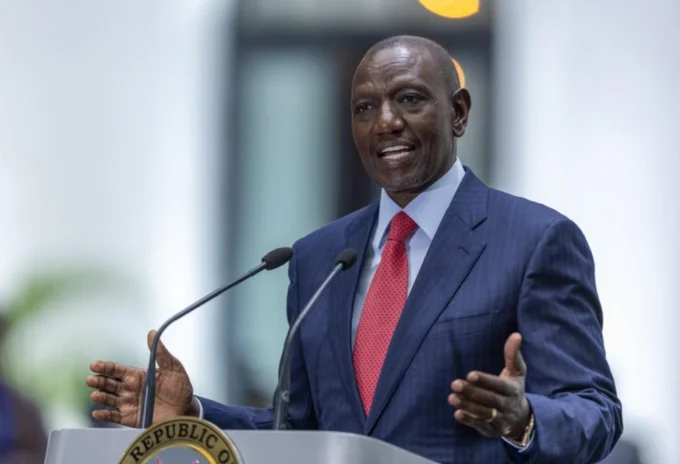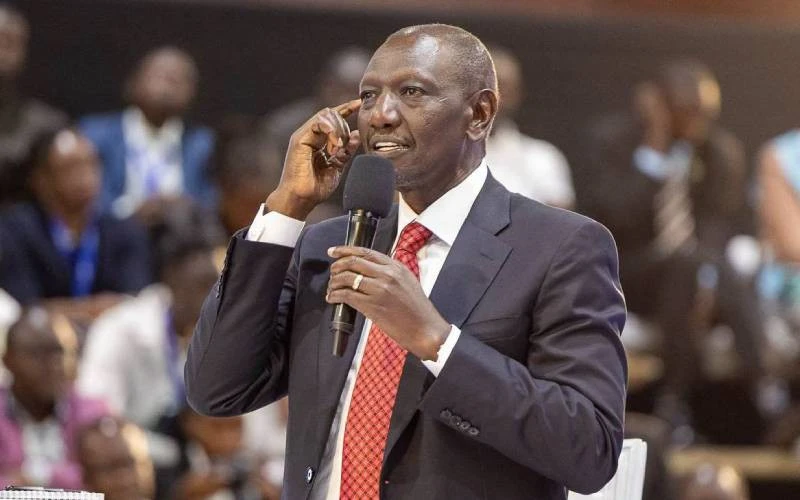
President William Ruto has ordered the government to begin taking action against foreign nationals operating as hawkers and small-scale retailers in Kenya, arguing that such activities should primarily create opportunities for local entrepreneurs.
Speaking to Micro, Small and Medium Enterprise traders at State House on September 2, Ruto said administrative enforcement would begin the following week as the government works on a longer-term legislative framework. He also directed officials to review the permits under which foreign investors and traders are operating in the country.
Key Overview
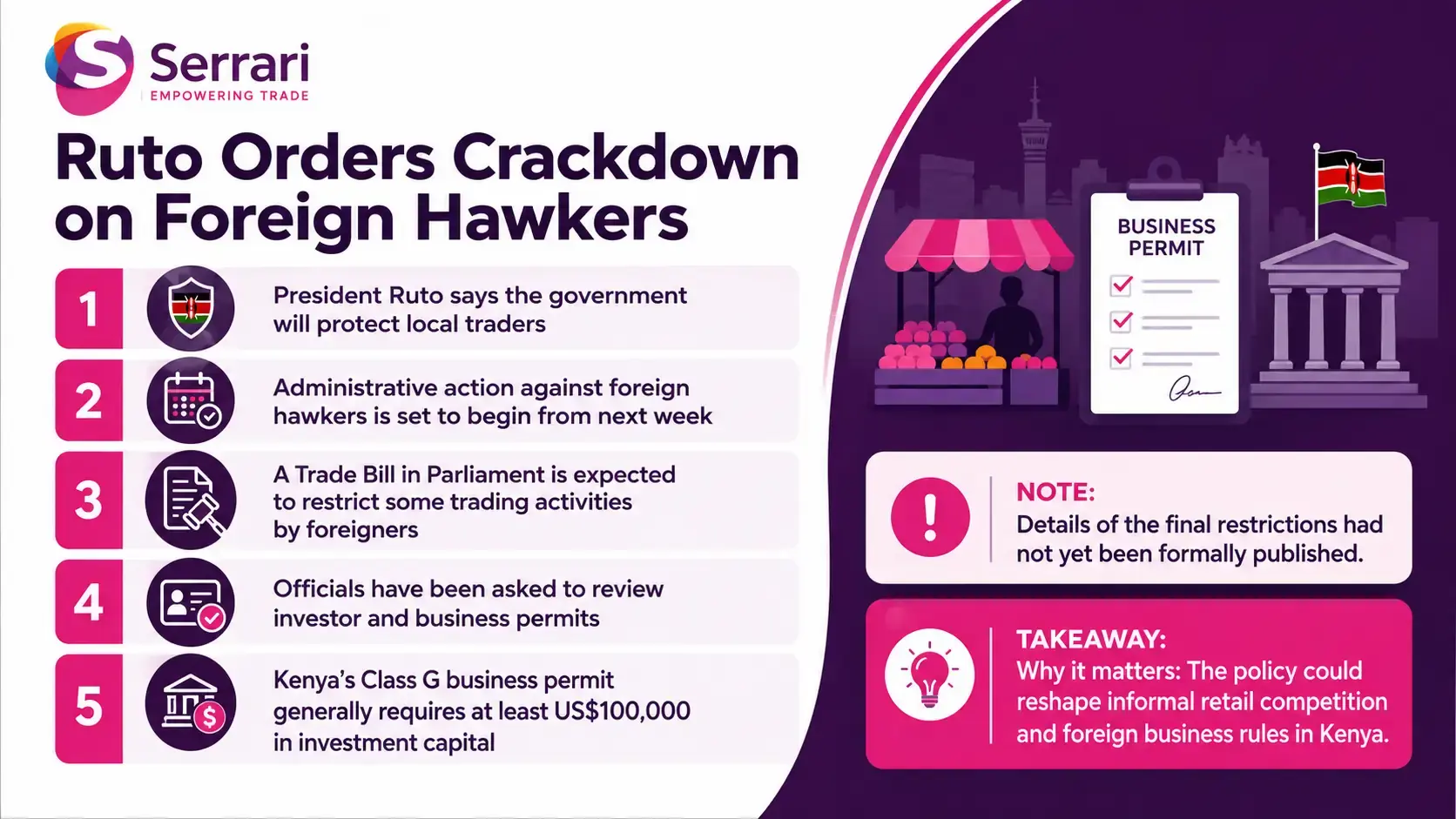
- Ruto has ordered action against foreign nationals engaged in hawking and small-scale retail trade.
- The government intends to begin administrative enforcement from the week of September 7, 2026.
- Ruto said a Trade Bill before Parliament is intended to identify activities that foreigners should not undertake.
- He directed officials to examine how investor and business permits are being issued.
- Kenya’s existing Class G business permit generally requires proof of at least US$100,000 in investment capital.
- The directive comes amid mounting pressure from Kenyan MSMEs over costs, imports and competition.
- No detailed list of businesses covered by the planned crackdown had been formally published at the time of the announcement.
Government Targets Small-Scale Foreign Retail Activity
Ruto’s directive followed complaints from local traders that foreign nationals were increasingly competing directly with Kenyan hawkers and small retailers, including by selling consumer goods such as duvets directly to customers.
The President argued that Kenya’s efforts to attract overseas capital were designed to bring investors capable of creating jobs, transferring skills and expanding productive businesses rather than encouraging foreign participation in informal retail.
Ruto said the government would move administratively against affected traders while Parliament considers proposed legislation, with Trade Cabinet Secretary Lee Kinyanjui expected to oversee the process after returning from Addis Ababa.
Some reports place the intended start of enforcement on Monday, September 7, although the government had not yet published detailed regulations identifying every business category or enforcement procedure when the directive was announced.
That distinction matters because existing foreign-owned businesses remain subject to Kenya’s current immigration, licensing and company laws until any new legislation or legally enforceable administrative measures take effect.
Context is everything. Stay ahead of shifting trends with today’s market updates, and uncover emerging opportunities using the Serrari Group Market Index and Marketplace. Then, take control of your own financial future by exploring our Money & Life Reset Transformation Blueprint ™ to build stronger habits, create better systems, and design a path toward lasting wealth.
Kenya Already Regulates Foreign Business Permits
Foreign nationals are already required to obtain appropriate authorisation before engaging in business in Kenya.
A Class G permit is specifically intended for a foreigner engaging in a trade, business or consultancy and requires applicants to provide company documents, tax information and documentary evidence of capital.
Current immigration requirements specify proof of at least US$100,000 in investment capital for Class G applicants. The permit carries a KSh20,000 processing charge and a KSh250,000 annual issuance fee, while nationals of East African Community member states are listed as exempt from those issuance charges.
The framework also requires the proposed activity to benefit Kenya and for applicants to obtain any licences or other regulatory approvals required for the business.
Separately, Kenya’s investment law sets a US$100,000 threshold for foreign investors seeking an investment certificate, alongside requirements that the investment be lawful and beneficial to the country.
Ruto has now directed National Assembly Majority Leader Kimani Ichung’wah to engage immigration officials and establish how investor permits are being granted, suggesting that enforcement of existing immigration conditions could become part of the wider crackdown.
Proposed Trade Rules Could Go Further
Ruto said Parliament is considering a Trade Bill that would establish clearer rules around activities available to foreign traders.
Publicly available proposals for Kenya’s broader trade framework already contemplate stronger government powers over wholesale and retail trade regulation, including business classifications, trading zones, licensing standards and measures intended to protect domestic livelihoods.
The draft framework also recognises foreign direct investment as important while allowing regulatory measures pursuing legitimate policy objectives such as protection of the domestic economy and livelihoods.
However, the precise restrictions referred to by Ruto were not fully detailed in his September 2 remarks. Until Parliament approves legislation and implementing rules are published, it would therefore be premature to conclude that all foreign-owned small businesses are automatically prohibited.
Local Traders Are Facing Wider Economic Pressure
The directive comes during a period of heightened concern among Kenyan small businesses about operating costs and competition.
Only days before Ruto’s announcement, Nairobi traders protested changes to customs valuation procedures, with demonstrations disrupting business in the capital as merchants argued that higher import costs would squeeze businesses relying on consolidated shipments.
The government has defended stronger customs enforcement as necessary to combat undervaluation and protect compliant traders and domestic manufacturers.
Foreign participation in small-scale commerce has now become another element of that debate. The government’s challenge will be protecting opportunities for Kenyan MSMEs while maintaining predictable investment rules and ensuring any restrictions are implemented through a clear legal framework.
For foreign businesses already operating in Kenya, the immediate issue will be whether their activities fall within the categories targeted by the government and whether their immigration, investment and trading permits match the businesses they actually conduct.
Sources: Citizen Digital / The Star / Directorate of Immigration Services / Kenya Law / Ministry of Investments, Trade and Industry / Reuters
Your financial future isn’t something you wait for—it’s something you build.
The real question is: when do you begin?
Move beyond simply staying informed.
Navigate the markets with clarity—track trends through the Serrari Group Market Index, uncover opportunities in the Serrari Marketplace, and build practical knowledge with our Curated Wealth Builder Platform.
Stay connected to what truly matters.
Get daily insights on macro trends and financial movements across Kenya, Africa, and global markets—delivered through the Serrari Newsletter.
Growth opens doors.
Advance your career through professional programs including ACCA, HESI A2, ATI TEAS 7 , HESI EXIT , NCLEX – RN and NCLEX – PN, Financial Literacy!🌟—designed to move you forward with confidence.
See where money is flowing—clearly and in real time.
Track Money Market Funds, Treasury Bills, Treasury Bonds, Green Bonds, and Fixed Deposits, alongside global and African indexes, key economic indicators, and the evolving Crypto and stablecoin landscape—all within Serrari’s Market Index.