
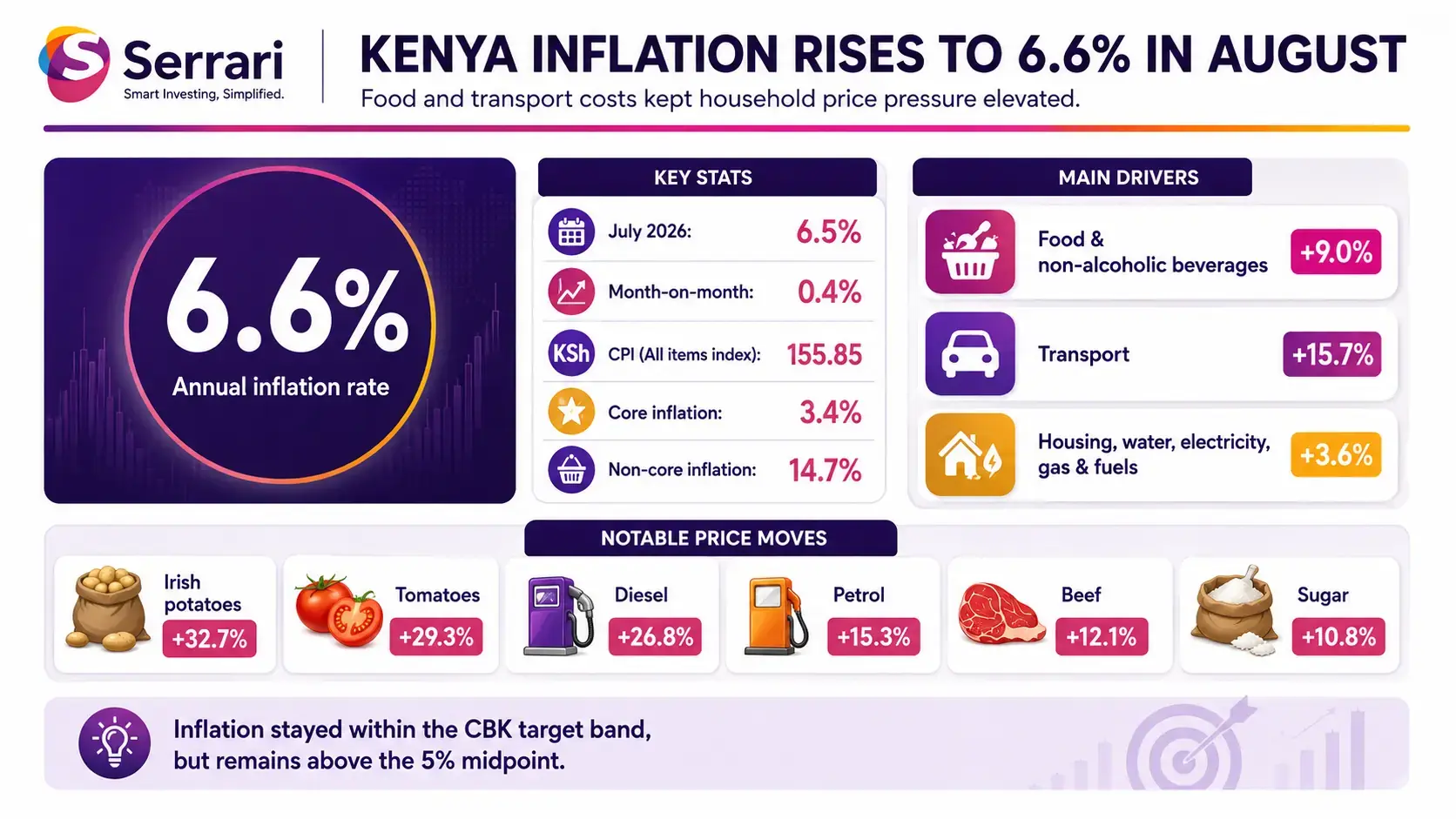
Kenya’s annual inflation rate increased to 6.6% in August 2026 from 6.5% in July, extending the renewed rise in consumer prices for a second consecutive month. The official August CPI release shows that food, transport and housing-related expenses remained the main sources of pressure on household budgets.
The reading was also stronger than expected, exceeding a 6.4% median forecast reported from economists surveyed ahead of the release. Inflation nevertheless remains within the Central Bank of Kenya’s 2.5%-7.5% target range, although it has remained above the 5% midpoint for several months.
Key Overview
- Annual inflation: 6.6%, up from 6.5% in July
- Monthly inflation: 0.4%
- Consumer Price Index: 155.85, up from 155.20
- Food and non-alcoholic beverages: Up 9.0% year-on-year
- Transport: Up 15.7%
- Housing, water, electricity, gas and fuels: Up 3.6%
- Core inflation: 3.4%
- Non-core inflation: 14.7%
- Economists’ median forecast: 6.4%
Food and Transport Keep Headline Inflation Elevated
Three major expenditure categories were responsible for much of August’s price pressure. Food and non-alcoholic beverage prices were 9.0% higher than a year earlier, while transport prices increased 15.7% and housing, water, electricity, gas and other fuels rose 3.6%. Together, these categories account for more than 57% of the weight used to calculate Kenya’s consumer price index.
Food alone contributed about 2.6 percentage points to headline inflation, while transport added another 1.5 percentage points. Housing-related costs contributed approximately 0.6 percentage points, illustrating how heavily essential household spending is influencing the national inflation rate.
Some individual items experienced substantially larger annual increases. Irish potatoes were 32.7% more expensive than in August 2025, while tomatoes rose 29.3%, diesel 26.8%, petrol 15.3%, beef with bone 12.1% and sugar 10.8%. The detailed August inflation breakdown highlights the continuing concentration of price pressure in food and energy-sensitive products.
Context is everything. Stay ahead of shifting trends with today’s market updates, and uncover emerging opportunities using the Serrari Group Market Index and Marketplace. Then, take control of your own financial future by exploring our Money & Life Reset Transformation Blueprint ™ to build stronger habits, create better systems, and design a path toward lasting wealth.
Monthly Price Movements Show a More Mixed Picture
While annual inflation accelerated, not every product became more expensive between July and August.
The overall CPI increased from 155.20 to 155.85, producing month-on-month inflation of 0.4%, compared with 0.2% in July. However, prices for several widely purchased goods actually declined during August.
The average price of a 2kg packet of sifted maize flour fell 2.7% during the month, while tomatoes declined 2.2%. Diesel prices also dropped approximately 2.2%, or around KSh5 per litre, despite remaining considerably higher than they were a year earlier.
Transport costs nevertheless increased by about 0.7% month-on-month. Local airfares rose 4.1%, while fares for inter-town buses and matatus increased 2.1%, showing that lower diesel prices did not immediately translate into falling transport costs across the economy.
Core Inflation Remains Relatively Contained
An important feature of the August data is the substantial gap between core and non-core inflation.
Core inflation, which is designed to capture more persistent underlying price movements by excluding particularly volatile items, rose to 3.4% from 3.2% in July. Non-core inflation, which is more heavily influenced by volatile food and energy prices, eased slightly to 14.7% from 15.0%.
The difference indicates that Kenya’s current inflation pressure remains disproportionately concentrated in volatile categories such as food, fuel and energy rather than being equally distributed throughout the economy.
The core CPI basket accounts for 81.1% of the overall CPI, while the more volatile non-core component accounts for the remainder. This means policymakers will be watching whether the current surge in food and energy costs eventually feeds more strongly into services, wages and other underlying prices.
Inflation Adds Complexity to Kenya’s Rate Outlook
At 6.6%, headline inflation remains within the official 5% ±2.5 percentage-point target band, meaning it has not breached the upper limit of 7.5%. However, the acceleration creates a more complicated environment for monetary policy because policymakers must balance inflation risks against the need to support economic activity and credit growth.
Recent surveys indicated that inflation expectations remained anchored within the target range, although agricultural-sector respondents showed increased concern over the near-term direction of prices. The latest monetary policy background data showed 58% of surveyed agricultural respondents expected inflation to increase over the following three months.
For households, however, the headline number tells only part of the story. Families spending a larger share of their income on food and transport may experience substantially greater cost pressure than the national 6.6% average suggests.
The coming months will therefore depend heavily on food supply conditions, global energy prices and transport costs. If those pressures ease, headline inflation could stabilise even with core inflation gradually rising. If they remain elevated, Kenya could move closer to the upper end of its inflation target range.
Sources: Kenya National Bureau of Statistics / Central Bank of Kenya / People Daily / The Sharp Daily
Your financial future isn’t something you wait for—it’s something you build.
The real question is: when do you begin?
Move beyond simply staying informed.
Navigate the markets with clarity—track trends through the Serrari Group Market Index, uncover opportunities in the Serrari Marketplace, and build practical knowledge with our Curated Wealth Builder Platform.
Stay connected to what truly matters.
Get daily insights on macro trends and financial movements across Kenya, Africa, and global markets—delivered through the Serrari Newsletter.
Growth opens doors.
Advance your career through professional programs including ACCA, HESI A2, ATI TEAS 7 , HESI EXIT , NCLEX – RN and NCLEX – PN, Financial Literacy!🌟—designed to move you forward with confidence.
See where money is flowing—clearly and in real time.
Track Money Market Funds, Treasury Bills, Treasury Bonds, Green Bonds, and Fixed Deposits, alongside global and African indexes, key economic indicators, and the evolving Crypto and stablecoin landscape—all within Serrari’s Market Index.