US bank stablecoins are gaining momentum as major, regional and midsize banks explore blockchain-based payment systems to defend deposits and compete with nonbank financial companies. JPMorgan Chase has reportedly discussed launching its own stablecoin, while the Bankchain Alliance plans a bank-operated blockchain network supporting stablecoins and tokenized deposits. With clearer regulation emerging and the stablecoin market potentially reaching $500 billion to $750 billion, banks increasingly view digital tokens as part of the future payments and settlement infrastructure.
Key Overview
The shift reflects growing concern among US banks that stablecoins could move money away from traditional bank deposits while allowing crypto and technology companies to capture more payment activity. JPMorgan is reportedly considering its own token, although it has not entered product development. Meanwhile, the Bankchain Alliance, representing banking associations across 39 states, is targeting the first half of 2027 for a blockchain network connecting about 3,000 banks.
US Bank Stablecoins Move Higher on Banking Agenda
The relationship between traditional banks and stablecoins is changing rapidly.
For years, dollar-backed tokens were primarily associated with cryptocurrency companies such as Tether and Circle. Banks largely remained on the sidelines while evaluating regulatory, liquidity and operational risks.
That position is beginning to shift.
According to The Wall Street Journal, JPMorgan Chase has held internal discussions about potentially launching its own stablecoin, although those discussions have not yet advanced into product development.
The development illustrates how traditional financial institutions are increasingly viewing stablecoins not simply as cryptocurrency products but as potential competitors to established payment and deposit businesses.
Banks Seek to Protect Traditional Deposits
One of the biggest issues is the potential impact on bank deposits.
Stablecoins allow users to hold dollar-linked value outside conventional deposit accounts and transfer it through blockchain networks. As adoption grows, some money that would otherwise remain within banks could migrate toward stablecoin issuers.
That creates both funding and competitive concerns for the banking sector.
Deposits provide banks with an important source of funding for loans and other financial activities. Significant movement of customer balances into stablecoins could potentially change deposit structures and increase competition for funding.
Banks therefore have an incentive to develop blockchain products that provide similar functionality while keeping customers and liquidity within regulated banking institutions.
Context is everything. Stay ahead of shifting trends with today’s market updates and uncover emerging opportunities using the Serrari Group Market Index and Marketplace. Then, take control of your own financial future by exploring our Money & Life Reset Transformation Blueprint ™ to build stronger habits, create better systems, and design a path toward lasting wealth.
Bankchain Alliance Targets 2027 Blockchain Launch
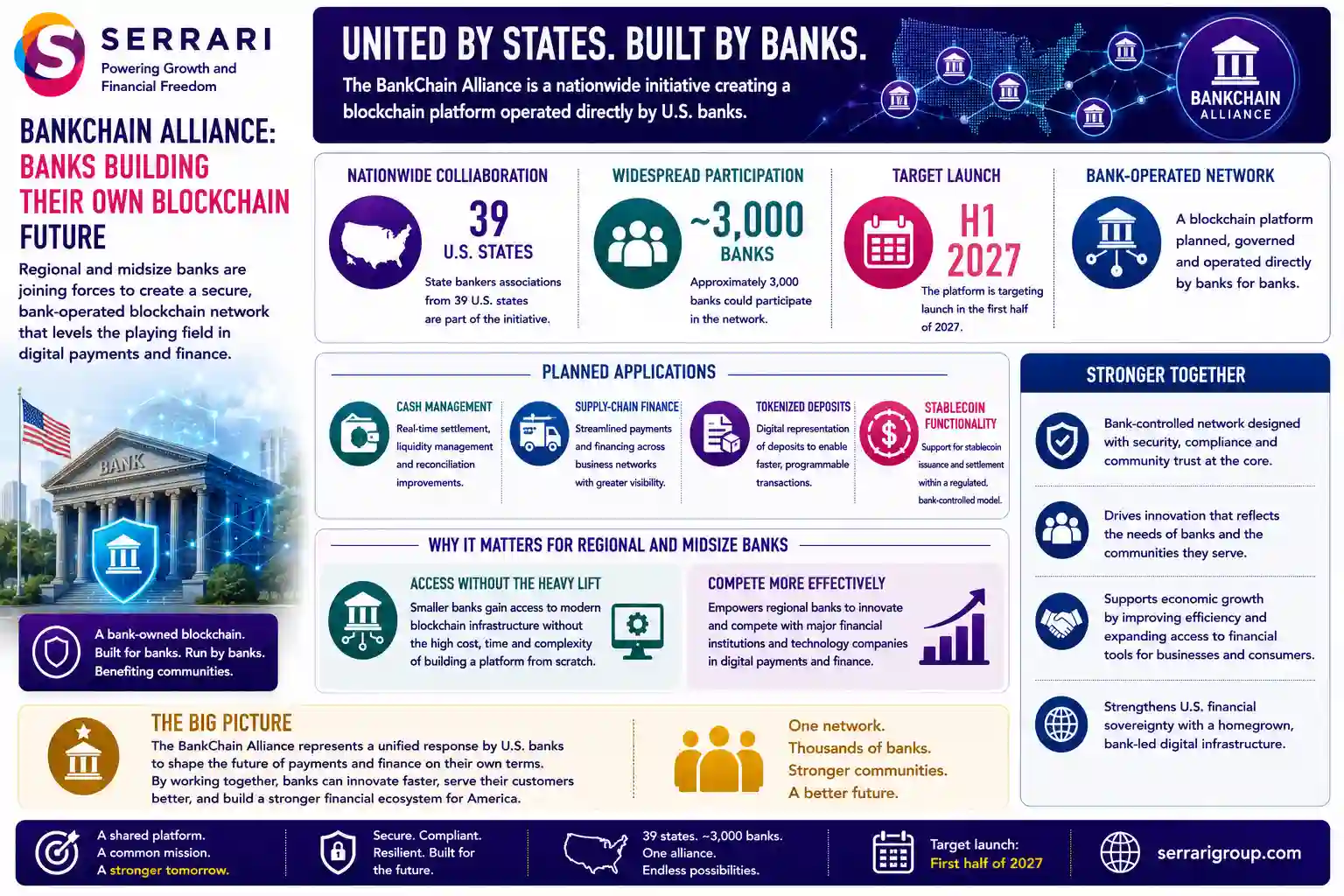
Regional and midsize banks are developing their own response through the Bankchain Alliance.
The initiative includes state bankers associations from 39 US states and is planning a blockchain platform operated directly by banks.
Approximately 3,000 banks could participate in the network, which is targeting launch in the first half of 2027.
Planned applications include cash management, supply-chain finance, tokenized deposits and stablecoin functionality.
The initiative could give smaller institutions access to blockchain infrastructure without requiring each bank to build an independent platform.
It could also allow regional banks to compete more effectively with major financial institutions and technology companies in digital payments.
Stablecoin Competition Expands Beyond Crypto Companies
The competitive landscape is becoming increasingly diverse.
Tether and Circle remain major participants in the stablecoin industry, but traditional financial and technology companies are exploring related opportunities.
Visa, BlackRock, Google and DoorDash have reportedly been reviewing or advancing businesses connected to stablecoins or digital payments.
Anchorage Digital is also working on more than 12 stablecoin projects, some reportedly being developed by individual banks or banking consortiums.
This expansion suggests digital assets are moving deeper into mainstream financial infrastructure.
Stablecoins could increasingly be used for payments, treasury management, cross-border transfers and settlement rather than primarily for moving funds between cryptocurrency trading platforms.
Banks See Stablecoins as Settlement Infrastructure
JPMorgan Global Research has estimated that the stablecoin market could grow to approximately $500 billion to $750 billion in the coming years.
The bank’s researchers have also highlighted stablecoins as a potential settlement mechanism for tokenized financial assets.
That use case could become particularly important as traditional securities—including bonds, funds and other assets—move onto distributed-ledger infrastructure.
A tokenized security requires an efficient way to settle the cash side of a transaction. Stablecoins, tokenized commercial bank deposits and central bank digital currencies represent different possible solutions.
This means blockchain payments could eventually extend well beyond consumer cryptocurrency transactions.
Regulation Could Accelerate Bank Participation
Regulatory clarity remains one of the most important factors determining how quickly banks enter the market.
Jonathan Gould, Comptroller of the Currency, has said it has become common for business plans submitted to the Office of the Comptroller of the Currency to include payment stablecoins.
The OCC has outlined proposed requirements covering areas such as reserves, redemption, risk management, custody, supervision and issuer standards.
Rulemaking is expected to be finalized in November 2026, according to Gould.
Clearer stablecoin regulation could give regulated financial institutions greater confidence to commit resources to new products while establishing requirements intended to protect customers and financial stability.
Dollar Tokens Could Expand to Other Currencies
Some emerging bank-led projects are expected to begin with dollar-denominated tokens before potentially expanding into other major currencies.
A dollar token provides an obvious starting point because the overwhelming majority of global stablecoin activity is currently linked to the US currency.
However, expansion into the euro and other G7 currencies could broaden the role of blockchain-based money in international payments and institutional financial markets.
The result could eventually be competition not only between banks and crypto companies but also among different forms of digital money.
Stablecoins, tokenized deposits and conventional bank balances could increasingly operate alongside one another.
Stablecoins Could Reshape Digital Payments
For banks, the strategic question is therefore becoming less about whether blockchain-based payments will exist and more about what role regulated financial institutions will play in them.
Banks already possess established customer relationships, regulatory infrastructure, payment expertise and access to large pools of deposits.
Crypto companies, meanwhile, have built significant early positions in blockchain-native financial services.
Technology companies bring enormous payment networks and consumer reach.
The emergence of US bank stablecoins represents an attempt by traditional financial institutions to combine their existing advantages with blockchain technology.
If adoption continues and regulation becomes clearer, stablecoins could develop into an increasingly important battleground for deposits, payments and digital financial infrastructure.
FAQs
Why are US banks considering stablecoins?
US banks are exploring stablecoins partly to protect their deposit and payments businesses as crypto firms and technology companies expand into digital finance. Bank-issued tokens could allow institutions to provide blockchain-based payment services while retaining stronger relationships with customers and their funds.
Is JPMorgan launching its own stablecoin?
JPMorgan has reportedly held internal discussions about potentially launching a stablecoin, but the project has not yet entered product development. The discussions nevertheless demonstrate growing interest among major banks in blockchain-based settlement and payments.
What is the Bankchain Alliance?
The Bankchain Alliance is an initiative involving state bankers associations from 39 US states. It plans to develop a bank-operated blockchain network connecting roughly 3,000 banks and supporting services including tokenized deposits, stablecoins, cash management and supply-chain finance.
How large could the stablecoin market become?
JPMorgan Global Research has projected that the stablecoin market could reach approximately $500 billion to $750 billion in the coming years. Growth will depend on regulation, institutional adoption, payment use cases and whether stablecoins become widely used for settling tokenized financial assets.
Sources: Bloomingbit, Digital Today, Daily Coin, Bitcoin Foundation
Your financial future isn’t something you wait for—it’s something you build.
The real question is: when do you begin?
Move beyond simply staying informed.
Navigate the markets with clarity—track trends through the Serrari Group Market Index, uncover opportunities in the Serrari Marketplace, and build practical knowledge with our Curated Wealth Builder Platform.
Stay connected to what truly matters.
Get daily insights on macro trends and financial movements across Kenya, Africa, and global markets—delivered through the Serrari Newsletter.
Growth opens doors.
Advance your career through professional programs including ACCA, HESI A2, ATI TEAS 7 , HESI EXIT , NCLEX – RN and NCLEX – PN, Financial Literacy!🌟—designed to move you forward with confidence.
See where money is flowing—clearly and in real time.
Track Money Market Funds, Treasury Bills, Treasury Bonds, Green Bonds, and Fixed Deposits, alongside global and African indexes, key economic indicators, and the evolving Crypto and stablecoin landscape—all within Serrari’s Market Index.