Uganda is preparing to issue its first sovereign green bond in early 2027, targeting up to $500 million, equivalent to approximately Shs1.865 trillion. The government is working with the European Union under the Global Green Bond Initiative, with nearly €20 million committed to support issuance costs and potentially lower the bond’s coupon. The proceeds are expected to support eligible climate-related projects as Uganda seeks new ways to narrow its substantial climate finance gap.
Key Overview
Uganda needs an estimated $28.1 billion by 2030 to meet its Nationally Determined Contribution goals but has mobilized only about $5.1 billion, leaving a financing gap of roughly $23 billion. The planned bond could channel capital into renewable energy, water, roads, environmental protection and land-related projects. However, sustainable finance experts say Uganda will need a credible pipeline of investment-ready projects to ensure the proceeds can be deployed effectively.
Uganda Prepares First Sovereign Green Bond
Uganda is moving towards a significant milestone in its capital markets, with the government preparing to issue the country’s first sovereign green bond in early 2027.
The planned transaction could raise as much as $500 million, equivalent to approximately Shs1.865 trillion.
Unlike conventional government bonds, green bonds require proceeds to be allocated to projects that meet defined environmental or climate-related criteria.
For Uganda, the planned issuance could provide a new source of financing for investments ranging from clean energy and water infrastructure to environmentally sustainable transport and land management.
The government is currently developing the framework needed to support the transaction and establish credibility with potential investors.
EU Commits Nearly €20 Million to Support Issuance
The European Union is supporting Uganda through its Global Green Bond Initiative.
Nearly €20 million, or approximately Shs87 billion, has been committed to help cover issuance costs and potentially reduce the interest rate Uganda will pay investors.
Part of the support is intended to create what is commonly described in sustainable finance as a “greenium.”
A greenium occurs when strong investor demand for environmentally focused debt enables an issuer to borrow at a slightly lower yield than it might pay on a comparable conventional bond.
Lower borrowing costs could make green financing more attractive to Uganda, particularly as the country faces significant funding requirements for climate-related infrastructure.
EU delegation programme manager Christina Banuta said the work underway represents essential building blocks for Uganda to establish access to both international and domestic green bond markets.
Context is everything. Stay ahead of shifting trends with today’s market updates and uncover emerging opportunities using the Serrari Group Market Index and Marketplace. Then, take control of your own financial future by exploring our Money & Life Reset Transformation Blueprint ™ to build stronger habits, create better systems, and design a path toward lasting wealth.
Uganda Faces $23 Billion Climate Finance Gap
The planned bond comes against the backdrop of a substantial climate finance deficit.
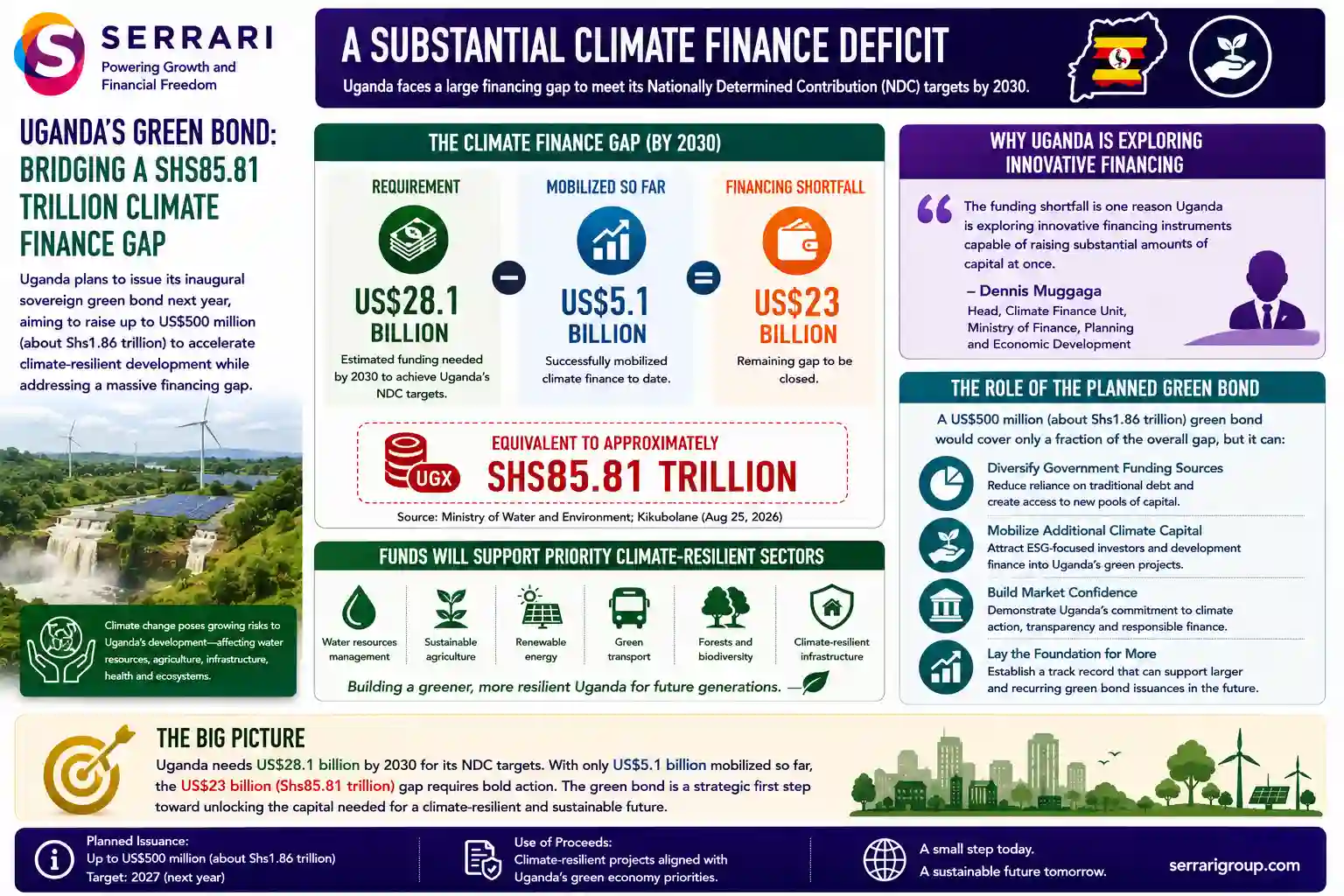
Uganda’s Ministry of Water and Environment estimates that the country requires approximately $28.1 billion by 2030 to achieve its Nationally Determined Contribution targets.
Only about $5.1 billion has so far been successfully mobilized.
That leaves a financing shortfall of approximately $23 billion, equivalent to around Shs85.81 trillion.
Dennis Muggaga, head of the Climate Finance Unit at the Ministry of Finance, Planning and Economic Development, said the funding shortfall is one reason Uganda is exploring innovative financing instruments capable of raising substantial amounts of capital at once.
A $500 million bond would cover only a fraction of the overall gap, but it could diversify the government’s funding sources while creating a foundation for future green debt issuance.
Uganda Needs a Credible Pipeline of Green Projects
Raising the money represents only one part of the challenge.
Uganda will also need sufficient investment-ready projects capable of absorbing the proceeds.
Lamin Trawally, Sustainable Finance Lead for Africa at the Global Green Growth Institute, has emphasized the importance of establishing a “credible pipeline” across sectors including energy, roads, water, environment and land.
That requirement is particularly important for a sovereign green bond because investors expect proceeds to be allocated according to a clearly defined green-finance framework.
The government must therefore identify eligible projects, establish mechanisms for tracking how proceeds are spent and provide reporting that allows investors to assess environmental outcomes.
Without enough qualified projects, Uganda could face difficulties deploying a large bond efficiently after issuance.
Renewable Energy and Infrastructure Could Benefit
The proposed transaction could expand renewable energy financing and climate-resilient infrastructure investment.
Energy projects could include renewable generation and related infrastructure, while water investments could strengthen access, conservation and resilience against droughts and floods.
Road and transport projects may also qualify where they demonstrate credible environmental benefits.
Environmental restoration, sustainable land management and other climate-resilience programmes could provide additional opportunities for deploying the proceeds.
For Uganda, this means green debt could become a bridge between climate policy and conventional infrastructure financing.
Instead of depending entirely on government revenue or development financing, eligible projects could gain access to capital from institutional investors participating in the fixed-income market.
Africa Still Captures Less Than 1% of Sustainable Bond Issuance
Uganda’s planned entry comes as the global sustainable debt market has grown into a multi-trillion-dollar sector.
Africa, however, continues to account for less than 1% of global sustainable bond issuance.
Much of the climate-related financing reaching African economies also comes through development finance institutions rather than large-scale private commercial investment.
A successful Ugandan issuance could therefore help demonstrate whether sovereign green debt can attract a wider pool of investors to African climate projects.
It could be particularly relevant for international asset managers and other ESG investment strategies seeking emerging-market assets with clearly defined environmental objectives.
What the Bond Could Mean for Uganda’s Fixed Income Market
The transaction could also broaden Uganda’s fixed income market by adding a new category of government security.
A successful issuance would provide a benchmark for future green bonds from government agencies, financial institutions or corporations.
However, investors will look beyond the green label.
Uganda’s sovereign credit profile, debt position, currency risks, maturity structure and coupon will remain important considerations alongside the environmental characteristics of the bond.
The planned issuance will therefore need to combine credible climate objectives with the financial standards expected from conventional sovereign debt.
If Uganda can achieve that balance, its first sovereign green bond could become an important step toward mobilizing more private capital for the country’s climate and infrastructure requirements.
FAQs
What is Uganda’s sovereign green bond?
Uganda’s sovereign green bond is a planned government debt issuance whose proceeds would be dedicated to eligible environmental and climate-related projects. The government is targeting up to $500 million, or approximately Shs1.865 trillion.
When will Uganda issue its first green bond?
The government is working towards issuing the bond in early 2027, subject to completion of the required framework, project preparation and issuance arrangements.
What will Uganda use the green bond proceeds for?
Potential areas include renewable energy, water, roads, environmental protection, land management and other eligible climate-related infrastructure. A credible pipeline of projects will be required before the proceeds can be deployed effectively.
Why is the European Union supporting the bond?
The EU has committed nearly €20 million to support issuance costs and potentially lower Uganda’s borrowing rate. The assistance is also intended to help establish the frameworks and credibility needed for Uganda to access domestic and international green bond investors.
Sources: The Independent, Uganda Radio Network, Kikubo Lane
Your financial future isn’t something you wait for—it’s something you build.
The real question is: when do you begin?
Move beyond simply staying informed.
Navigate the markets with clarity—track trends through the Serrari Group Market Index, uncover opportunities in the Serrari Marketplace, and build practical knowledge with our Curated Wealth Builder Platform.
Stay connected to what truly matters.
Get daily insights on macro trends and financial movements across Kenya, Africa, and global markets—delivered through the Serrari Newsletter.
Growth opens doors.
Advance your career through professional programs including ACCA, HESI A2, ATI TEAS 7 , HESI EXIT , NCLEX – RN and NCLEX – PN, Financial Literacy!🌟—designed to move you forward with confidence.
See where money is flowing—clearly and in real time.
Track Money Market Funds, Treasury Bills, Treasury Bonds, Green Bonds, and Fixed Deposits, alongside global and African indexes, key economic indicators, and the evolving Crypto and stablecoin landscape—all within Serrari’s Market Index.