India is preparing to launch its first India tokenized corporate bond in September 2026, marking an important experiment in bringing blockchain technology into the country’s traditional debt market. State-owned power financier REC is expected to issue less than INR 5 billion, approximately $57 million, in tokenized bonds to a selected group of investors. The pilot will combine a wholesale digital rupee wallet with a blockchain-based securities wallet called DEMAT 2.0, potentially creating a new model for issuing, holding and settling corporate debt.
Key Overview
India’s central bank and securities regulator are reportedly working together on the pilot, which could be unveiled at a major fintech event in Mumbai in September. REC is expected to act as the issuer, while investors will use two digital wallets: one for wholesale digital rupees and another for recording ownership of the tokenized securities. The initiative could test whether tokenization can improve settlement and market infrastructure in India’s large but relatively illiquid corporate bond market.
India Tokenized Corporate Bond to Test Blockchain Settlement
India is preparing to take a significant step in the modernization of its capital markets with its first tokenized corporate bond issuance.
According to Reuters, state-owned REC is expected to issue tokenized bonds worth less than INR 5 billion, equivalent to approximately $57 million.
The initial transaction is expected to remain relatively small and be offered to a limited group of investors as regulators test the technology and operational infrastructure.
Rather than replacing traditional corporate bonds immediately, the pilot appears designed to determine whether distributed-ledger technology can make issuance, ownership recording and settlement more efficient.
How the Tokenized Bond Could Work
The proposed transaction would use two separate digital wallets.
The first would be a wholesale digital rupee wallet provided through a participating bank. This would allow the cash side of the transaction to operate using the Reserve Bank of India’s central bank digital currency infrastructure.
The second would be a new securities wallet called DEMAT 2.0.
This wallet would record investors’ bond holdings on a distributed ledger, effectively creating a blockchain-based record of ownership.
Combining tokenized securities with digital central-bank money could potentially allow the bond and payment legs of a transaction to settle through digital infrastructure.
That makes the pilot more significant than simply converting a conventional bond certificate into a digital token.
RBI’s Digital Rupee Provides the Foundation
India has been gradually developing the infrastructure needed to support this type of financial innovation.
The Reserve Bank of India launched its wholesale digital rupee pilot in November 2022, initially focusing on settlement of government securities transactions. A retail central bank digital currency pilot followed in December.
The central bank subsequently expanded its experimentation.
By October 2025, testing had extended into tokenized deposits within the wholesale digital-currency environment. Authorities have also considered the tokenization of commercial paper and other money-market instruments.
A corporate bond pilot therefore represents another stage in the gradual expansion of blockchain-based financial infrastructure.
Context is everything. Stay ahead of shifting trends with today’s market updates and uncover emerging opportunities using the Serrari Group Market Index and Marketplace. Then, take control of your own financial future by exploring our Money & Life Reset Transformation Blueprint ™ to build stronger habits, create better systems, and design a path toward lasting wealth.
Why India’s Corporate Bond Market Matters
India already has a substantial corporate debt market.
Industry estimates have valued the country’s corporate bond market at around INR 59 lakh crore, while other estimates put it at approximately $617 billion, equivalent to roughly 16% of GDP.
Its size, however, does not necessarily translate into deep secondary-market liquidity.
Institutional investors frequently purchase bonds and hold them until maturity, while retail participation remains relatively limited. Corporate borrowers consequently remain heavily dependent on private placements.
Introducing digital securities does not automatically solve those structural problems.
Tokenization can potentially improve settlement efficiency, record keeping and operational processes, but deeper liquidity ultimately requires more active buyers and sellers.
That distinction will be important when assessing the success of India’s pilot.
How India’s $57 Million Pilot Compares Globall
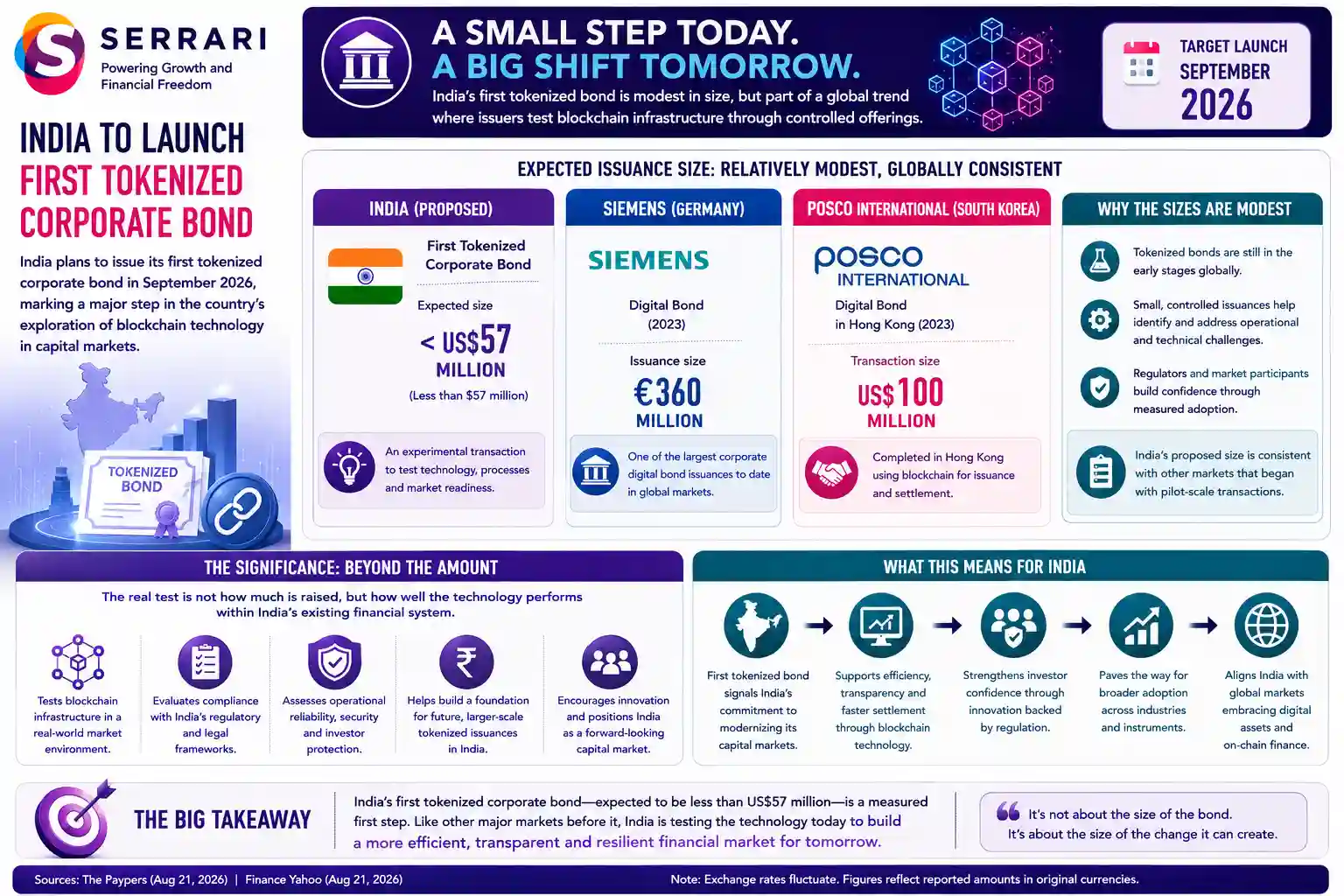
The expected issuance size is relatively modest compared with India’s overall debt market, but that is consistent with the experimental nature of the transaction.
Other major markets have followed a similar approach.
Siemens, for example, has issued a €360 million digital bond, while South Korea’s POSCO International completed a $100 million digital bond transaction in Hong Kong.
India’s proposed transaction of less than $57 million therefore fits within a broader international trend in which issuers first test blockchain infrastructure through controlled bond offerings before considering larger-scale adoption.
The significance lies less in the amount raised and more in whether the technology can function reliably within India’s existing regulatory and financial architecture.
Regulators Explore Digital Assets Without Abandoning Existing Markets
India’s approach also demonstrates how digital assets can be incorporated into conventional financial markets without necessarily creating an entirely separate system.
The country’s markets regulator and central bank are reportedly working together on the initiative.
That cooperation matters because tokenized bonds sit at the intersection of securities regulation, payment infrastructure, custody and settlement.
India is also examining blockchain applications beyond fixed income.
In July, Maharashtra Chief Minister Devendra Fadnavis directed officials to prepare draft legislation for a proposed framework governing tokenized interests linked to immovable property.
Together, these developments suggest blockchain is increasingly being explored as financial infrastructure rather than exclusively as technology associated with cryptocurrencies.
What the Pilot Could Mean for Institutional Investors
For institutional investors, one potential benefit is more efficient settlement.
Traditional bond transactions can involve multiple intermediaries responsible for payments, securities ownership, clearing, custody and reconciliation.
Distributed-ledger systems could potentially reduce some of that operational complexity by maintaining synchronized ownership records.
Using wholesale digital rupees alongside tokenized bonds could also provide an opportunity to test delivery-versus-payment mechanisms where securities and payment are exchanged through closely integrated digital infrastructure.
However, the pilot will need to demonstrate measurable advantages over India’s established dematerialized securities system before broader adoption becomes compelling.
A Test for India’s Digital Bond Market
The planned REC transaction should therefore be viewed as an infrastructure experiment rather than a transformation of India’s bond market overnight.
Its relatively small size limits financial risk while allowing regulators, banks, issuers and investors to examine how blockchain can operate alongside established market systems.
If successful, the model could eventually be extended to additional bond issuance, commercial paper or other fixed-income securities.
For now, September’s proposed launch will provide an important test of whether tokenized securities and central-bank digital money can work together efficiently in one of the world’s largest emerging capital markets.
FAQs
What is the India tokenized corporate bond?
India’s first tokenized corporate bond is a planned pilot in which state-owned REC is expected to issue less than INR 5 billion, or approximately $57 million, of corporate debt using distributed-ledger technology.
Who is expected to issue India’s first tokenized corporate bond?
State-owned power-sector financier REC is expected to conduct the pilot issuance. The transaction is reportedly being developed alongside work by India’s central bank and securities regulator.
What is DEMAT 2.0?
DEMAT 2.0 is the proposed securities wallet that would record ownership of the tokenized bonds on a distributed ledger. Investors are also expected to use a separate wholesale digital rupee wallet for the payment side of transactions.
Will tokenization improve India’s corporate bond market liquidity?
Not necessarily. Tokenization could improve settlement, record keeping and operational efficiency, but technology alone cannot guarantee higher trading volumes. Improving secondary-market liquidity would also require broader investor participation and more active trading.
Sources: Traders Union, Yahoo Finance, Biggo Finance, Reuters, The Paypers
Your financial future isn’t something you wait for—it’s something you build.
The real question is: when do you begin?
Move beyond simply staying informed.
Navigate the markets with clarity—track trends through the Serrari Group Market Index, uncover opportunities in the Serrari Marketplace, and build practical knowledge with our Curated Wealth Builder Platform.
Stay connected to what truly matters.
Get daily insights on macro trends and financial movements across Kenya, Africa, and global markets—delivered through the Serrari Newsletter.
Growth opens doors.
Advance your career through professional programs including ACCA, HESI A2, ATI TEAS 7 , HESI EXIT , NCLEX – RN and NCLEX – PN, Financial Literacy!🌟—designed to move you forward with confidence.
See where money is flowing—clearly and in real time.
Track Money Market Funds, Treasury Bills, Treasury Bonds, Green Bonds, and Fixed Deposits, alongside global and African indexes, key economic indicators, and the evolving Crypto and stablecoin landscape—all within Serrari’s Market Index.