CLARITY Act stablecoin rules could determine whether crypto exchanges and wallet providers can continue rewarding users for stablecoin balances or must tie incentives more directly to payments and other activity. The GENIUS Act already prevents stablecoin issuers themselves from paying interest or yield, but third-party programmes remain a major policy dispute. Current CLARITY language seeks to distinguish deposit-like passive yield from rewards connected to bona fide activity. That matters for Circle and USDC because rewards can affect how attractive stablecoins are relative to bank deposits and money-market products. Banking groups argue interest-like programmes could accelerate deposit migration and weaken lending capacity. White House CEA modelling reaches a much smaller estimate of the lending benefit from eliminating yield. The Senate’s next procedural hurdle is currently scheduled for September 15.
Key Overview
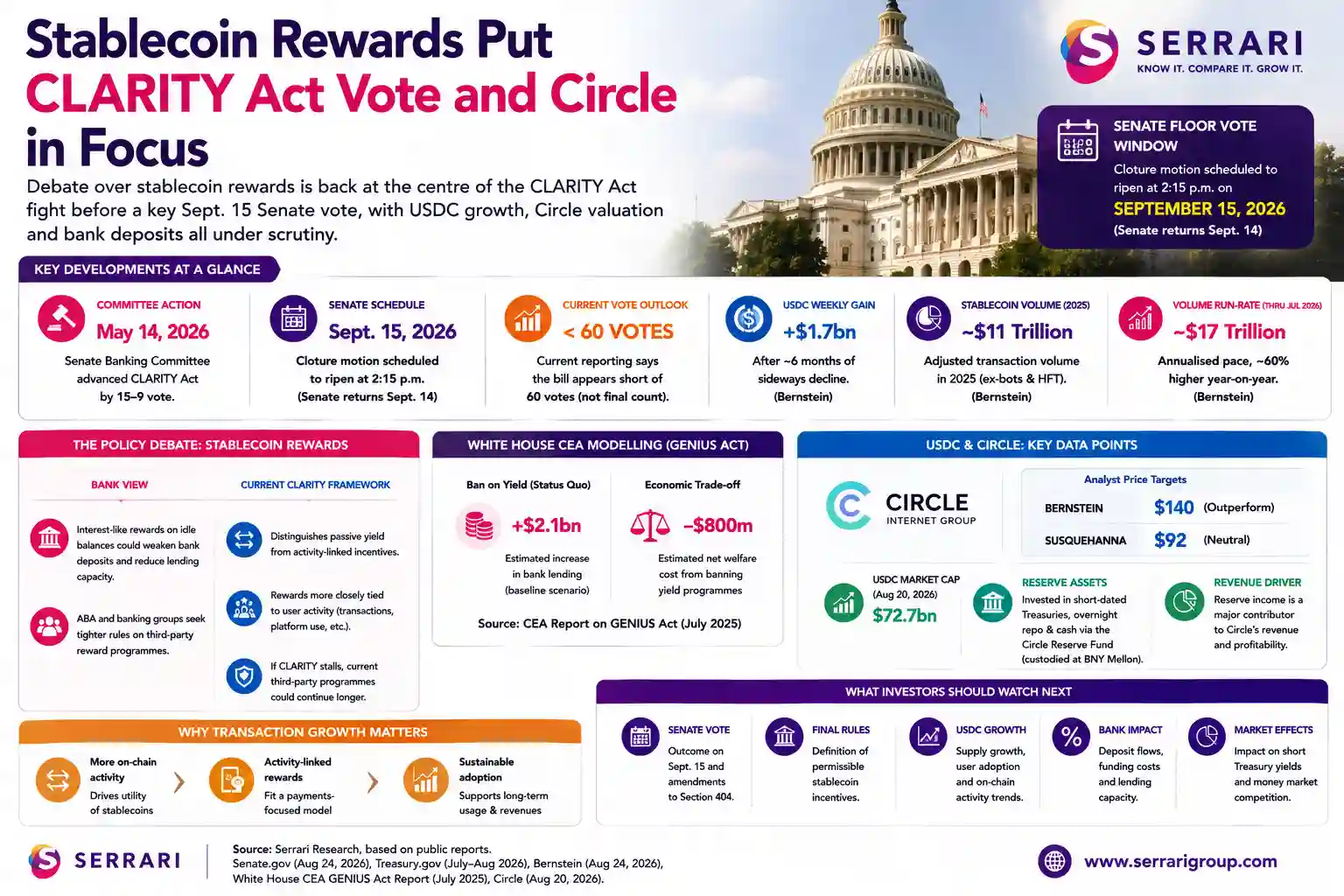
- The committee advanced CLARITY by 15-9 on May 14, 2026, sending the legislation to the Senate floor.
- The Senate returns on September 14, with the CLARITY Act cloture motion scheduled to ripen at 2:15 p.m. on September 15.
- Current August 24 reporting says the legislation appears short of sixty votes, although this is a current vote assessment rather than a final whip count.
- Bernstein says USDC added $1.7bn last week, after roughly six months of sideways decline.
- Bernstein estimates adjusted stablecoin transaction volume reached approximately $11 trillion in 2025 and is running at an annualised $17 trillion pace through July 2026, around 60% higher year-on-year.
- White House CEA modelling found that banning yield adds $2.1bn lending under its baseline while producing an estimated $800 million net welfare cost.
Stablecoin Rewards Put CLARITY Act Vote and Circle in Focus
Stablecoin Rewards Have Become an Economic Question
The next Senate fight over digital assets is increasingly about product economics rather than whether stablecoins should be regulated at all.
The committee vote occurred May 14, when the Senate Banking Committee advanced the CLARITY Act by 15 votes to nine.
The Senate subsequently filed cloture on the motion to proceed. Its published floor schedule says the cloture motion ripens September 15 at 2:15 p.m.
That does not guarantee a successful vote. Fresh August 24 reporting says the bill currently lacks necessary sixty votes, although senators can change positions and negotiations remain active.
Among the unresolved issues is stablecoin yield regulation.
The Dispute Is Really About Passive Balances
The GENIUS Act already prohibits payment-stablecoin issuers from paying interest or yield directly to holders.
The policy dispute concerns what happens when an exchange, wallet provider, affiliate or another third party pays a reward instead.
Banking groups argue that allowing rewards based mainly on the size or duration of an idle stablecoin balance recreates the economics of an interest-bearing deposit without imposing the same banking framework.
The American Bankers Association and other trade groups have therefore asked Congress to tighten Section 404. Their position is that rewards could weaken bank deposits and reduce the funding banks use for household, business and agricultural lending.
The emerging compromise instead distinguishes passive yield from activity-based incentives.
Under Bernstein’s interpretation of the current framework, passage would mean rewards become more closely linked to user activity rather than simply holding idle balances. If CLARITY stalls, current third-party programmes could persist for longer.
That creates two very different commercial paths.
Circle Is the Listed-Equity Test Case
For investors, Circle Internet Group makes the debate measurable.
USDC adoption determines the size of Circle’s reserve base, while reserve assets generate a large part of the company’s revenue. Reward programmes offered through exchanges and other partners can therefore influence how attractive USDC is to users.
Bernstein said USDC gained $1.7bn in supply during the latest week after months of relatively weak expansion.
Its analysts also argue that Circle’s growth does not depend entirely on CLARITY passing.
Their broader thesis rests on payment adoption, tokenisation, on-chain capital markets and new automated-payment use cases.
Bernstein maintained a Circle price target of $140, while Susquehanna raised its target to $92 but retained a Neutral rating.
Those targets are analyst opinions rather than forecasts Serrari should adopt.
The disagreement is useful precisely because it shows how uncertain the economics remain.
Transaction Growth May Matter More
The bull case for USDC increasingly relies on use, not merely balance growth.
Bernstein estimates adjusted volume reached $11tn during 2025 after removing bots and high-frequency activity.
Through July 2026, the annualised pace reached $17tn already, around 60% above the comparable year-earlier pace.
If that trajectory persists, activity-linked USDC rewards could potentially fit naturally with a payments-focused regulatory model.
Users might receive benefits for transactions, platform use or other qualifying behaviour rather than simply leaving tokens untouched.
That would change the stablecoin competitive proposition from “hold this instead of a savings account” toward “use this and receive incentives.”
Context is everything. Stay ahead of shifting trends with today’s market updates, and uncover emerging opportunities using the Serrari Group Market Index and Marketplace. Then, take control of your own financial future by exploring our Money & Life Reset Transformation Blueprint ™ to build stronger habits, create better systems, and design a path toward lasting wealth.
The Bank-Lending Debate Is Not Settled
Banks frame the issue around bank deposit flight.
If households replace bank deposits with stablecoins, part of the banking system’s relatively inexpensive funding base could shrink. Banks might then need to raise deposit rates, borrow elsewhere or adjust lending.
The ABA argues that stablecoins risk disintermediating banking activity, including deposit-taking and lending.
But White House economic modelling reaches a much smaller baseline result than some industry warnings.
The Council of Economic Advisers estimated that eliminating yield increases lending $2.1bn — only around 0.02% — while generating a net welfare cost of $800m.
Its model therefore argues that prohibiting yield provides little additional lending under baseline assumptions.
That does not invalidate banking-industry concerns. It shows that the estimated scale depends heavily on assumptions about stablecoin adoption, reserve composition and where users’ money originates.
What Investors Should Watch in September
The first signal is procedural.
The Senate reconvenes on September 14 under current schedule, and the CLARITY cloture motion is scheduled to ripen the following afternoon.
Investors should watch whether negotiations produce enough support to clear the 60-vote hurdle and whether Section 404 changes before the vote.
For Circle, the more durable indicators remain USDC supply, transaction activity, reserve income and partner economics rather than a single legislative event.
Susquehanna’s more cautious position is useful here: despite raising its target to $92, it points to growing competition and Circle’s continued dependence on reserve income.
Conclusion
Stablecoin rewards have become a test of what Washington ultimately wants payment stablecoins to be.
A strict passive-yield prohibition would push them further toward transactions and payments rather than savings-account substitutes.
A looser third-party regime could make stablecoin balances more competitive with bank deposits, but could also intensify concerns over funding migration.
For investors, the September vote therefore matters less as a simple regulatory victory or defeat than as a decision about the future economic model of digital dollars.
USDC’s recent growth suggests adoption can continue even while legislation remains unsettled.
The question is whether that growth will increasingly be driven by balances earning rewards — or by users actually putting stablecoins to work.
FAQs
What are stablecoin rewards?
Stablecoin rewards are payments or incentives offered to users who hold or use tokens such as USDC. They can resemble interest when rewards accumulate mainly because a user maintains a balance over time, or they can operate more like cashback and loyalty incentives when tied to transactions or platform activity. The regulatory debate focuses heavily on whether passive rewards make stablecoins function too much like uninsured bank deposits.
When is the next CLARITY Act Senate vote?
The Senate’s current published schedule says the cloture motion on the motion to proceed to H.R. 3633, the Digital Asset Market Clarity Act, will ripen at 2:15 p.m. on September 15, 2026. The Senate is scheduled to reconvene the previous day. Cloture is a procedural hurdle rather than final enactment of the legislation, and the schedule can still change.
Does the CLARITY Act currently have 60 votes?
That is not established. August 24 reporting from The Block said the legislation did not appear to have the necessary 60 votes at that point. That should be treated as a current political assessment rather than an official whip count or prediction of the September result. Senators can change positions, negotiations remain active and the legislation itself can still be amended.
Why do stablecoin rewards matter to Circle?
Circle issues USDC and earns substantial reserve income from assets backing circulating tokens. If rewards offered through exchanges, wallets and other partners encourage users to hold or use more USDC, circulating supply can increase and potentially enlarge the reserve base. Regulation that changes reward economics can therefore influence adoption, distribution costs and competition. Bernstein nevertheless argues that payments, tokenisation and broader blockchain activity can sustain Circle’s growth even without CLARITY passage.
Would banning stablecoin yield protect bank lending?
It could protect some deposits from migrating into stablecoins, but the size of the effect is disputed. The White House Council of Economic Advisers estimated in its baseline model that removing stablecoin yield would increase bank lending by about $2.1 billion, or roughly 0.02%, while imposing an estimated $800 million net welfare cost. Banking associations argue the potential deposit and credit effect could be substantially larger under broader adoption scenarios.
Sources: U.S. Senate Democratic Caucus, U.S. Senate — Cloture Motions, 119th Congress, Senate Banking Committee, The Block, White House Council of Economic Advisers, American Bankers Association, Yahoo Finance
Your financial future isn’t something you wait for—it’s something you build.
The real question is: when do you begin?
Move beyond simply staying informed.
Navigate the markets with clarity—track trends through the Serrari Group Market Index, uncover opportunities in the Serrari Marketplace, and build practical knowledge with our Curated Wealth Builder Platform.
Stay connected to what truly matters.
Get daily insights on macro trends and financial movements across Kenya, Africa, and global markets—delivered through the Serrari Newsletter.
Growth opens doors.
Advance your career through professional programs including ACCA, HESI A2, ATI TEAS 7 , HESI EXIT , NCLEX – RN and NCLEX – PN, Financial Literacy!🌟—designed to move you forward with confidence.
See where money is flowing—clearly and in real time.
Track Money Market Funds, Treasury Bills, Treasury Bonds, Green Bonds, and Fixed Deposits, alongside global and African indexes, key economic indicators, and the evolving Crypto and stablecoin landscape—all within Serrari’s Market Index.