

















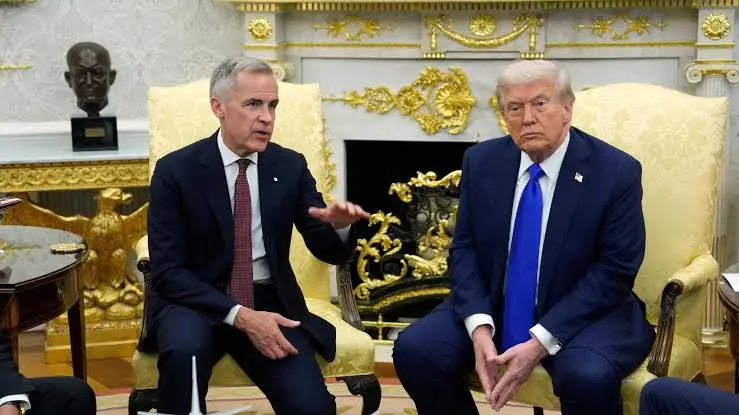
Trade tensions between the United States and Canada have escalated sharply after negotiations collapsed and Washington imposed new 50% tariffs on a range of Canadian products. The measures cover roughly C28billion,oraboutUS20 billion, of Canadian exports, after an earlier three-day suspension failed to produce an agreement.
Prime Minister Mark Carney has responded by announcing that Canada will introduce dollar-for-dollar counter-tariffs from September 8, targeting sectors including steel, dairy, appliances, agricultural equipment, pulp and paper, and electronics. The confrontation raises new questions about the stability of one of the world’s most integrated trading relationships and the longer-term future of the US-Mexico-Canada Agreement.
Key Overview
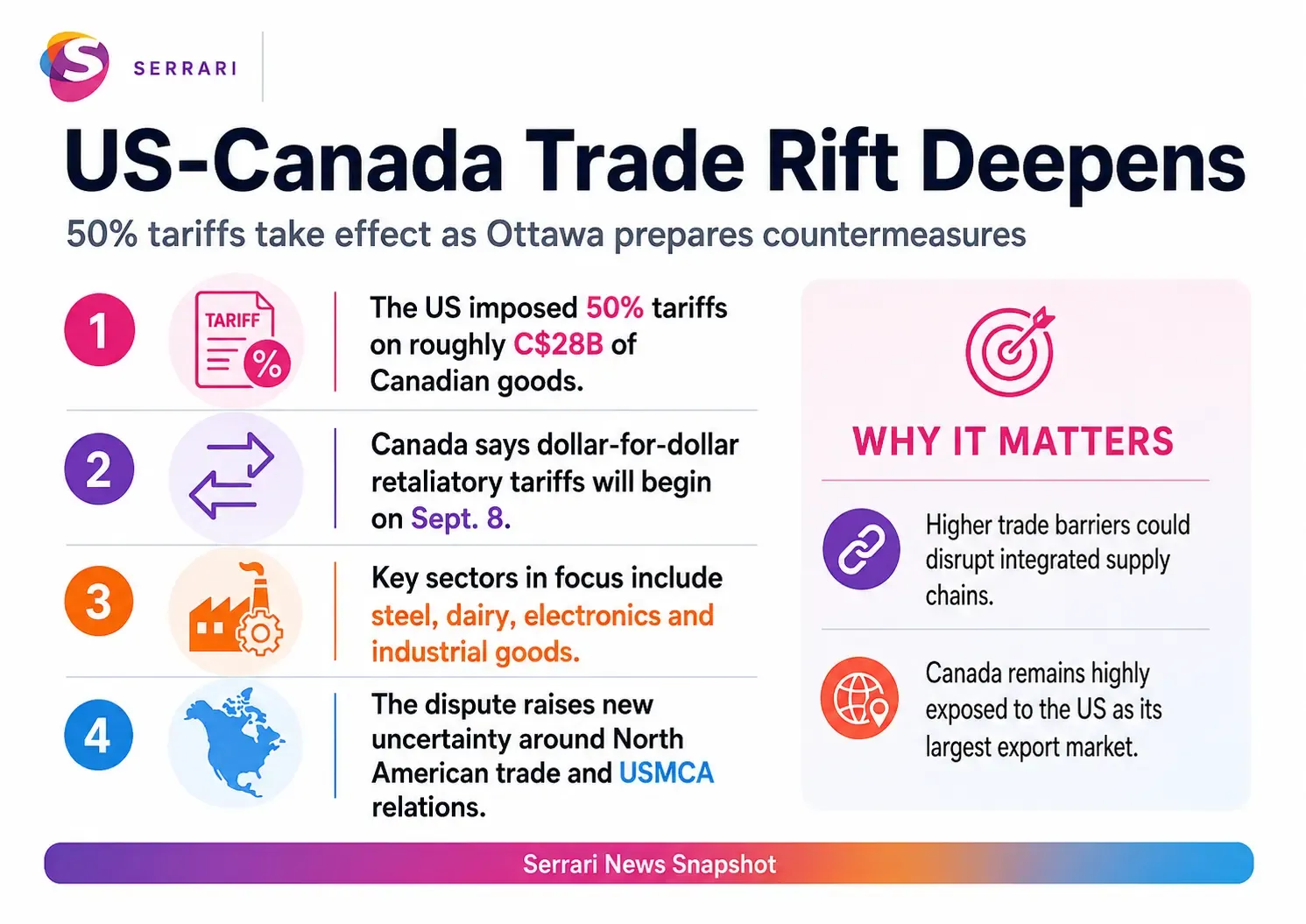
- New U.S. tariffs of 50% have taken effect on roughly C$28 billion of Canadian goods.
- Canada will retaliate dollar for dollar from September 8, with detailed product lists still to be released.
- Trade negotiations have been suspended after both governments blamed the other for the collapse.
- Steel, dairy, electronics and industrial goods are among sectors expected to face Canadian countermeasures.
- The USMCA remains legally in force until 2036, despite the U.S. declining to approve a new 16-year extension during the 2026 review.
- Canada remains highly exposed to the U.S. economy, which received 71.7% of Canadian merchandise exports in 2025.
Washington’s 50% Tariffs Trigger Canadian Retaliation
The latest U.S. duties stem from measures announced under Section 338 of the Tariff Act of 1930. Washington initially planned to introduce the additional tariffs on August 19 but temporarily suspended their implementation for three days while negotiations continued.
Those discussions ultimately failed. The tariffs took effect on August 22 and apply to selected Canadian products in industries including dairy, alcoholic beverages, clothing, building materials and other manufactured goods.
Carney said Canada had entered negotiations seeking to preserve broad tariff-free access, lower duties on strategically important industries and create greater certainty for cross-border businesses. He argued that new U.S. demands introduced late in negotiations were economically unacceptable and could have constrained Canada’s policy independence.
Washington has presented a different account. U.S. Trade Representative Jamieson Greer has argued that Canada rejected favourable terms and said the U.S. had been prepared to reduce tariffs affecting areas such as steel, vehicles and lumber.
With no new negotiations immediately scheduled, both sides are now preparing for a more prolonged confrontation.
Context is everything. Stay ahead of shifting trends with today’s market updates, and uncover emerging opportunities using the Serrari Group Market Index and Marketplace. Then, take control of your own financial future by exploring our Money & Life Reset Transformation Blueprint ™ to build stronger habits, create better systems, and design a path toward lasting wealth.
Canada Plans Dollar-for-Dollar Response
Canada intends to match the value of the new U.S. tariffs rather than respond with a blanket duty on all American imports. Carney said the countermeasures will be concentrated in selected sectors and will come into force on September 8.
The strategy is designed to protect Canadian industries while increasing pressure on politically and economically significant U.S. exporters. Ottawa has also indicated that further financial support will be provided to businesses and workers affected by the trade dispute.
Canada nevertheless faces substantial economic risks from continued escalation. The U.S. remains overwhelmingly its largest export destination, although that dependence has declined. In 2025, the share of Canadian merchandise exports going to the United States fell to 71.7%, down from 75.9% in 2024.
That concentration makes replacing lost U.S. demand difficult in the short term, particularly for highly integrated industries such as automobiles, metals, energy and manufacturing.
USMCA Faces a More Uncertain Future
The dispute is also increasing uncertainty surrounding the North American trade framework. The United States declined in July to approve an automatic new 16-year extension of the USMCA following its first mandatory six-year review.
Importantly, this does not mean the agreement has expired. The USMCA remains in effect until 2036, and the three countries can still agree to extend it before then.
Because all three parties did not agree on an extension during the 2026 review, the agreement now moves into a process of annual reviews. At any of those meetings, Canada, the U.S. and Mexico can unanimously approve another 16-year term.
The current tariff confrontation could make those negotiations more difficult, especially as governments debate automotive rules, steel and aluminium trade, agriculture and the treatment of regional supply chains.
Canada Accelerates Trade Diversification
Ottawa is simultaneously attempting to reduce its vulnerability to future U.S. trade disruptions by expanding relationships elsewhere. Canada currently has 15 active free trade agreements covering 51 countries, providing preferential access to markets representing about 61% of global economic output.
Still, replacing the scale and geographical advantages of the U.S. market would be extremely difficult. Cross-border supply chains have developed over decades, and many Canadian businesses depend on fast access to American customers, suppliers and production networks.
The immediate outlook therefore remains uncertain. Unless negotiations resume, September’s Canadian retaliation could trigger additional U.S. measures and deepen economic pressure on businesses on both sides of the border. What began as a dispute over individual sectors is increasingly becoming a wider test of the economic relationship underpinning North American trade.
Sources: Government of Canada / White House / U.S. Trade Representative / Statistics Canada / Reuters
Your financial future isn’t something you wait for—it’s something you build.
The real question is: when do you begin?
Move beyond simply staying informed.
Navigate the markets with clarity—track trends through the Serrari Group Market Index, uncover opportunities in the Serrari Marketplace, and build practical knowledge with our Curated Wealth Builder Platform.
Stay connected to what truly matters.
Get daily insights on macro trends and financial movements across Kenya, Africa, and global markets—delivered through the Serrari Newsletter.
Growth opens doors.
Advance your career through professional programs including ACCA, HESI A2, ATI TEAS 7 , HESI EXIT , NCLEX – RN and NCLEX – PN, Financial Literacy!🌟—designed to move you forward with confidence.
See where money is flowing—clearly and in real time.
Track Money Market Funds, Treasury Bills, Treasury Bonds, Green Bonds, and Fixed Deposits, alongside global and African indexes, key economic indicators, and the evolving Crypto and stablecoin landscape—all within Serrari’s Market Index.