Africa50 plans to more than double the combined value of infrastructure projects it backs to at least $20 billion over the next five years, significantly expanding its role in financing power, transport, logistics and other critical infrastructure across Africa.
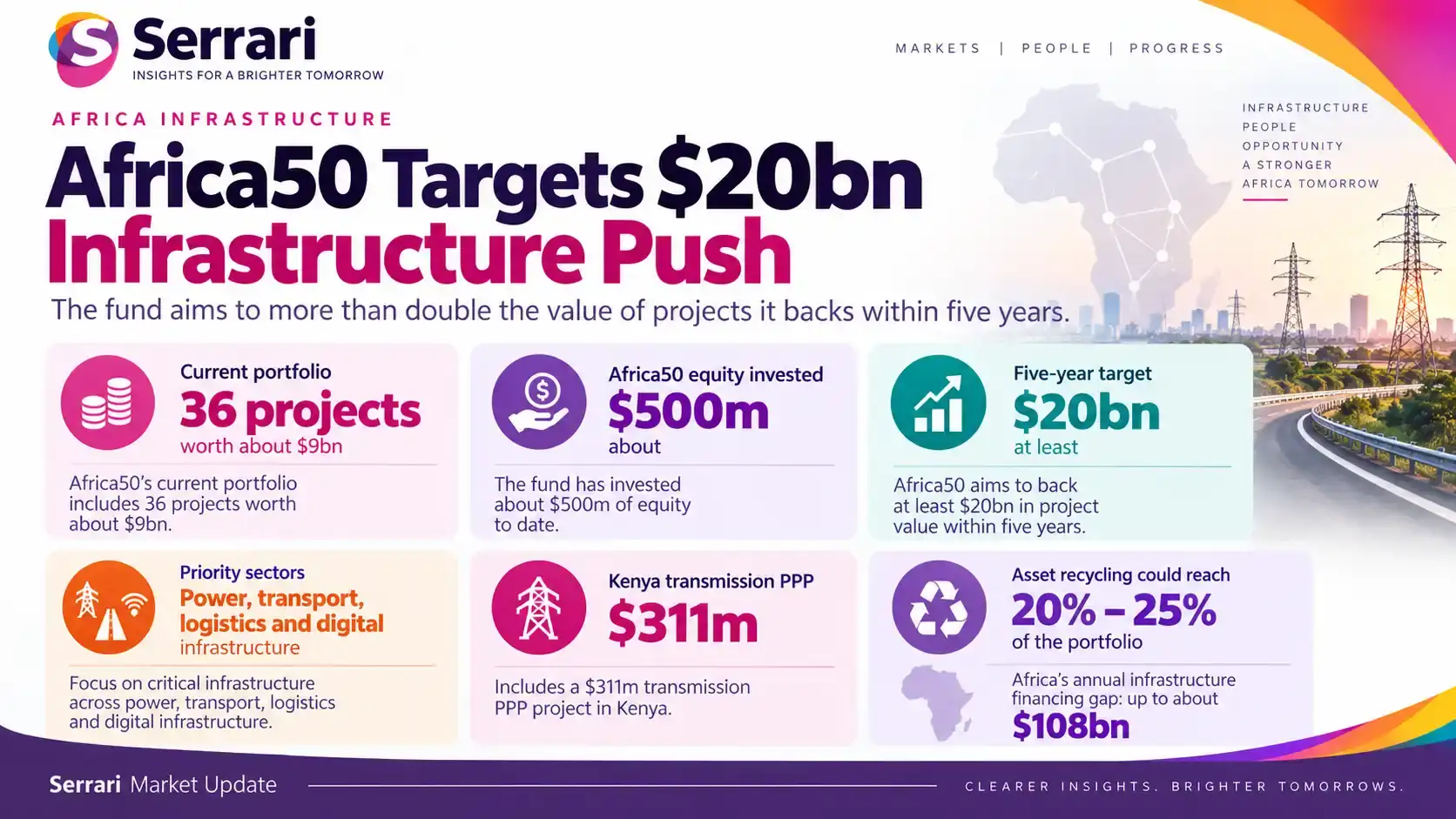
The pan-African investment platform has co-invested in 36 projects with an estimated combined value of about $9 billion, while committing roughly $500 million of its own equity. Its next phase will place particular emphasis on sectors facing large investment shortfalls, including electricity generation and transmission.
Key Overview
- Africa50 is targeting at least $20 billion in co-invested project value within five years.
- Its existing portfolio comprises 36 projects valued at about $9 billion.
- Africa50 has invested approximately $500 million of equity into those projects.
- Power generation and electricity transmission are among its priority investment areas.
- A $311 million Kenyan electricity transmission PPP is among its major recent projects.
- Asset recycling could eventually represent roughly 20% to 25% of its portfolio.
- Africa still faces an annual infrastructure financing gap estimated at $68 billion to $108 billion.
Africa50 Sets Sights on a Much Larger Portfolio
Africa50’s Chief Operating Officer Tshepidi Moremong said the platform wants to double or potentially triple the value of projects that it supports over the coming years, with $20 billion representing a minimum ambition for the next five years.
That would represent a major step up from the roughly $9 billion of projects already backed by the platform. Africa50’s investment strategy is designed to use its own capital alongside financing from governments, development institutions and private investors, allowing a relatively smaller amount of equity to help mobilise substantially larger project investments.
The organisation was created to mobilise public and private financing for commercially viable African infrastructure projects while combining financial returns with development impact. Its investor base now includes African governments, regional central banks, institutional investors and the African Development Bank.
The model is particularly important because infrastructure projects often require large amounts of long-duration capital that governments cannot provide entirely from public budgets.
Electricity Networks Become a Major Focus
Power generation and transmission are expected to remain important areas for Africa50 as governments seek to expand electricity access while incorporating more renewable energy into national grids.
Kenya provides one of the clearest examples. In December 2025, a consortium involving Africa50 and India’s PowerGrid signed agreements for a privately financed $311 million transmission project with Kenya Electricity Transmission Company.
The project covers two high-voltage transmission corridors and associated substations. It will be financed by the private partner without direct public funding for construction, with the infrastructure operated under a concession before eventually being transferred back to the state.
One line will strengthen the evacuation of wind and prospective geothermal generation from northern Kenya, while the second will improve electricity transmission into western Kenya. The investment demonstrates how public-private partnerships can allow governments to expand essential infrastructure while spreading financing requirements over longer periods.
Africa50 has also backed energy projects across Nigeria, Egypt, Cameroon and Madagascar, alongside investments in areas including digital infrastructure, transport and healthcare.
Context is everything. Stay ahead of shifting trends with today’s market updates, and uncover emerging opportunities using the Serrari Group Market Index and Marketplace. Then, take control of your own financial future by exploring our Money & Life Reset Transformation Blueprint ™ to build stronger habits, create better systems, and design a path toward lasting wealth.
Africa’s Infrastructure Gap Remains Enormous
The push comes as the continent continues to struggle with one of the world’s largest infrastructure financing deficits. Current estimates put Africa’s annual infrastructure requirements at roughly $130 billion to $170 billion, with an annual financing gap of $68 billion to $108 billion.
This gap covers everything from power grids and roads to ports, digital networks, water systems and transport infrastructure. At the same time, tighter government budgets and weaker development assistance have increased pressure to bring private institutional capital into projects that historically depended heavily on states and development lenders.
That is pushing financing structures such as concessions, public-private partnerships, guarantees and asset recycling further into the mainstream.
Asset Recycling Offers Governments Another Funding Route
Africa50 is also expanding a model that allows governments to unlock money from infrastructure they already own.
Under asset recycling, a government grants a private investor the right to operate and maintain an established infrastructure asset for a defined period. The investor makes an upfront payment, while revenue generated by the asset helps support its operation and investment requirements.
Africa50’s flagship example is the Senegambia Bridge concession, where its operating company assumed responsibility for bridge operations after the first $15.5 million payment under a $100 million asset-recycling programme.
The arrangement includes toll collection as well as upgrades to toll plazas, surveillance systems, maintenance facilities and other infrastructure. By monetising an existing public asset, the government can free capital for investment elsewhere without permanently selling the infrastructure.
Moremong estimates that this strategy could eventually represent one-fifth to one-quarter of Africa50’s portfolio.
If Africa50 achieves its $20 billion target, the platform will become an increasingly important bridge between Africa’s vast infrastructure requirements and the pools of private capital needed to finance them.
Sources
Reuters / Africa50 / African Development Bank
Your financial future isn’t something you wait for—it’s something you build.
The real question is: when do you begin?
Move beyond simply staying informed.
Navigate the markets with clarity—track trends through the Serrari Group Market Index, uncover opportunities in the Serrari Marketplace, and build practical knowledge with our Curated Wealth Builder Platform.
Stay connected to what truly matters.
Get daily insights on macro trends and financial movements across Kenya, Africa, and global markets—delivered through the Serrari Newsletter.
Growth opens doors.
Advance your career through professional programs including ACCA, HESI A2, ATI TEAS 7 , HESI EXIT , NCLEX – RN and NCLEX – PN, Financial Literacy!🌟—designed to move you forward with confidence.
See where money is flowing—clearly and in real time.
Track Money Market Funds, Treasury Bills, Treasury Bonds, Green Bonds, and Fixed Deposits, alongside global and African indexes, key economic indicators, and the evolving Crypto and stablecoin landscape—all within Serrari’s Market Index.