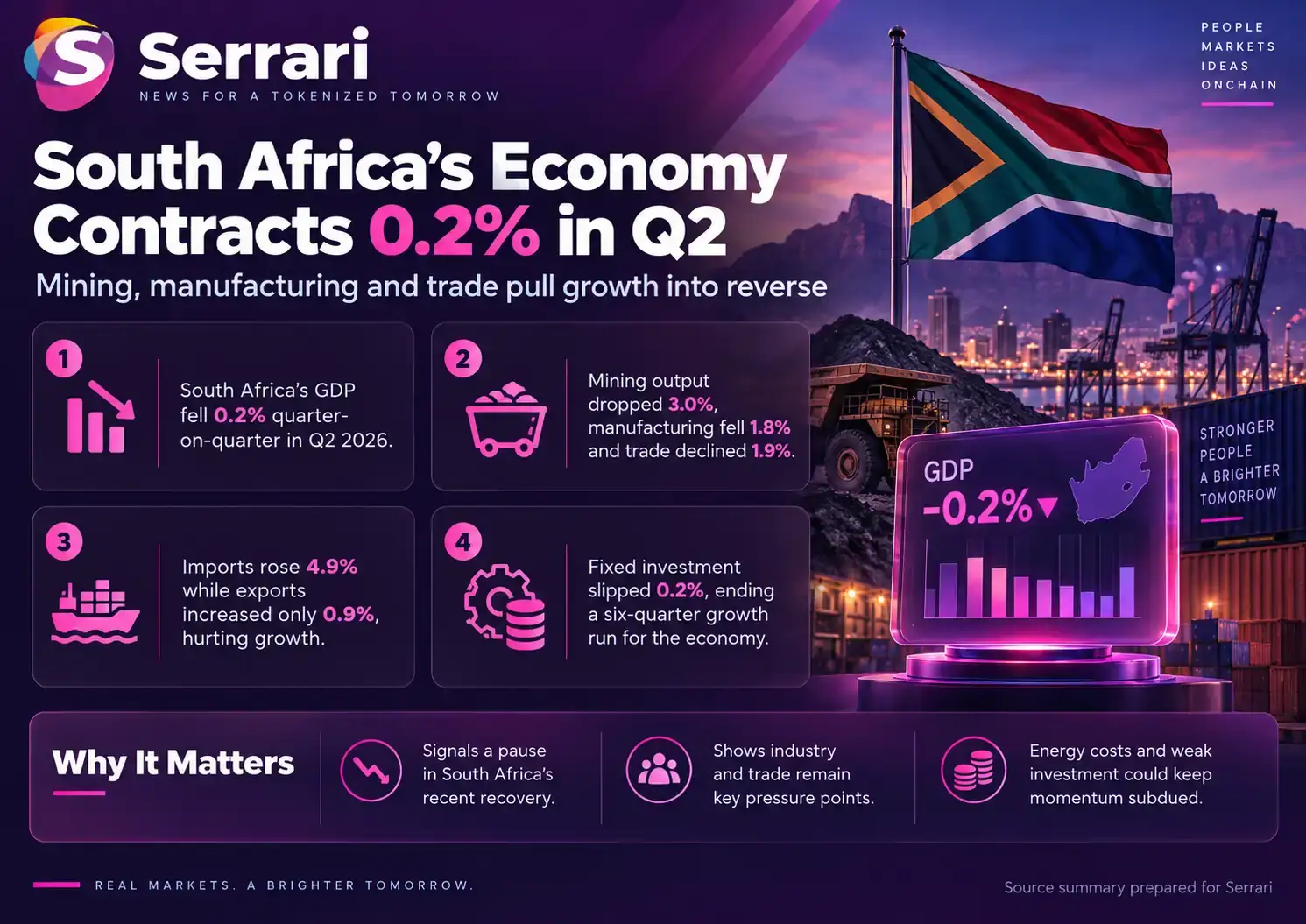
South Africa’s economy contracted by 0.2% in the second quarter of 2026, ending six consecutive quarters of growth and interrupting a recovery that had been building since late 2024. The decline followed 0.4% quarter-on-quarter growth in the first quarter.
Weakness was concentrated in mining, manufacturing and trade, while the expenditure side of the economy was pressured by a sharp increase in imports and subdued fixed investment. Higher energy costs linked to conflict in the Middle East also complicated the quarter by raising fuel and import costs.
Key Overview
The official second-quarter GDP figures show that mining output fell 3.0%, manufacturing declined 1.8% and the trade, catering and accommodation industry contracted 1.9%. Those three industries were the main production-side drags on the economy.
On the spending side, imports jumped 4.9% while exports rose only 0.9%, leaving external trade as a major drag on growth. Gross fixed capital formation also slipped 0.2%, although household consumption and government spending both increased by 0.4%.
Six-Quarter Growth Run Comes to an End
The 0.2% quarterly contraction was South Africa’s first decline after six consecutive quarters of growth. The economy had expanded by 0.4% in the first quarter of 2026 before momentum weakened between April and June.
That makes the second-quarter result significant because it interrupts a period of gradual improvement rather than extending an existing recession. One quarter of contraction alone does not establish that a prolonged downturn has begun.
Seven industries still recorded growth during the quarter, including transport, finance, government services and personal services. Their gains were not large enough to offset declines in the three weakest sectors.
Mining, Manufacturing and Trade Lead the Decline
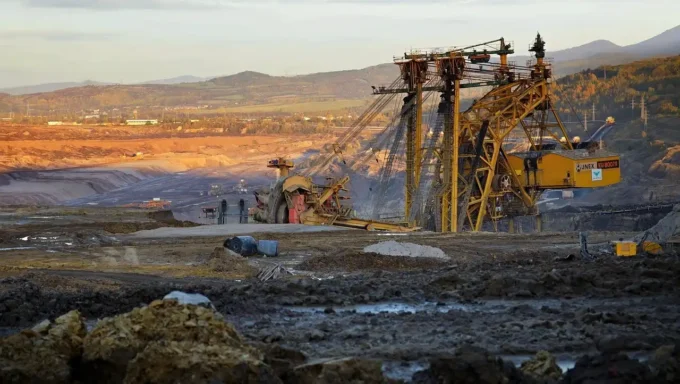
Mining recorded the largest percentage fall, shrinking by 3.0%. The decline in mining output was led by platinum group metals, manganese ore, gold and iron ore.
Manufacturing contracted by 1.8%, marking its third consecutive quarterly decline. Seven of the ten manufacturing divisions weakened, with notable pressure in food and beverages, furniture and other manufacturing, and basic iron and steel and related metal products.
Trade fell 1.9% after six quarters of growth. Wholesale trade, motor trade and food and beverages weakened, although retail activity and accommodation were more resilient. Softer fuel sales also weighed on motor trade.
Imports Become a Major Drag on Growth
One of the most important features of the quarter was the imbalance between imports and exports. Imports of goods and services rose 4.9%, driven mainly by machinery and electrical equipment and mineral products.
Exports increased by a much smaller 0.9%, supported by precious and semi-precious stones, precious metals and other goods. The widening gap meant external trade placed substantial pressure on quarterly growth.
South Africa’s current account also moved into deficit during the quarter as higher import costs put additional pressure on the trade balance.
Context is everything. Stay ahead of shifting trends with today’s market updates, and uncover emerging opportunities using the Serrari Group Market Index and Marketplace. Then, take control of your own financial future by exploring our Money & Life Reset Transformation Blueprint ™ to build stronger habits, create better systems, and design a path toward lasting wealth.
Investment Remains a Weak Point
Gross fixed capital formation declined for a second consecutive quarter. Construction works and transport equipment were among the largest negative contributors, while private businesses and public corporations reduced capital formation.
The investment decline matters because fixed capital formation supports future productive capacity. Persistent weakness can limit improvements in infrastructure, industrial capacity and business expansion even when other parts of the economy are growing.
Inventories provided some support, however, with businesses recording a net build-up of R8.8 billion during the quarter.
Higher Fuel Costs Add External Pressure
The second quarter also coincided with elevated global energy prices linked to conflict in the Middle East. South Africa is exposed to international oil prices because it imports crude oil and refined petroleum products.
During the April fuel-price review, the average Brent crude price rose from $69.08 to $93.67 per barrel. The government temporarily reduced the general fuel levy to cushion consumers from the resulting increase in domestic fuel prices.
By the May review, Brent had risen further to about $101 per barrel, keeping pressure on transport and household costs. Higher fuel prices can weaken disposable income and increase operating expenses, although they were not the only factor behind the GDP contraction.
Household Spending Shows Some Resilience
Despite the broader slowdown, household consumption increased by 0.4% during the quarter. Spending rose across several categories, including food and non-alcoholic beverages and restaurants and hotels, helping prevent an even larger contraction.
Government consumption also increased by 0.4%, while transport, finance, government services and personal services made positive contributions on the production side.
This mixed picture supports the view that the recovery has been interrupted rather than uniformly reversed. The economy weakened in several large sectors, but activity remained positive elsewhere.
Outlook Depends on Energy, Investment and Industry
South Africa’s near-term outlook will depend on whether mining and manufacturing recover, whether energy and import costs ease, and whether fixed investment begins to strengthen.
The 0.2% contraction is a setback after six quarters of expansion, but the data does not yet point to an economy in broad-based decline. A stronger recovery will require more than resilient consumption: improving industrial output, investment and the external trade balance will be central to restoring momentum.
Sources: Statistics South Africa / Reuters / South African Government / South African Reserve Bank
Your financial future isn’t something you wait for—it’s something you build.
The real question is: when do you begin?
Move beyond simply staying informed.
Navigate the markets with clarity—track trends through the Serrari Group Market Index, uncover opportunities in the Serrari Marketplace, and build practical knowledge with our Curated Wealth Builder Platform.
Stay connected to what truly matters.
Get daily insights on macro trends and financial movements across Kenya, Africa, and global markets—delivered through the Serrari Newsletter.
Growth opens doors.
Advance your career through professional programs including ACCA, HESI A2, ATI TEAS 7 , HESI EXIT , NCLEX – RN and NCLEX – PN, Financial Literacy!🌟—designed to move you forward with confidence.
See where money is flowing—clearly and in real time.
Track Money Market Funds, Treasury Bills, Treasury Bonds, Green Bonds, and Fixed Deposits, alongside global and African indexes, key economic indicators, and the evolving Crypto and stablecoin landscape—all within Serrari’s Market Index.