Kenya Treasury bond yields help explain why the August switch attracted stronger demand than some earlier debt-management operations. Eligible investors exchanged near-term Treasury bills and a 2027 bond into FXD4/2019/010, which carries a 12.28% coupon but cleared at an average accepted yield of 11.2391%. Because the market yield is below the bond’s coupon, the security trades at a premium to face value rather than allowing investors to earn 12.28% simply by purchasing it. The auction also involved a comparatively moderate extension into November 2029 rather than the much longer maturity requested in May’s weaker switch. For investors, the result suggests selective appetite for medium-duration government paper while reinforcing the importance of analysing yield to maturity, acquisition price and reinvestment risk rather than coupon alone.
LIVEKenya bond yields: Average yield 11.93% across 58 bonds · 16 OctSee yields →Key Overview
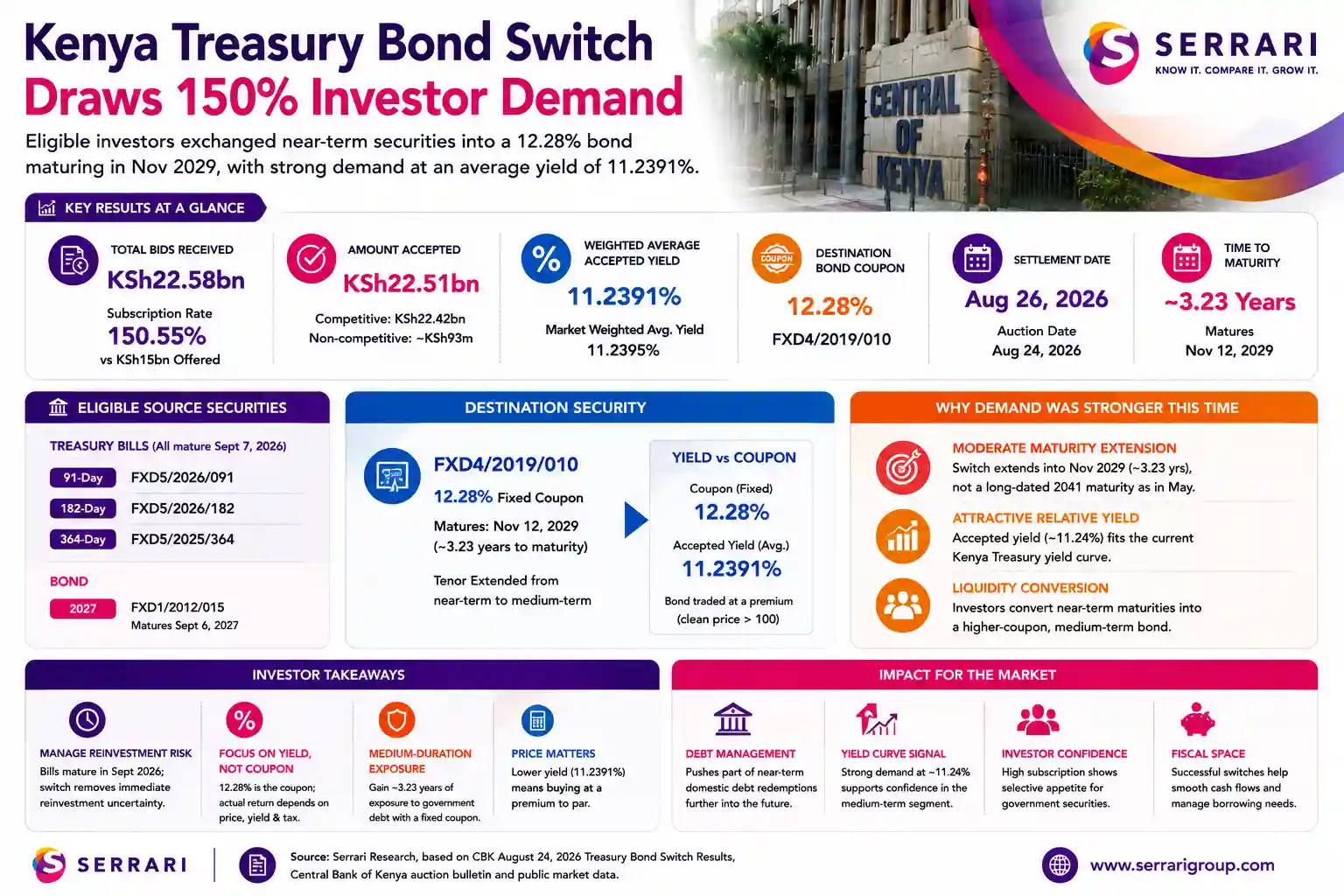
- CBK received KSh22.58 billion of bids against KSh15 billion offered, equivalent to 150.55% subscription.
- CBK accepted approximately KSh22.51 billion, including KSh22.42 billion competitive and about KSh93 million non-competitive bids.
- The weighted average accepted yield was 11.2391%, compared with a 11.2395% market weighted average rate.
- Destination bond FXD4/2019/010 carries a 12.28% coupon and matures on November 12, 2029.
- The three eligible Treasury bills mature on September 7, 2026, while source bond FXD1/2012/015 matures on September 6, 2027.
- Settlement is scheduled for August 26, 2026, completing a switch that pushes part of Kenya’s near-term domestic redemption burden further into the future.
Kenya Treasury Bond Switch Draws 150% Investor Demand
Stronger Demand Changes the Signal
Kenya’s August Treasury bond switch has produced a markedly stronger result than some earlier liability-management exercises this year. CBK received KSh22.58 billion bids against KSh15 billion offered, a 150.55% performance rate, and CBK accepted KSh22.51 billion total.
The result matters because this was not a conventional cash bond auction open to every investor. Participation was restricted to holders of specified Treasury bills and FXD1/2012/015. The demand signal is therefore best interpreted as willingness among eligible holders to extend existing Kenya government securities, rather than a measure of demand from the entire market.
The accepted book was also unusually close to the amount tendered. Competitive bids reached KSh22.42 billion, while non-competitive bids were roughly KSh93 million. The market weighted average yield was 11.2395%, while the accepted yield averaged 11.2391 percent.
That narrow yield gap suggests CBK did not need to move far away from submitted pricing to complete the switch.
Why the 2029 Destination Was Easier to Accept
The destination bond helps explain the stronger participation.
FXD4/2019/010 destination bond pays 12.28 percent and bond matures November 12 2029, leaving about 3.23 years to maturity around the auction date.
For holders of the three eligible Treasury bills, which three bills mature September 7, the transaction converts an imminent cash repayment into medium-duration government exposure rather than locking capital away for a decade or more.
The other source security, FXD1/2012/015, matures on September 6, 2027. Its holders are also extending duration, but only into late 2029.
That is materially different from the May switch, which asked investors to move from a July 2027 maturity into a security running until July 2041.
That transaction May switch drew 76.14 percent subscription against its KSh10 billion target, while May switch accepted KSh4.53 billion.
The comparison does not prove maturity length was the only reason for August’s stronger demand. It does support a more selective interpretation of duration appetite: investors may be willing to extend when the additional maturity risk is moderate and pricing fits the prevailing curve.
Coupon Versus Yield Sends Another Signal
The destination bond’s 12.28% coupon sits above the August auction’s 11.2391% average accepted yield.
That distinction matters because coupon and yield are not interchangeable.
The coupon determines interest paid against face value. Yield reflects the price an investor effectively pays for the remaining coupons and principal. When market yield falls below the fixed coupon on an existing bond, that security will generally trade above par on a clean-price basis.
CBK’s official pricing table demonstrates that relationship. At an 11.25% yield, the clean price equals KSh102.6815 approximately per KSh100 of face value. The auction’s average accepted yield was slightly lower still.
Investors were therefore not simply receiving a “12.28% return” without paying for the higher coupon. They were acquiring an older high-coupon security at a premium consistent with prevailing Kenya Treasury bond yields.
That is an important distinction when comparing older government securities. A high legacy coupon can look attractive, but the market normally capitalises that advantage into price.
Context is everything. Stay ahead of shifting trends with today’s market updates, and uncover emerging opportunities using the Serrari Group Market Index and Marketplace. Then, take control of your own financial future by exploring our Money & Life Reset Transformation Blueprint ™ to build stronger habits, create better systems, and design a path toward lasting wealth.
What the Result Says About Duration Appetite
The August outcome suggests stronger willingness to exchange near-term liquidity for medium-duration government exposure.
It does not necessarily mean investors have become broadly bullish on every long-dated Kenyan bond.
That distinction matters because the domestic fixed-income market has shown periods of strong preference for Treasury bills during 2026, particularly when investors expected yields to rise. Business Daily reported strong movement into short-dated bills in July as investors preserved reinvestment flexibility.
Moving from a September 2026 bill into a November 2029 bond is therefore a very different risk decision from extending into a 2041 maturity.
LIVEKenya bond yields: Average yield 11.93% across 58 bonds · 16 OctSee yields →For pension funds, insurers and fund managers, the 2029 line can provide a middle ground: longer cash-flow visibility without the much greater price sensitivity associated with far longer remaining maturities.
The Government Also Gains Flexibility
For the National Treasury, the CBK bond switch auction pushes part of upcoming domestic redemptions further into the future without requiring the same investors to first receive cash and then bid again through an ordinary bond auction.
Treasury has indicated that Treasury plans monthly switch auctions as part of its 2026/27 domestic borrowing strategy. The objective is to smooth redemption peaks, reduce maturity pressure and support larger, more liquid benchmark securities.
The fiscal year ended June had already seen four switch operations that switches extended KSh66.8 billion maturities into later periods.
August’s acceptance of KSh22.51 billion therefore provides more than an investor-demand signal. It also gives the government meaningful near-term liability-management relief before the selected Treasury bills mature in September.
What Investors Should Watch Next
Settlement falls on August 26, after which successful holdings should be reflected through the DhowCSD system.
Investors should then watch secondary-market pricing of FXD4/2019/010, the shape of the three- to five-year section of the government yield curve and the terms offered in future August 2026 bond auction and switch operations.
If subsequent medium-duration switches also attract strong participation, August’s result would look less like a one-off and more like evidence that investors are becoming more comfortable extending maturities at current yields.
If demand weakens when CBK asks investors to move substantially further along the curve, the lesson would be different: duration appetite has improved, but selectively.
Conclusion
Kenya’s August bond switch delivered a clear improvement in participation.
Bids reached KSh22.58 billion against KSh15 billion offered, and CBK accepted almost the entire book at an average yield of 11.2391%.
The more important signal is not simply that the transaction was oversubscribed. It is that eligible investors were willing to exchange near-term maturities for a November 2029 bond while still pricing that exposure below its 12.28% coupon.
Compared with May’s weaker and much longer maturity extension, August points toward selective appetite for medium duration rather than a blanket rush into long-dated Kenya domestic debt.
FAQs
Why did Kenya’s August Treasury bond switch attract stronger demand?
The August switch asked investors to extend into FXD4/2019/010, which had roughly 3.23 years remaining to maturity, rather than into a very long-dated security. That makes the duration commitment more moderate for investors giving up Treasury bills due in September 2026 or a bond due in September 2027. The 12.28% coupon and an accepted market yield around 11.24% also made the destination security relevant to prevailing secondary-market pricing. Other factors may have contributed, so maturity length should not be treated as the sole explanation.
Does the 12.28% coupon mean investors earn 12.28%?
No. The coupon is the fixed interest rate paid on the bond’s face value. Investors acquiring an existing bond may pay above or below par, changing their effective yield to maturity. In the August auction, the average accepted yield was 11.2391%, below the 12.28% coupon. CBK’s pricing table shows that yields around this level correspond with a clean price above KSh100 per KSh100 face value. The correct return measure therefore requires investors to consider purchase price, accrued interest, tax and remaining cash flows.
How did August compare with the May switch auction?
The May switch attracted KSh7.61 billion of bids against a KSh10 billion target, equivalent to 76.14% subscription, with CBK accepting KSh4.53 billion. That transaction asked holders of a bond maturing in July 2027 to move into a security maturing in July 2041. August instead attracted 150.55% subscription while moving eligible holdings into November 2029. The contrast suggests investors may distinguish sharply between moderate and much longer duration extensions.
Is switch-auction demand the same as a normal Treasury bond auction?
No. A switch auction is restricted to investors already holding specific eligible government securities. In this case, participation was limited to holders of Treasury bills 2685/091, 2646/182 and 2574/364 and Treasury bond FXD1/2012/015. A conventional primary Treasury bond auction has a broader investor pool. The 150.55% performance rate should therefore be interpreted as strong demand among eligible switch participants rather than a direct measure of demand from every fixed-income investor in Kenya.
Why does the National Treasury use bond switches?
Switches allow the government to move debt from near-term maturities into later redemption dates without first repaying investors in cash and then refinancing the full amount through another auction. This can smooth the government’s maturity profile, reduce concentrated refinancing pressure and help consolidate issuance into more liquid benchmark lines. Treasury’s 2026/27 borrowing plan indicates that switches are expected to become a more regular liability-management tool.
Sources: Central Bank of Kenya, Business Today, People Daily, Streamline
Your financial future isn’t something you wait for—it’s something you build.
The real question is: when do you begin?
Move beyond simply staying informed.
Navigate the markets with clarity—track trends through the Serrari Group Market Index, uncover opportunities in the Serrari Marketplace, and build practical knowledge with our Curated Wealth Builder Platform.
Stay connected to what truly matters.
Get daily insights on macro trends and financial movements across Kenya, Africa, and global markets—delivered through the Serrari Newsletter.
Growth opens doors.
Advance your career through professional programs including ACCA, HESI A2, ATI TEAS 7 , HESI EXIT , NCLEX – RN and NCLEX – PN, Financial Literacy!🌟—designed to move you forward with confidence.
See where money is flowing—clearly and in real time.
Track Money Market Funds, Treasury Bills, Treasury Bonds, Green Bonds, and Fixed Deposits, alongside global and African indexes, key economic indicators, and the evolving Crypto and stablecoin landscape—all within Serrari’s Market Index.