Kenya Airways fleet recovery is the central issue investors should watch when the airline reports H1 2026 results on August 25. In H1 2025, three grounded Boeing 787-8 Dreamliners reduced available capacity by 16%, contributing to a 19% decline in revenue to about KSh75 billion and a KSh6.2 billion operating loss. The H1 2026 results should show whether improved aircraft availability has translated into higher Available Seat Kilometres, passenger volumes and revenue. Investors should also compare operating performance with fleet ownership costs, cash, borrowings and Kenya Airways’ negative equity position. A stronger profit figure would be encouraging, but the more important evidence of a sustainable turnaround would be simultaneous improvement in capacity, revenue and operating profitability.
LIVENSE market summarySee NSE data →Key Overview
- Kenya Airways’ official 2026 calendar schedules its H1 unaudited financial-results investor briefing for August 25, 2026.
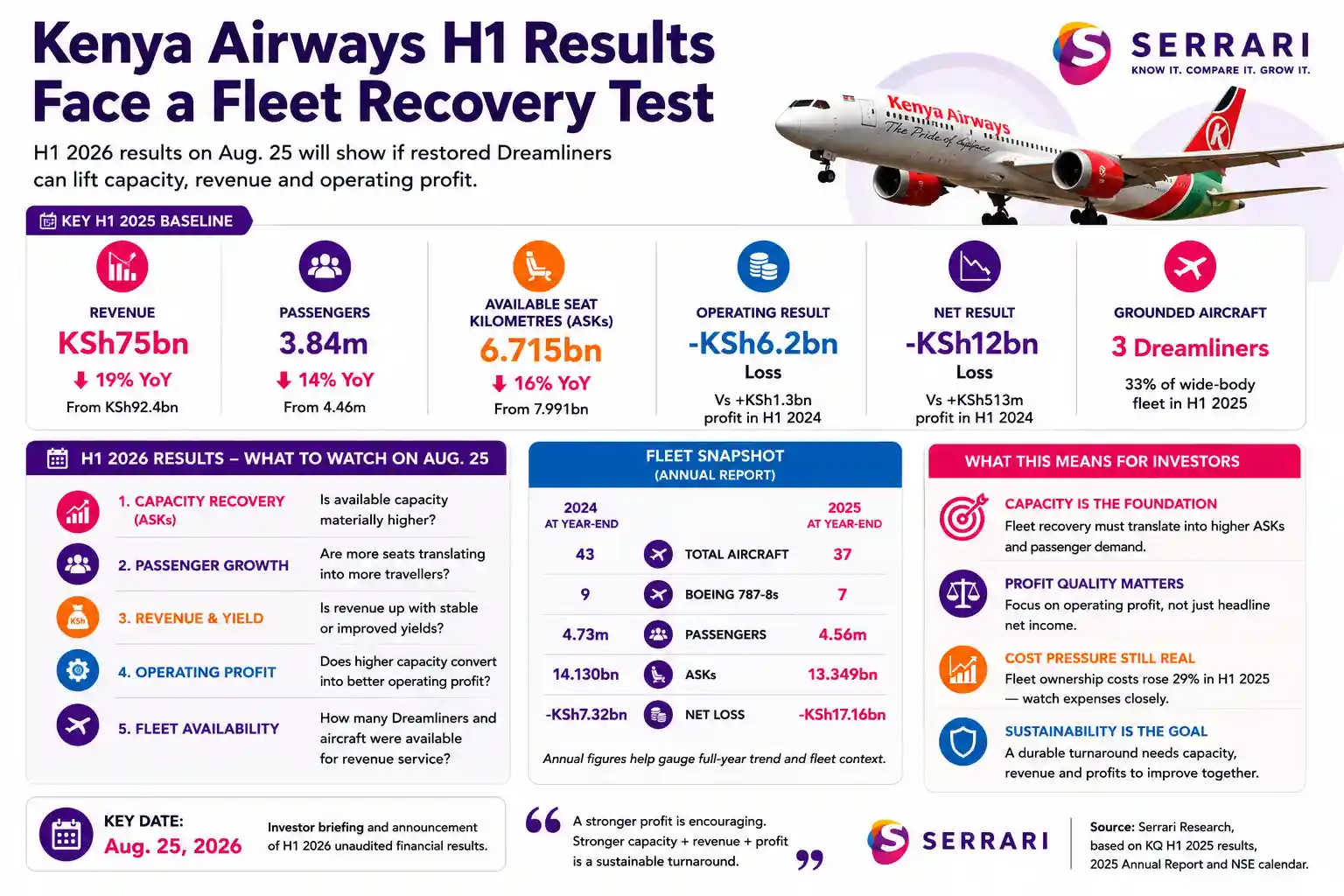
- Three Boeing 787-8 Dreamliners were grounded during H1 2025, representing 33% of the airline’s wide-body fleet at the time.
- H1 2025 revenue fell 19% to about KSh75 billion, while passenger numbers declined 14% and available capacity dropped 16%.
- The operating result deteriorated from a KSh1.3 billion profit to a KSh6.2 billion loss, while the net result moved from a KSh513 million profit to a KSh12 billion loss.
- FY2025 turnover was KSh161.47 billion, ASKs were 13.349 billion, passengers fell to about 4.56 million, and the group recorded a KSh17.16 billion net loss.
- The 2025 annual report listed 37 aircraft in service at year-end, including seven Boeing 787-8s, compared with 43 total aircraft and nine 787-8s in 2024.
Kenya Airways H1 Results Face a Fleet Recovery Test
Tuesday’s Result Is Really a Capacity Test
Kenya Airways enters Tuesday’s H1 2026 results with a much sharper investor question than whether profit after tax improves.
The airline spent much of 2025 dealing with a capacity shock caused by grounded wide-body aircraft. three Dreamliners represented 33% fleet during H1 2025. That hit the number of seats KQ could offer, reduced passenger volumes and pushed the airline back into loss.
The official NSE calendar confirms that results are scheduled August 25 as an investor briefing and announcement of unaudited half-year financial results.
Tomorrow’s report should therefore be read as a test of Kenya Airways fleet recovery first and accounting profit second.
ASKs Are the First Number
The first number to watch is Available Seat Kilometres, or ASKs.
In the comparison period, ASKs fell to 6.715 billion from 7.991 billion a year earlier. At the same time, capacity declined sixteen percent year-on-year.
The capacity contraction flowed directly into commercial performance. passenger numbers declined fourteen percent, while revenue fell 19% to KSh75bn.
If H1 2026 ASKs recover materially, investors will have evidence that the restoration programme is translating into sellable capacity.
But higher capacity only matters economically if Kenya Airways can fill those seats at sensible yields and control the cost of putting aircraft back into operation.
That makes passenger growth the second number to watch. A rebound in passengers without corresponding improvement in Kenya Airways revenue could signal weaker fares or mix. Stronger revenue without proportional passenger growth could instead point toward better yields, network mix or ancillary performance.
Operating Profit Will Show the Quality
The H1 2025 operating result shows why capacity matters so much.
operating loss reached KSh6.2 billion after KQ had earned a KSh1.3 billion operating profit in H1 2024. Its bottom line also deteriorated as the net loss reached KSh12 billion.
Cost pressure mattered too. fleet ownership costs rose 29% following leased-asset remeasurement and the addition of a Boeing 737.
The operating line is therefore more informative than headline net income alone.
If capacity returns but the operating result remains deeply negative, aircraft availability was not the only problem. Fuel, maintenance, fleet ownership, labour, financing and network economics would then require closer attention.
If operating performance improves alongside ASKs and revenue, the evidence supporting a genuine KQ turnaround becomes stronger.
Fleet Availability Is Number Five
The fleet itself is the fifth number.
Kenya Airways said one Dreamliner returned July 2025, while the other two were expected to follow later in 2025.
Yet the audited annual report shows that seven Dreamliners remained in service at December 2025, compared with nine at the end of 2024.
That makes tomorrow’s fleet disclosure particularly important.
Investors need to know how many Kenya Airways Dreamliners and other aircraft were actually available for revenue service during H1 2026, rather than simply how many aircraft form part of the wider fleet.
An aircraft that exists within the fleet but spends extended periods unavailable does not solve the capacity constraint.
Context is everything. Stay ahead of shifting trends with today’s market updates, and uncover emerging opportunities using the Serrari Group Market Index and Marketplace. Then, take control of your own financial future by exploring our Money & Life Reset Transformation Blueprint ™ to build stronger habits, create better systems, and design a path toward lasting wealth.
Full-Year 2025 Left a Difficult Baseline
Full-year 2025 provides the broader comparison.
FY2025 turnover reached KSh161.47 billion, down from KSh188.50 billion in 2024. Meanwhile, ASKs fell 17.7% during 2025 and RPKs fell 18.2% during 2025.
passengers fell to 4.56 million, and the FY2025 loss reached KSh17.16 billion.
The fleet ended 2025 at 37 aircraft in service, down from 43 one year earlier.
LIVENSE market summarySee NSE data →Those figures mean H1 2026 does not need only a better profit number. It needs evidence that the operating platform is regaining enough capacity to rebuild revenue without allowing cost growth to overwhelm the improvement.
Project Kifaru Still Needs Capital
Project Kifaru remains the strategic frame around that recovery.
Kenya Airways’ FY2025 investor materials show that capital raising remains strategic priority, while aircraft and engines remain priorities alongside cost optimisation and operational stability.
The airline has also continued developing its commercial network through partnerships. Its JetBlue codeshare launched during March, expanding onward connectivity from New York into the United States.
Partnerships can widen commercial reach, but the economics still depend on having enough reliable aircraft capacity to serve the core network.
The Balance Sheet Remains Critical
For equity investors, the balance sheet remains the other half of the story.
At December 2025, group equity was negative KSh132.1bn. At the same date, group borrowings reached KSh151.3 billion while cash balances reached KSh5.33 billion.
Those numbers explain why capital raising remains important even if operating performance improves.
A stronger H1 operating result can demonstrate that the core airline business is healing, but negative equity and heavy borrowings mean the investment case also depends on how recapitalisation is structured, whether creditors participate and how much dilution existing shareholders ultimately face.
Acting Group Managing Director and CEO Captain George Kamal now leads that process after assuming the role in December 2025.
What Investors Should Watch Tomorrow
The most useful way to read Tuesday’s results is in sequence:
- ASKs — has available capacity recovered?
- Passenger volumes — is KQ filling that capacity?
- Revenue — is additional flying commercially productive?
- Operating result — are revenues improving faster than costs?
- Fleet availability — how many aircraft are genuinely operational?
Then compare that operating picture with cash, debt and negative equity.
The KQ share price reaction may focus initially on the headline profit or loss, but the more durable signal for investors tracking NSE airline shares will be whether restored capacity is becoming financially productive rather than merely creating a larger operating footprint.
Conclusion
Kenya Airways’ H1 2026 report is a fleet-recovery test because 2025 demonstrated how quickly grounded aircraft can damage revenue and profitability.
A better result tomorrow would be encouraging, but the quality of that improvement matters more than the headline.
If ASKs, passenger volumes and revenue recover together while the operating loss narrows or turns positive, investors would have stronger evidence that restoring aircraft is rebuilding the earnings engine.
If capacity rises without equivalent operating improvement, attention will shift quickly toward costs, yields and the balance sheet.
That is the benchmark against which the Kenya Airways earnings 2026 release should be judged.
FAQs
When will Kenya Airways release its H1 2026 results?
Kenya Airways’ official forward-looking calendar filed through the Nairobi Securities Exchange schedules an investor briefing and announcement of its unaudited half-year 2026 financial results for Tuesday, August 25, 2026. The figures will cover the six months ended June 30. As this is a preview, no H1 2026 revenue, profit, passenger, ASK or fleet-availability result should be assumed before the company publishes the announcement.
Why are ASKs important for Kenya Airways investors?
Available Seat Kilometres measure the passenger-carrying capacity an airline offers after accounting for both seats and distance flown. Kenya Airways’ H1 2025 ASKs fell to 6.715 billion from 7.991 billion as aircraft groundings reduced capacity. If H1 2026 ASKs recover, that would provide evidence that more aircraft capacity returned to the network. Investors must then determine whether that extra capacity also generated passengers, revenue and improved operating profitability.
What happened to Kenya Airways in H1 2025?
Three Boeing 787-8 Dreamliners were temporarily grounded, representing 33% of Kenya Airways’ wide-body fleet at the time. Revenue fell 19% to KSh75 billion, passenger numbers declined 14%, available capacity fell 16%, and KQ moved from an operating profit of KSh1.3 billion to an operating loss of KSh6.2 billion. The net result deteriorated from a KSh513 million profit to a KSh12 billion loss.
Has Kenya Airways completely restored its Dreamliner fleet?
The currently available official information does not support claiming that fleet restoration is complete. Kenya Airways confirmed that one grounded Dreamliner returned in July 2025 and originally expected two more to follow. However, its audited 2025 annual report lists seven Boeing 787-8 aircraft in service at year-end, compared with nine in 2024. Tuesday’s H1 2026 disclosure is therefore important for establishing the latest actual operational fleet position.
Why does the balance sheet still matter if earnings improve?
Kenya Airways ended 2025 with substantial financial stress despite its operating-recovery programme. Group equity was negative KSh132.1 billion, borrowings were KSh151.3 billion and cash and bank balances were approximately KSh5.33 billion. An improvement in H1 earnings would therefore strengthen the operating story but would not by itself resolve the need for capital restructuring, liquidity improvement and balance-sheet repair.
Sources: NSE, Kenya Airways, Kenya Airways Financial Results Archive, Kenya Airways FY2025 Integrated Annual Report, Kenya Airways FY2025 Investor Briefing
Your financial future isn’t something you wait for—it’s something you build.
The real question is: when do you begin?
Move beyond simply staying informed.
Navigate the markets with clarity—track trends through the Serrari Group Market Index, uncover opportunities in the Serrari Marketplace, and build practical knowledge with our Curated Wealth Builder Platform.
Stay connected to what truly matters.
Get daily insights on macro trends and financial movements across Kenya, Africa, and global markets—delivered through the Serrari Newsletter.
Growth opens doors.
Advance your career through professional programs including ACCA, HESI A2, ATI TEAS 7 , HESI EXIT , NCLEX – RN and NCLEX – PN, Financial Literacy!🌟—designed to move you forward with confidence.
See where money is flowing—clearly and in real time.
Track Money Market Funds, Treasury Bills, Treasury Bonds, Green Bonds, and Fixed Deposits, alongside global and African indexes, key economic indicators, and the evolving Crypto and stablecoin landscape—all within Serrari’s Market Index.