A REIT acquisition yield indicates the income return expected from acquired property relative to the price paid, but it does not by itself determine whether an acquisition creates shareholder value. Dipula Properties says its nine-property transaction carries a blended acquisition yield of about 9.3%. Investors still need to compare that figure with the effective cost of debt and equity used to fund the R2.043 billion transaction. Dipula has raised approximately R1.1 billion through a private placement, meaning existing shareholders also face dilution from additional shares. The investment case therefore depends on whether additional rental income and future growth exceed financing costs, dilution and integration risks. Dipula says the acquisition will be earnings-accretive from day one, but that remains management’s assessment, while seller financial information disclosed in the transaction announcement is unaudited.
Key Overview
- Dipula announced the transaction August 24, 2026, through a JSE SENS filing.
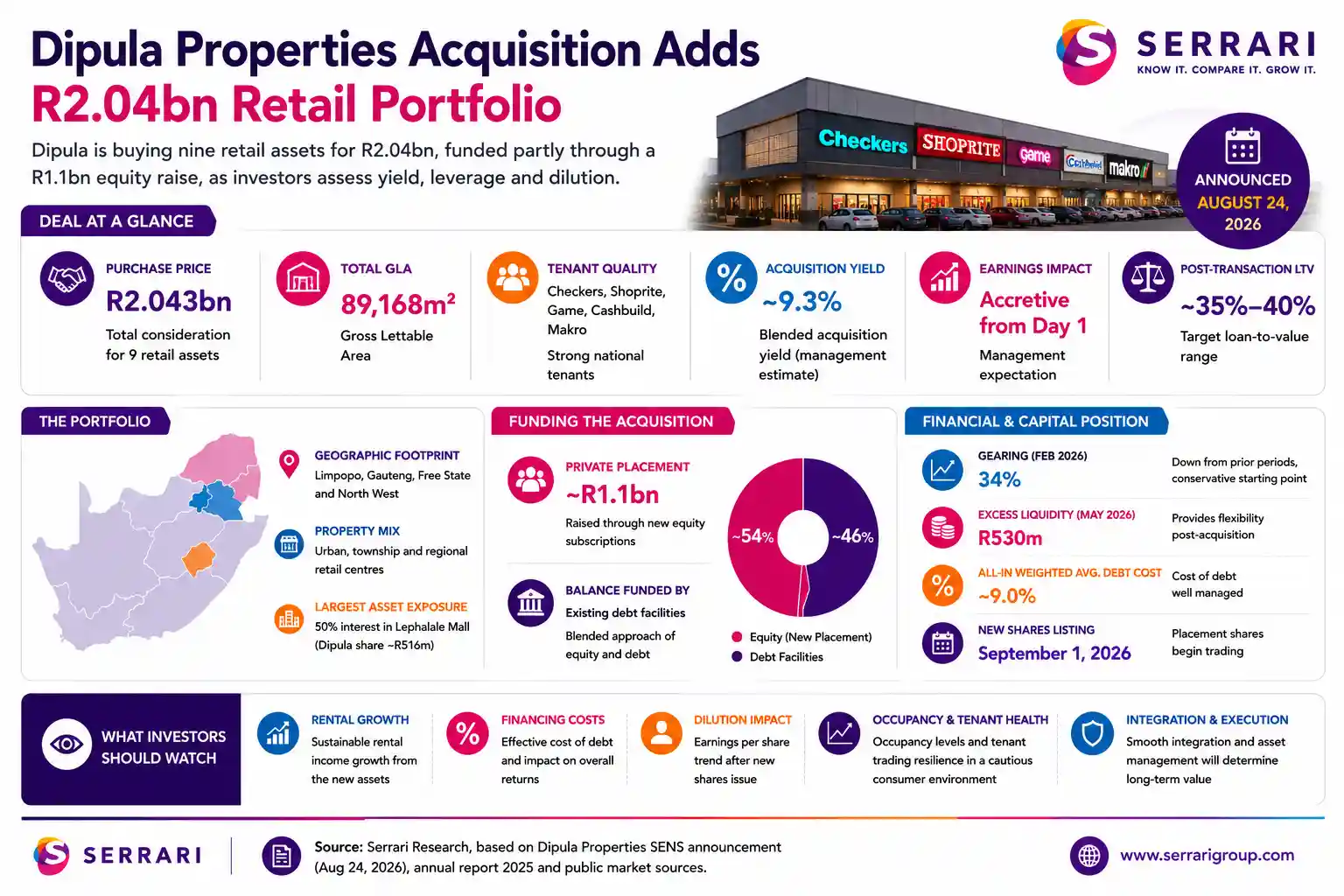
- The purchase consideration totals R2.043 billion across nine retail properties.
- The combined GLA totals 89,168 square-metres, with tenants including Checkers, Shoprite, Game, Cashbuild and Makro.
- The placement raised roughly R1.1 billion in new equity subscriptions.
- Dipula reports a blended acquisition yield of approximately 9.3% and says the portfolio should be earnings-accretive from implementation.
- The company expects post-transaction loan-to-value to remain around 35%–40%, while the new placement shares are expected to begin trading on September 1.
Dipula Properties Acquisition Adds R2.04bn Retail Portfolio
Dipula Makes a R2 Billion Retail Bet
Dipula Properties has agreed to acquire a substantial portfolio from Moolman Group entities and their co-investors as the JSE-listed REIT continues shifting capital toward retail property.
The transaction was announced August 24, with the purchase consideration totals R2.043 billion.
The portfolio contains nine retail properties spread across Limpopo, Gauteng, the Free State and North West. The combined GLA totals 89,168 square-metres, with national tenants including Checkers, Shoprite, Game, Cashbuild and Makro.
The assets range from urban centres to township and regional retail properties. The largest individual exposure is a 50% interest in Lephalale Mall, with Dipula’s share valued at roughly R516 million.
For the Dipula Properties REIT, the acquisition meaningfully increases exposure to the segment management considers one of its defensive core property categories.
The 9.3% Yield Is Only the Starting Point
Management says the portfolio is being acquired at a blended yield of 9.3 percent.
That sounds attractive in isolation, but acquisition yield should never be evaluated without considering how the assets are financed.
A property producing a 9.3% initial yield creates value only if its income, growth and eventual capital performance adequately compensate investors for the cost of funding, transaction expenses and operational risk.
That comparison becomes particularly important because Dipula is not financing the entire transaction from existing cash.
The placement raised roughly R1.1 billion in new equity, while Dipula says existing debt facilities will help fund the balance.
For shareholders, this creates the central trade-off: the acquisition can increase rental earnings, but issuing additional equity spreads those earnings across a larger share base.
Dilution Does Not Automatically Destroy Value
The Dipula private placement therefore deserves as much attention as the properties themselves.
New shares dilute existing ownership percentages. That is not automatically negative if the capital raised is invested at attractive enough returns.
The question is whether incremental earnings generated by the properties are sufficient to offset the larger number of shares outstanding and any additional debt costs.
Dipula says the transaction will be earnings-accretive from day one. That is an important management signal, but it remains forward-looking rather than an audited result. Engineering News reports that management expects the acquisition to be accretive based on its proposed mix of equity and debt funding.
The new shares list September 1, 2026, according to the SENS timetable.
Investors will therefore soon begin seeing the enlarged equity base reflected directly in the listed security.
Context is everything. Stay ahead of shifting trends with today’s market updates, and uncover emerging opportunities using the Serrari Group Market Index and Marketplace. Then, take control of your own financial future by exploring our Money & Life Reset Transformation Blueprint ™ to build stronger habits, create better systems, and design a path toward lasting wealth.
The Balance Sheet Still Matters
Dipula enters the transaction from a relatively measured leverage position.
At February 2026, gearing fell to 34 percent, while its SA REIT loan-to-value ratio was approximately 34.25%.
The company also reported excess liquidity of R530 million in early May and an all-in weighted average debt cost of roughly 9.0%.
After the acquisition, management expects Dipula loan-to-value to remain between approximately 35% and 40%.
That suggests the equity raise is serving an important balance-sheet purpose: helping finance growth without forcing the REIT to fund the entire R2 billion purchase through incremental borrowing.
For South Africa property investment, that funding mix matters because higher leverage can magnify both rental returns and downside risk when interest rates, vacancies or property values move against the owner.
Dipula Has Been Expanding Quickly
The new transaction is not happening in isolation.
Once completed, management says Dipula will have acquired 14 properties worth roughly R3 billion over the preceding 12 months.
That increases the importance of execution.
Acquisitions can improve portfolio quality and income diversification, but rapid expansion also requires successful leasing, collections, maintenance, capital expenditure and integration across multiple new assets.
The company’s recent earnings provide a stronger starting point. Distributable earnings reached R310 million for the six months ended February, while earnings increased 20 percent year-on-year.
Its property portfolio had also risen to approximately R11.5 billion by the February reporting date.
The R2.043 billion transaction is therefore significant relative to Dipula’s existing asset base.
Conditions Still Have to Be Met
The Dipula Properties Acquisition is agreed but not fully implemented.
The SENS filing contains several outstanding conditions, including funding approvals, completion of transaction agreements and competition-authority approvals.
The competition deadline is December 15, 2026, while the long-stop date is March 31, 2027.
The acquisition is also a transaction classified Category 2 acquisition under JSE Listings Requirements because its value exceeds 10% but is below 30% of Dipula’s market capitalisation.
Importantly, the seller financial information included in the SENS disclosure has not been reviewed or reported on by Dipula’s auditors.
That caveat should remain part of any investor assessment of projected accretion.
What Investors Should Watch Next
The first near-term checkpoint is Dipula’s full-year pre-close update.
The presentation occurs August 27 2026 at 11:00 SAST.
Investors should listen for further detail on acquisition funding, expected earnings contribution, post-deal leverage, transaction costs and management’s assumptions behind the reported 9.3% yield.
The September listing of new shares will then make the dilution more tangible.
Beyond that, rental performance at the acquired centres, tenant retention, occupancy, financing cost and regulatory completion will determine whether the portfolio produces the value management currently expects.
Conclusion
Dipula’s R2.043 billion retail acquisition is large enough to reshape both the REIT’s asset base and its funding structure.
A reported 9.3% acquisition yield provides an encouraging starting point, while the R1.1 billion equity raise helps limit the amount of new debt required.
But neither figure alone proves value creation.
For shareholders, the real test is whether additional property income exceeds the combined cost of equity dilution, debt funding, transaction execution and any deterioration in leverage or operating performance.
That is what will ultimately determine whether this R2 billion expansion becomes genuinely accretive.
FAQs
What is Dipula Properties buying?
Dipula Properties has agreed to acquire nine retail properties and their associated rental businesses from entities linked to Moolman Group and its co-investors for an aggregate R2.043 billion. The portfolio spans Limpopo, Gauteng, Free State and North West and has a combined gross lettable area of 89,168 square metres. Major tenants across the portfolio include Checkers, Shoprite, Game, Cashbuild and Makro.
What does Dipula’s 9.3% acquisition yield mean?
The reported 9.3% blended acquisition yield represents management’s stated income yield on the portfolio relative to its purchase price. It is not the same as the return shareholders are guaranteed to earn. To determine whether the transaction creates value, investors must also consider financing costs, new-share dilution, transaction expenses, rental growth, vacancies and future property valuations. The 9.3% figure is therefore a transaction metric rather than an independently guaranteed investor return.
How is Dipula financing the acquisition?
Dipula has completed a private placement that attracted approximately R1.1 billion of new equity subscriptions. Management says those proceeds, together with existing debt facilities and other available funding, will be used toward the acquisition. The equity component helps reduce the amount that would otherwise have to be debt-funded, but it also creates dilution because additional Dipula shares will be issued to investors.
Will the acquisition increase Dipula’s leverage?
Management expects loan-to-value after implementation to remain within approximately 35%–40%. Dipula reported gearing of around 34% at its February 2026 interim period, so leverage is expected to increase but remain within management’s stated range. The actual outcome will depend on final funding, asset values and the timing of transaction implementation.
Is the Dipula acquisition already complete?
No. Dipula has signed the acquisition agreements, but several conditions precedent remain outstanding. These include funding arrangements, completion of certain transaction agreements, competition-authority approval and other implementation requirements. The transaction announcement specifies a March 31, 2027 long-stop date for remaining conditions, subject to extension by agreement between the parties.
Sources: JSE SENS / Sharenet, Engineering News, Moneyweb SENS, Dipula Properties, Dipula, Dipula / Sharenet
Your financial future isn’t something you wait for—it’s something you build.
The real question is: when do you begin?
Move beyond simply staying informed.
Navigate the markets with clarity—track trends through the Serrari Group Market Index, uncover opportunities in the Serrari Marketplace, and build practical knowledge with our Curated Wealth Builder Platform.
Stay connected to what truly matters.
Get daily insights on macro trends and financial movements across Kenya, Africa, and global markets—delivered through the Serrari Newsletter.
Growth opens doors.
Advance your career through professional programs including ACCA, HESI A2, ATI TEAS 7 , HESI EXIT , NCLEX – RN and NCLEX – PN, Financial Literacy!🌟—designed to move you forward with confidence.
See where money is flowing—clearly and in real time.
Track Money Market Funds, Treasury Bills, Treasury Bonds, Green Bonds, and Fixed Deposits, alongside global and African indexes, key economic indicators, and the evolving Crypto and stablecoin landscape—all within Serrari’s Market Index.