

















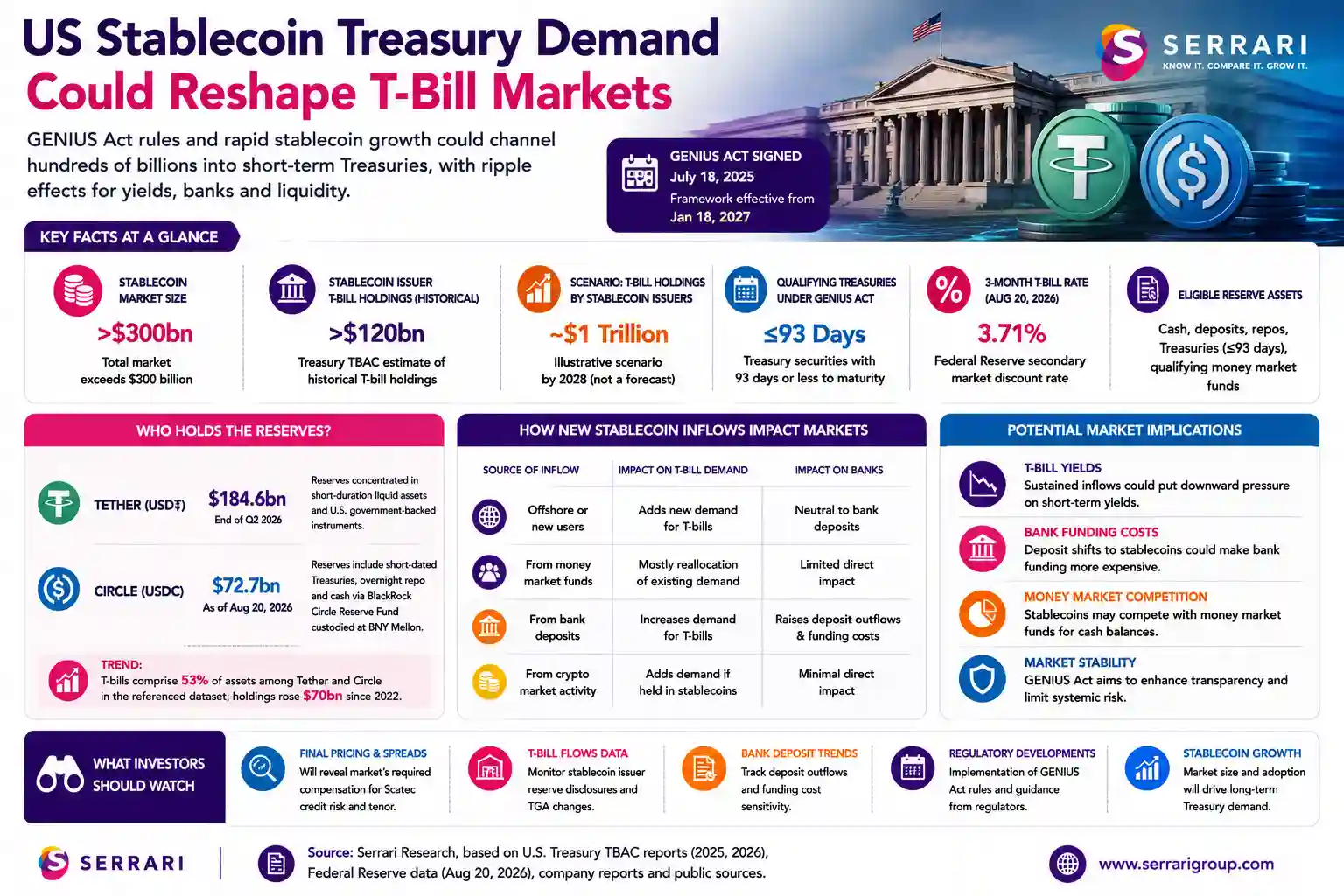
Stablecoin Treasury bills could become an increasingly important part of the U.S. short-term government-debt market because the GENIUS Act restricts payment-stablecoin reserves to highly liquid assets, including Treasury securities with 93 days or less remaining maturity. Treasury’s advisory committee has estimated that stablecoin issuers historically held more than $120 billion of T-bills and modelled a scenario in which holdings could approach $1 trillion by 2028. That is a scenario, not an official forecast. The actual market impact depends heavily on where stablecoin inflows originate. Money entering from offshore or previously unbanked users could create genuinely new Treasury demand. Money shifted from money-market funds may mostly rearrange demand already present. Transfers from bank deposits could have a different effect by raising bank funding costs while simultaneously increasing demand for short-term government securities.
Key Overview
- The Act signed on July 18, 2025 created the federal payment-stablecoin framework.
- Eligible reserve assets include cash, deposits, repos, qualifying money-market funds and Treasuries need 93 days remaining or less to maturity.
- The market now exceeds $300 billion, making reserve allocation increasingly relevant to Treasury demand.
- A Treasury advisory analysis estimated stablecoin issuers historically held more than $120 billion of T-bills and illustrated a scenario approaching $1 trillion by 2028.
- The three-month bill rate reached 3.71% on August 20 on the Federal Reserve’s secondary-market discount-rate measure.
- Treasury’s August implementation proposal says the GENIUS framework is expected to become effective on January 18, 2027.
US Stablecoin Treasury Demand Could Reshape T-Bill Markets
Stablecoins Are Becoming a Treasury-Market Story
The GENIUS Act changed the connection between stablecoins and government securities from an issuer preference into a regulatory question.
The Act signed on July 18, 2025 requires permitted payment stablecoins to maintain one-to-one reserves. Treasury’s advisory committee says those reserves can include cash, bank deposits, qualifying repurchase agreements and Treasury bills, notes or bonds with no more than 93 days remaining to maturity, together with qualifying money-market funds holding similar assets.
That creates a natural link between growth in digital dollars and US T-bill demand.
The link became more immediate when Treasury rulemaking arrived August 17, 2026. Treasury says the expected effective date January 18, 2027 is the benchmark from which people generally cannot issue payment stablecoins in the United States without an appropriate federal or state licence.
The Numbers Are Already Large
This is no longer a marginal reserve pool.
Today’s Wall Street Journal analysis describes a market now exceeds $300 billion and connects stablecoin policy directly with Treasury Secretary Scott Bessent’s evolving approach to government financing and short-term debt.
The two largest tokens illustrate the scale. Tether ended June at $184.6bn of USD₮ issuance at the end of the second quarter. Circle reported that USDC reached $72.7bn August 20, 2026.
Those snapshots are from different dates, so their roughly $257 billion combined value should not be treated as a same-day market-cap figure. But they show why the reserve behaviour of Tether and Circle increasingly matters beyond crypto markets.
Tether says its reserves remain concentrated in short-duration liquid assets and U.S. government-backed instruments. Circle says USDC reserves can include short-dated Treasuries, overnight Treasury repo and cash, including through the BlackRock-managed Circle Reserve Fund custodied at BNY Mellon.
Treasury Has Modelled a Much Larger Scenario
The most striking numbers come from the Treasury Borrowing Advisory Committee.
Its 2025 digital-money analysis estimated that issuers historically held above $120bn in Treasury bills while the T-bill market measured roughly $6.4tn.
The same exercise showed an illustrative case where the scenario reaches $1tn by 2028 in stablecoin-issuer T-bill holdings, representing incremental demand approaches roughly $900bn.
That figure requires an important qualification.
It is not a Treasury forecast.
It is a modelling scenario tied to assumptions about very rapid stablecoin-market growth. The analysis itself notes uncertainty around market adoption, regulation, reserve composition and whether stablecoins eventually compete directly with other cash-like products.
Treasury’s more recent 2026 work nevertheless confirms the direction of travel. Among Tether and Circle, T-bills comprise 53% of assets in the referenced dataset, while holdings rose $70bn since 2022.
Context is everything. Stay ahead of shifting trends with today’s market updates, and uncover emerging opportunities using the Serrari Group Market Index and Marketplace. Then, take control of your own financial future by exploring our Money & Life Reset Transformation Blueprint ™ to build stronger habits, create better systems, and design a path toward lasting wealth.
Where the Money Comes From Matters
More stablecoins do not automatically mean an equal amount of new Treasury demand.
Treasury’s advisory work makes that distinction explicit.
If stablecoin adoption comes from offshore users or people moving savings into U.S. dollars for the first time, unbanked inflows create new demand for T-bills.
If investors instead move money from traditional money-market funds into stablecoins, MMF shifts may remain neutral for overall Treasury demand because government MMFs already own large quantities of bills and repo.
The chain changes, but the underlying Treasury buyer may simply move from one vehicle to another.
This is especially relevant because GENIUS Act reserves can themselves include qualifying money-market funds. Stablecoin growth can therefore coexist with MMFs rather than necessarily replacing them.
Bank Deposits Create a Different Transmission Channel
The more disruptive scenario involves stablecoins and bank deposits.
Treasury’s advisory committee warned that money leaving banks for stablecoins could force banks to pay more to retain deposits or increase reliance on wholesale funding. The committee said bank deposits bear close monitoring as the market expands.
The mechanism is important.
A customer deposit held by a commercial bank helps fund loans and other assets. If that money moves into a stablecoin whose issuer then buys T-bills, the financial system could simultaneously experience stronger short-government demand and weaker deposit funding for banks.
That does not automatically mean less bank lending. Banks can replace deposits through other funding sources. But replacement funding may be more expensive, creating another channel through which stablecoin growth could influence conventional finance.
Could Stablecoins Push T-Bill Yields Lower?
At the margin, a structurally larger class of buyers should support Treasury-bill prices and place downward pressure on yields, all else equal.
The front end is especially relevant because the GENIUS framework focuses reserve eligibility on extremely short maturities. On August 20, the Federal Reserve reported that the three-month bill rate reached 3.71% on a secondary-market discount basis.
But short-term Treasury yields depend on far more than stablecoin demand.
Federal Reserve policy expectations, Treasury issuance volumes, money-market fund flows, bank demand, foreign buyers and broader liquidity conditions can all outweigh stablecoin purchases.
Even a major increase in stablecoin buying would therefore not guarantee materially cheaper government borrowing.
Treasury Is Watching the Structural Shift
Bessent has already identified the market as a potential source of structural Treasury demand.
In remarks at the Treasury Market Conference, Bessent sees stablecoins driving demand alongside continued growth in money-market funds. He said Treasury would respond over time if structural demand for particular securities or maturities changed.
That does not mean Treasury issuance will be determined by stablecoins.
It does mean a digital-asset market once viewed as peripheral is increasingly entering conventional debt-management calculations.
The risk also runs both ways. If stablecoin issuance creates Treasury purchases, large-scale redemptions can require issuers to raise cash. In stressed conditions, large redemptions could reverse flows and turn reserve portfolios from buyers into sellers.
Conclusion
The biggest stablecoin story may eventually have less to do with cryptocurrency prices than with the plumbing of the U.S. financial system.
GENIUS Act reserve rules encourage payment-stablecoin issuers toward cash-like assets, short Treasury securities and qualifying money-market funds. If the industry grows substantially, those rules could create a larger structural buyer at the front end of the Treasury curve.
But the impact depends on the source of that growth.
New offshore dollar demand could meaningfully expand the Treasury buyer base. Money shifting from MMFs may mostly reorganise existing demand. Money moving from bank deposits could simultaneously support T-bills while changing bank funding economics.
For investors, that distinction is more important than any headline projection of stablecoin market size.
FAQs
Why would stablecoin issuers buy Treasury bills?
The GENIUS Act requires permitted payment stablecoins to maintain one-to-one reserves composed of specified highly liquid assets. Eligible instruments include cash, qualifying deposits, certain Treasury-backed repurchase agreements, Treasury securities with 93 days or less remaining maturity and qualifying money-market funds holding similar assets. T-bills therefore offer issuers a combination of liquidity, government credit quality and income while remaining compatible with the reserve framework.
Could stablecoins really hold $1 trillion of T-bills?
Treasury’s advisory analysis included an illustrative scenario in which stablecoin-issuer Treasury-bill holdings approached $1 trillion by 2028, up from a historical estimate above $120 billion. That scenario implied roughly $900 billion of incremental demand. It should not be reported as an official Treasury forecast. It depends on aggressive assumptions about stablecoin-market growth, reserve composition and user adoption, all of which can develop differently from the model.
Would stablecoin growth automatically lower Treasury yields?
No. Larger structural demand can support Treasury-bill prices and put downward pressure on yields at the margin, but Treasury yields are determined by many forces. Federal Reserve policy, inflation expectations, Treasury issuance, money-market fund demand, banks, overseas investors and general liquidity conditions all matter. Stablecoin demand could become one meaningful buyer category without becoming the dominant determinant of short-term rates.
How could stablecoins affect bank deposits?
If households or businesses move money from bank deposits into stablecoins, the receiving issuer may place much of that money into Treasury bills, repo or other eligible reserves. Banks would lose some deposit funding and might respond by offering higher deposit rates or using alternative wholesale funding. Treasury’s advisory committee has therefore highlighted bank-deposit effects as an area that deserves monitoring as stablecoins expand.
Do money-market funds lose if stablecoins grow?
Not necessarily. Some money moving directly from money-market funds into stablecoins could simply shift Treasury demand between vehicles rather than create entirely new demand. Furthermore, qualifying money-market funds can themselves form part of stablecoin reserve arrangements. Circle, for example, uses the BlackRock-managed Circle Reserve Fund as part of its reserve structure. Stablecoins and MMFs can therefore compete in some areas while remaining linked within the same reserve ecosystem.
Sources: Wall Street Journal, U.S. Treasury, Treasury Borrowing Advisory Committee, Tether Q2 2026 Results, Circle USDC and Reserve Transparency, Federal Reserve
Your financial future isn’t something you wait for—it’s something you build.
The real question is: when do you begin?
Move beyond simply staying informed.
Navigate the markets with clarity—track trends through the Serrari Group Market Index, uncover opportunities in the Serrari Marketplace, and build practical knowledge with our Curated Wealth Builder Platform.
Stay connected to what truly matters.
Get daily insights on macro trends and financial movements across Kenya, Africa, and global markets—delivered through the Serrari Newsletter.
Growth opens doors.
Advance your career through professional programs including ACCA, HESI A2, ATI TEAS 7 , HESI EXIT , NCLEX – RN and NCLEX – PN, Financial Literacy!🌟—designed to move you forward with confidence.
See where money is flowing—clearly and in real time.
Track Money Market Funds, Treasury Bills, Treasury Bonds, Green Bonds, and Fixed Deposits, alongside global and African indexes, key economic indicators, and the evolving Crypto and stablecoin landscape—all within Serrari’s Market Index.