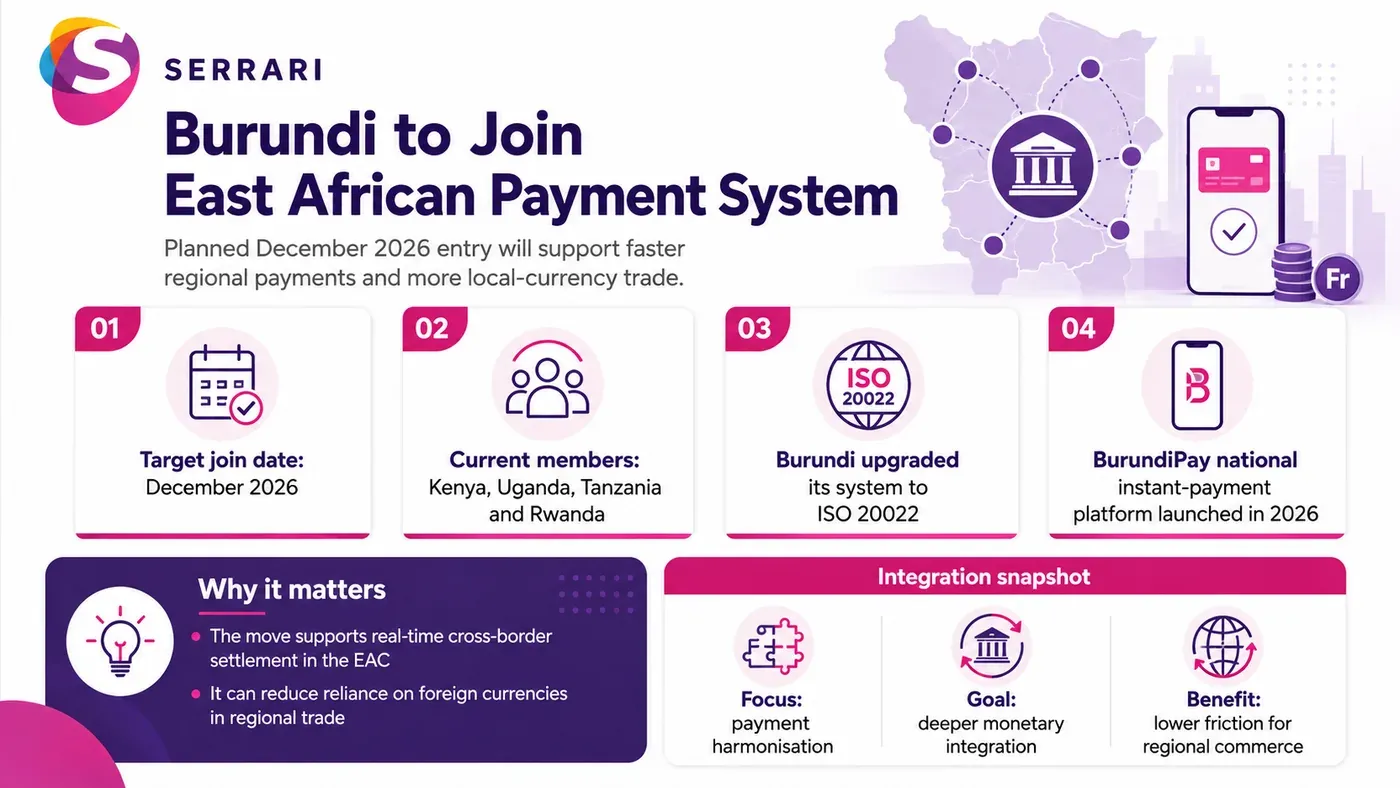
Burundi is targeting December 2026 to connect to the East African Payment System, extending a regional payment network currently linking Kenya, Uganda, Tanzania and Rwanda. The move is expected to improve cross-border settlement, support greater use of East African currencies in regional trade and advance Burundi’s integration into the East African Community’s financial architecture.
The planned connection follows major upgrades to Burundi’s domestic payment infrastructure, including its migration to the ISO 20022 standard and the introduction of its national instant-payment platform, BurundiPay. Together, these changes are designed to make the country’s financial system more interoperable with regional and international payment networks.
Key Overview
- Burundi plans to join the East African Payment System by December 2026.
- Kenya, Uganda, Tanzania and Rwanda are currently connected to the regional payment network.
- The system allows cross-border settlement using participating countries’ domestic currencies, reducing the need to route every transaction through foreign currencies.
- Burundi completed the migration of its automated transfer infrastructure to ISO 20022 in February 2026.
- The country’s BurundiPay instant-payment system was officially launched on April 23, 2026.
- Regional central banks are also implementing a broader cross-border payment plan aimed at reducing transaction costs and improving interoperability.
- The payment reforms form part of preparations for deeper monetary integration and the EAC’s longer-term objective of establishing a common currency.
Burundi Targets December Connection to EAPS
Burundi’s central bank has set December as the deadline for completing its integration into the regional payment system, according to details presented during the 29th Ordinary Meeting of the Monetary Affairs Committee in Kampala.
The East African Payment System connects the real-time gross settlement platforms operated by participating central banks. Instead of requiring businesses to settle regional transactions primarily through currencies such as the U.S. dollar, the infrastructure allows payments to be processed using participating East African currencies.
Kenya, Uganda, Tanzania and Rwanda are currently connected. Regional payment data has historically shown a particularly large role for the Kenyan shilling in transactions passing through the system, reflecting Kenya’s significant position in intra-regional trade and financial activity.
Adding Burundi would broaden the payment network while giving Burundian businesses another channel for settling transactions with counterparties elsewhere in the region.
Context is everything. Stay ahead of shifting trends with today’s market updates, and uncover emerging opportunities using the Serrari Group Market Index and Marketplace. Then, take control of your own financial future by exploring our Money & Life Reset Transformation Blueprint ™ to build stronger habits, create better systems, and design a path toward lasting wealth.
Burundi Modernises Its Domestic Payment Infrastructure
Preparation for regional integration has required significant changes within Burundi’s own financial infrastructure. In February, the central bank completed migration of its Automated Transfer System to ISO 20022, the international financial messaging standard increasingly being adopted by payment systems and financial institutions worldwide.
The upgrade is important because common messaging standards allow financial institutions and payment networks to exchange richer and more structured transaction data, improving interoperability and reducing technical barriers between systems.
Burundi also officially launched BurundiPay on April 23, 2026. The national instant-payment platform connects banks, microfinance institutions and mobile wallets, enabling users to transfer funds across different providers within the country.
These domestic reforms create much of the technical foundation Burundi requires before connecting more deeply with regional payment platforms.
Regional Integration Could Reduce Reliance on Foreign Currency
One of the central objectives behind EAPS is to increase the use of local currencies in cross-border commerce. Burundi has indicated that it intends to promote greater use of partner-state currencies as its integration progresses.
Regional trade can become more expensive when payments require conversion from one East African currency into a major international currency and then into another regional currency. Each additional conversion can introduce foreign-exchange spreads, settlement delays and liquidity requirements.
The regional cross-border payment strategy identifies currency convertibility, interoperability and fragmented payment infrastructure as important constraints on efficient regional settlement.
A more interconnected system could therefore allow businesses trading within East Africa to settle more transactions directly in regional currencies, although widespread adoption will still depend on liquidity, exchange-rate arrangements and participation by commercial banks and businesses.
Payments Become Central to Monetary Union Plans
Burundi’s planned entry also forms part of a much broader regional financial-integration agenda. At the July meeting in Kampala, central bank governors reaffirmed plans to accelerate monetary integration, including implementation of the Cross-Border Payment System Masterplan.
The regional plan aims to make payments more seamless, lower transaction costs, improve interoperability and support increased intra-EAC trade. These improvements are particularly important because monetary integration requires more than governments meeting inflation, debt and fiscal convergence targets.
Businesses and consumers also need payment infrastructure capable of moving money efficiently across borders if a more integrated financial market is to deliver practical benefits.
The EAC is currently working toward a single East African currency by 2031, although member states continue to make uneven progress toward the required macroeconomic and institutional conditions.
For Burundi, joining EAPS would therefore represent both a technology upgrade and a step toward deeper participation in the region’s evolving monetary architecture. If the December timetable is achieved, the country would move closer to a system where regional commerce can increasingly be settled through interconnected domestic financial infrastructure rather than relying heavily on external currencies and payment channels.
Sources: The EastAfrican / East African Community / Bank of the Republic of Burundi / Bank of Uganda
Your financial future isn’t something you wait for—it’s something you build.
The real question is: when do you begin?
Move beyond simply staying informed.
Navigate the markets with clarity—track trends through the Serrari Group Market Index, uncover opportunities in the Serrari Marketplace, and build practical knowledge with our Curated Wealth Builder Platform.
Stay connected to what truly matters.
Get daily insights on macro trends and financial movements across Kenya, Africa, and global markets—delivered through the Serrari Newsletter.
Growth opens doors.
Advance your career through professional programs including ACCA, HESI A2, ATI TEAS 7 , HESI EXIT , NCLEX – RN and NCLEX – PN, Financial Literacy!🌟—designed to move you forward with confidence.
See where money is flowing—clearly and in real time.
Track Money Market Funds, Treasury Bills, Treasury Bonds, Green Bonds, and Fixed Deposits, alongside global and African indexes, key economic indicators, and the evolving Crypto and stablecoin landscape—all within Serrari’s Market Index.