Three solar photovoltaic plants with a combined capacity of approximately 20 MW have been inaugurated in the Union of the Comoros, supported by AED 84.4 million in financing from the Abu Dhabi Fund for Development (ADFD). The projects include battery storage and transmission infrastructure and are expected to generate 33.75 GWh of clean electricity annually.
Key Overview
- Comoros inaugurates three solar PV plants with approximately 20 MW combined capacity.
- ADFD provided approximately AED 84.4 million in financing.
- The projects are located across Grande Comore, Anjouan and Mohéli.
- Battery storage has a combined capacity of 16 MWh.
- The facilities are expected to generate 33.75 GWh annually.
- Solar generation is expected to meet the needs of around 17,500 households.
- The projects are expected to avoid approximately 20,900 tonnes of CO₂ emissions annually.
- Imported diesel accounted for 91% of Comoros’ energy mix in 2024.
Comoros Inaugurates Three Solar PV Plants
Three solar photovoltaic (PV) plants with a combined capacity of approximately 20 MW have been inaugurated in the Union of the Comoros, supported by AED 84.4 million in financing from the Abu Dhabi Fund for Development (ADFD).
The projects are aimed at strengthening the country’s electricity infrastructure, improving energy security and reducing its reliance on imported diesel.
The solar plants were financed by ADFD, implemented by Abu Dhabi Future Energy Company PJSC – Masdar, and managed by Global South Utilities (GSU).
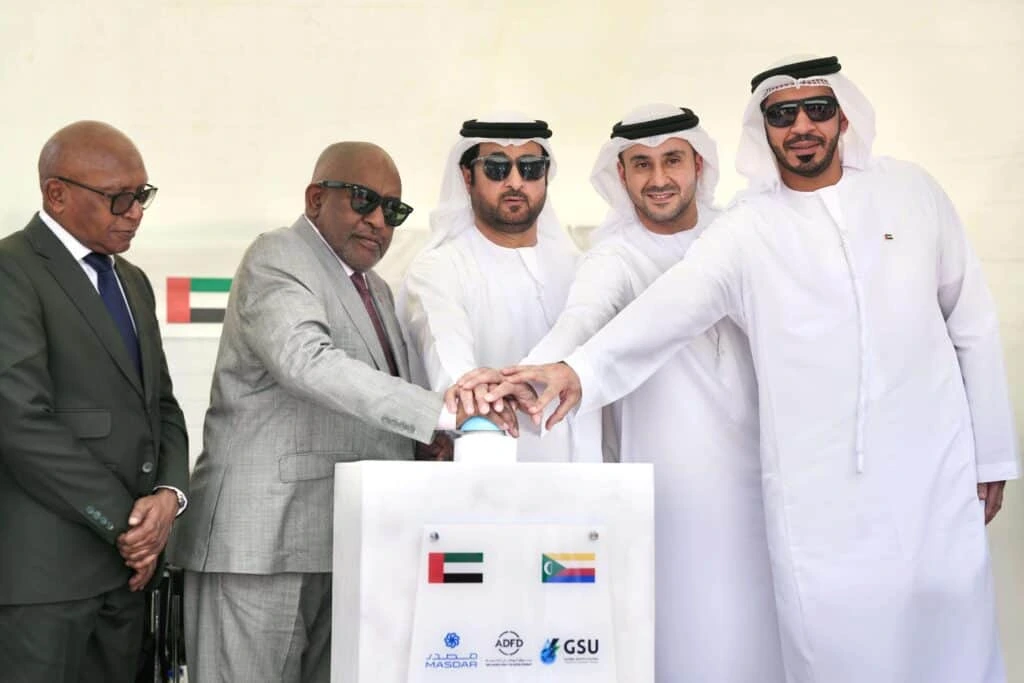
The inauguration was led by Azali Assoumani, President of the Union of the Comoros, alongside senior officials from the UAE and Comoros.
Solar Plants Across Three Main Islands
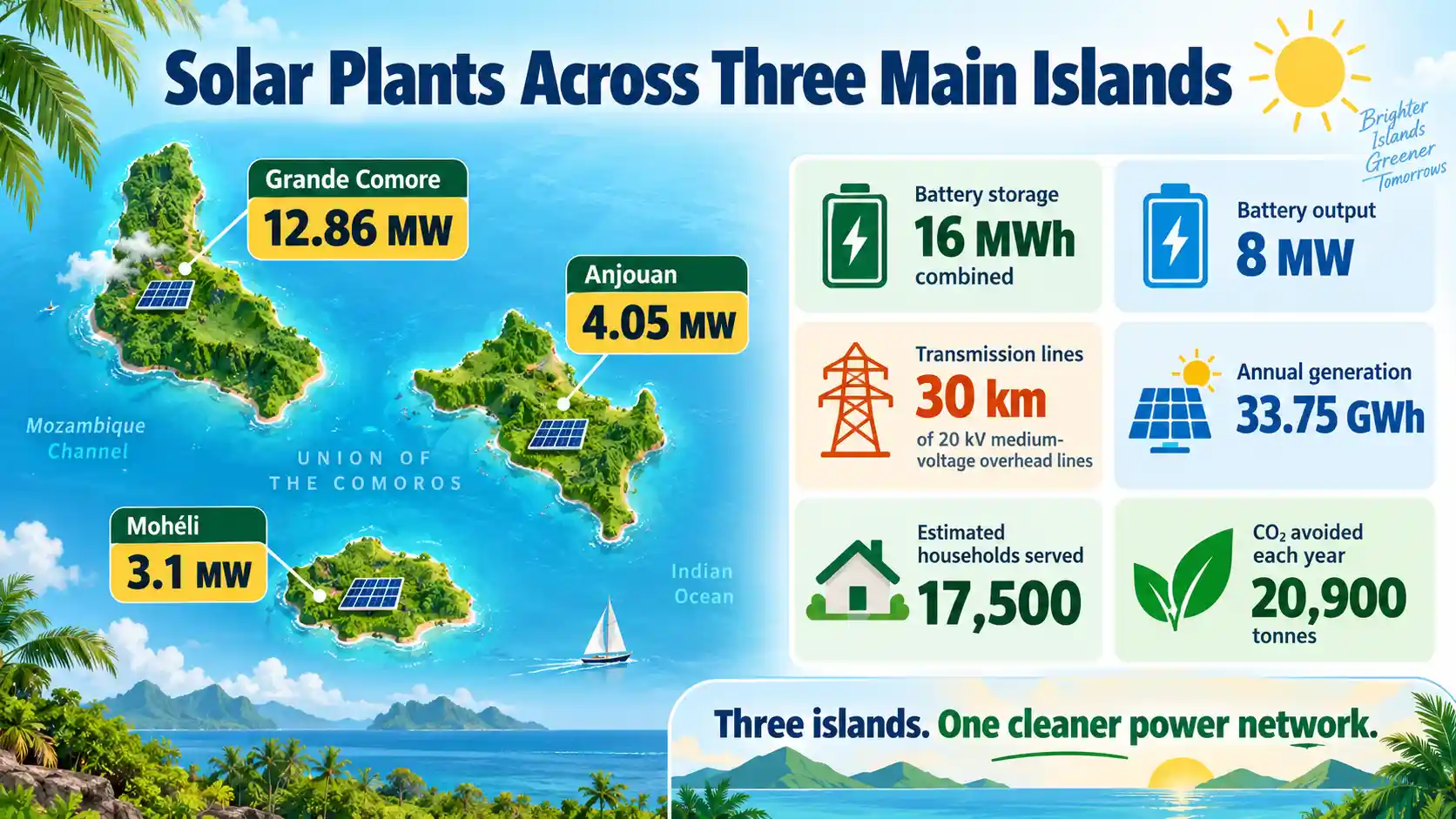
The three solar PV facilities are located across Comoros’ main islands.
The Grande Comore project has a capacity of 12.86 MW, while the Anjouan plant has a capacity of 4.05 MW and the Mohéli facility has a capacity of 3.1 MW.
The development also includes battery energy storage systems with a combined capacity of 16 megawatt-hours (MWh) and an 8 MW power output across Grande Comore and Anjouan.
Approximately 30 kilometres of 20 kV medium-voltage overhead transmission lines have also been installed to support electricity transmission and grid integration.
According to technical studies, the three plants are expected to generate approximately 33.75 GWh of clean electricity annually.
The generation is estimated to meet the electricity needs of around 17,500 households and avoid approximately 20,900 tonnes of carbon dioxide emissions each year.
Solar Projects Target Diesel Dependence
The new facilities are intended to meet rising power demand, diversify electricity sources and reduce Comoros’ reliance on imported diesel.
Imported diesel accounted for approximately 91% of the country’s energy mix in 2024.
During the same year, electricity demand reached 254 GWh, compared with actual generation of only 150 GWh. The country also experienced approximately 3,000 power outages during the year.
The new solar facilities are expected to provide electricity equivalent to 13.3% of total electricity demand and 22.5% of actual generation.
The projects are therefore intended to diversify the country’s power mix, reduce fuel dependence and improve system reliability.
Battery Storage Supports Grid Integration
The solar development incorporates 16 MWh of battery storage, with an 8 MW power output across Grande Comore and Anjouan.
The project also includes approximately 30 kilometres of 20 kV medium-voltage overhead transmission lines developed to support electricity transmission and grid integration.
The combination of solar generation, battery storage and transmission infrastructure is intended to strengthen Comoros’ electricity infrastructure while expanding access to clean and reliable power.
Context is everything. Stay ahead of shifting trends with today’s market updates, and uncover emerging opportunities using the Serrari Group Market Index and Marketplace. Then, take control of your own financial future by exploring our Money & Life Reset Transformation Blueprint ™ to build stronger habits, create better systems, and design a path toward lasting wealth.
UAE Supports Comoros Energy Development
President Azali Assoumani expressed appreciation for the UAE’s continued support for Comoros’ development priorities and bilateral partnership.
“This strategic project translates our partnership into action, strengthening our energy infrastructure, expanding access to clean and reliable electricity, and supporting greater economic resilience, sustainable growth and improved livelihoods for our people,” said Assoumani.
Jumaa Alromaithi, Ambassador of the UAE to the Union of the Comoros, said the project reflects the UAE’s commitment to sustainable development partnerships.
“By strengthening the Comoros’ energy infrastructure and expanding access to reliable solar power, the project supports greater energy resilience while laying stronger foundations for economic and social development.”
Alromaithi also said the project demonstrates how innovative renewable energy and storage solutions can help address the country’s energy needs and support its long-term development priorities.
ADFD Highlights Energy Security
Mohammed Al Suwaidi, Director General of ADFD, said the project would help reduce Comoros’ exposure to imported fuel costs and volatility while improving electricity reliability.
He also said the development would support local capabilities, employment and economic resilience.
The project is financed by ADFD at approximately AED 84.4 million, with Masdar responsible for implementation and GSU managing the facilities.
Masdar Delivers Solar and Storage Project
Mohamed Al Ramahi, CEO of Masdar, said the company was proud to work with its partners to deliver clean energy to the people of the Union of the Comoros.
“Renewables provide the clearest route to energy security and economic resilience, and this project will not only meet the nation’s needs today but also support its long-term development ambitions.”
Al Ramahi added that leveraging solar power and advanced storage technologies would help accelerate sustainable socioeconomic growth across the country while providing benefits to businesses and local communities.
The project comes as Comoros continues to face significant challenges in its electricity sector, including high dependence on imported diesel, insufficient generation compared with demand and frequent power outages.
According to figures published by the Africa Solar Industry Association (AFSIA) in its online project database, there is an additional 46.9 MW of operational solar in Comoros.
Outlook
The three solar PV plants add approximately 20 MW of installed capacity across Grande Comore, Anjouan and Mohéli, alongside 16 MWh of battery storage and approximately 30 kilometres of transmission lines. Technical studies indicate annual clean electricity generation of 33.75 GWh, equivalent to the needs of around 17,500 households.
With imported diesel accounting for 91% of Comoros’ energy mix in 2024, the projects are expected to support greater diversification of electricity sources. Their expected generation is equivalent to 13.3% of total electricity demand and 22.5% of actual generation, while avoiding approximately 20,900 tonnes of CO₂ emissions annually.
FAQs
1. How much solar capacity do the three Comoros plants have?
The three solar PV plants have a combined installed capacity of approximately 20 MW, comprising 12.86 MW on Grande Comore, 4.05 MW on Anjouan and 3.1 MW on Mohéli.
2. How much did ADFD finance the Comoros solar projects?
The Abu Dhabi Fund for Development (ADFD) provided approximately AED 84.4 million in financing for the projects.
3. How much electricity will the solar plants generate?
The three facilities are expected to generate approximately 33.75 GWh of clean electricity annually, enough to meet the electricity needs of around 17,500 households.
4. How will the solar projects improve Comoros’ energy sector?
The projects are expected to diversify electricity sources, reduce reliance on imported diesel, improve system reliability and avoid approximately 20,900 tonnes of CO₂ emissions annually.
Sources: SolarQuarter, Renewables Now, Zawya, reNEWS, Green Building Africa, pv magazine
Your financial future isn’t something you wait for—it’s something you build.
The real question is: when do you begin?
Move beyond simply staying informed.
Navigate the markets with clarity—track trends through the Serrari Group Market Index, uncover opportunities in the Serrari Marketplace, and build practical knowledge with our Curated Wealth Builder Platform.
Stay connected to what truly matters.
Get daily insights on macro trends and financial movements across Kenya, Africa, and global markets—delivered through the Serrari Newsletter.
Growth opens doors.
Advance your career through professional programs including ACCA, HESI A2, ATI TEAS 7 , HESI EXIT , NCLEX – RN and NCLEX – PN, Financial Literacy!🌟—designed to move you forward with confidence.
See where money is flowing—clearly and in real time.
Track Money Market Funds, Treasury Bills, Treasury Bonds, Green Bonds, and Fixed Deposits, alongside global and African indexes, key economic indicators, and the evolving Crypto and stablecoin landscape—all within Serrari’s Market Index.