DTB Group profit before tax increased 37% to KSh9.84 billion in the first half of 2026, supported by lower funding costs, stronger loan growth and improved operating efficiency. Diamond Trust Bank (DTB) recorded a 26.4% increase in net interest income to KSh20.04 billion as interest expenses declined despite higher interest income. The East African banking group also expanded its customer base, deposits and loan portfolio while improving its cost-to-income and non-performing loan ratios.
LIVENSE market summarySee NSE data →Key Overview
DTB Group’s gross operating income increased 20.9% to KSh26.51 billion, while operating expenses rose by a much slower 5.9% to KSh12.24 billion. This pushed operating profit before provisions up 36.8% to KSh14.27 billion. Profit attributable to shareholders increased 34.1% to KSh6.39 billion, while total assets expanded 10.4% to KSh675.09 billion.
DTB Group Profit Reaches KSh9.84 Billion
Diamond Trust Bank Group delivered stronger financial performance during the first six months of 2026, with pre-tax profit climbing 37% year-on-year to KSh9.84 billion.
The improvement came as revenue expanded substantially faster than operating costs.
Gross operating income increased 20.9% to KSh26.51 billion, compared with a 5.9% rise in operating expenses to KSh12.24 billion.
As a result, operating profit before provisions climbed 36.8% to KSh14.27 billion.
The difference between revenue and expense growth also pushed DTB’s cost-to-income ratio down to 46.0% from 52.4% a year earlier, indicating improved operating efficiency.
Lower Funding Costs Boost Net Interest Income
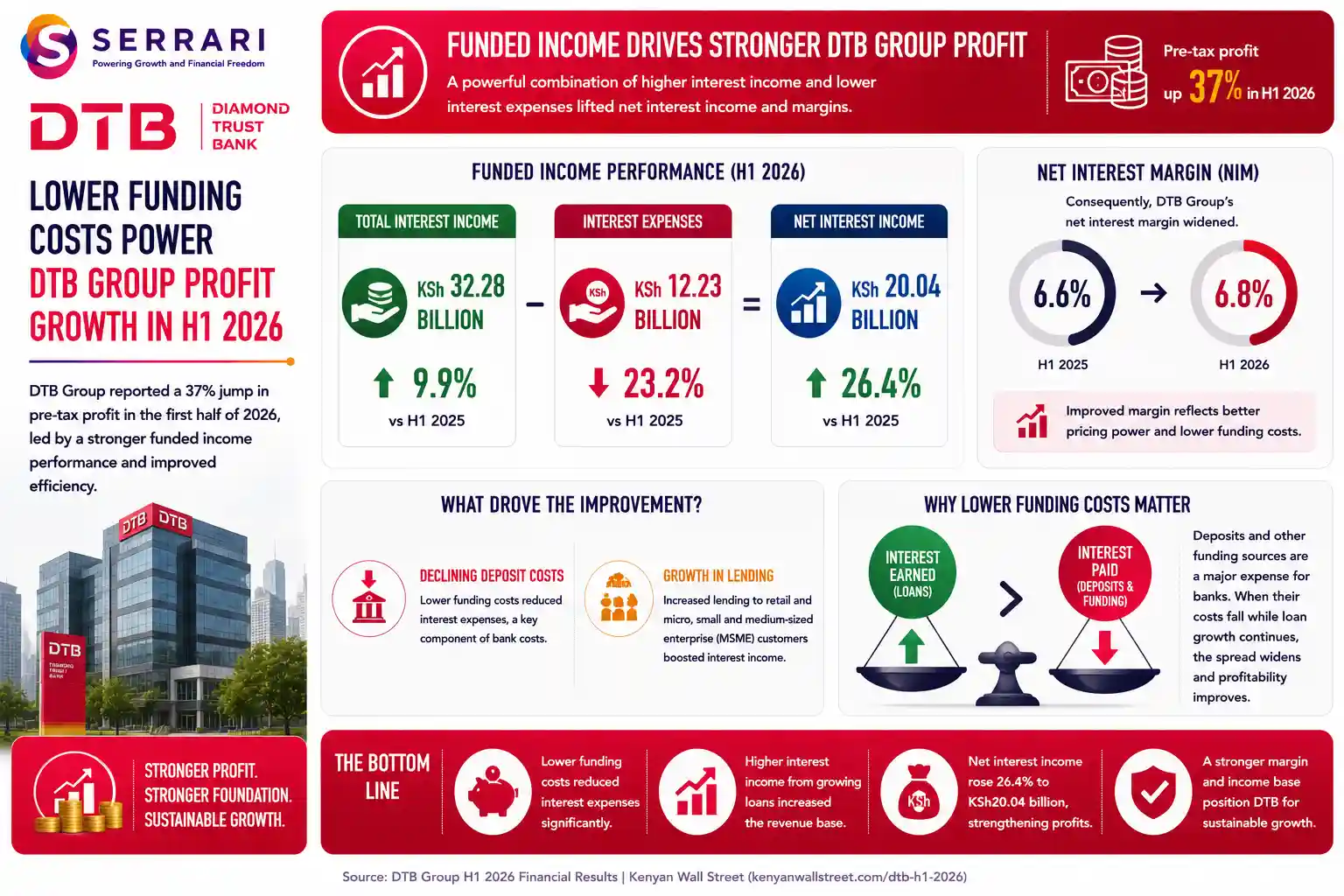
Funded income was the main driver of the stronger DTB Group profit.
Total interest income increased 9.9% to KSh32.28 billion, while interest expenses dropped 23.2% to KSh12.23 billion.
That combination pushed net interest income up 26.4% to KSh20.04 billion.
DTB attributed the improvement partly to declining deposit costs and growth in lending to retail and micro, small and medium-sized enterprise customers.
Net interest margin consequently widened to 6.8% from 6.6%.
Lower funding costs are particularly significant for banks because deposits and other sources of funding represent a major expense. When those costs decline while lending volumes continue growing, the spread between interest earned and interest paid can improve profitability.
Non-Interest Income Grows at Slower Pace
Non-interest income increased 6.6% to KSh6.47 billion during the period.
Growth was weaker than funded income due partly to narrower foreign-exchange margins and slower trade-related business.
The figures therefore show that DTB’s first-half earnings expansion was driven primarily by its core lending and deposit operations rather than fees, foreign exchange and other non-funded revenue streams.
Context is everything. Stay ahead of shifting trends with today’s market updates, and uncover emerging opportunities using the Serrari Group Market Index and Marketplace. Then, take control of your own financial future by exploring our Money & Life Reset Transformation Blueprint ™ to build stronger habits, create better systems, and design a path toward lasting wealth.
DTB Loans and Deposits Expand
The banking sector group also recorded significant balance-sheet growth.
Total assets increased 10.4% to KSh675.09 billion, while customer deposits grew 10.6% to KSh534.15 billion.
Net loans expanded faster, increasing 13.7% to KSh327.99 billion. Gross loans climbed approximately 15% to KSh357.6 billion.
Local-currency lending represented 62% of the loan portfolio, up from 59% a year earlier.
Because lending grew faster than deposits, DTB’s loan-to-deposit ratio increased to 61.4% from 59.3%.
The bank is targeting smaller and potentially more stable customer deposits as it continues expanding its lending operations. Local-currency deposits increased to 69% of the total from 67%.
Loan Provisions Increase Despite Better Asset Quality
One counterweight to the stronger earnings was a significant increase in credit provisions.
Loan-loss provisions rose 36.5% to KSh4.43 billion, while the cost of risk increased to 2.7% from 2.3%.
However, some underlying asset-quality indicators improved.
DTB’s non-performing loan ratio declined to 11.6% from 13.0%, while specific provision coverage increased substantially to 56.6% from 40.7%.
LIVENSE market summarySee NSE data →Stage 3 loans remained around KSh41 billion, compared with approximately KSh40 billion a year earlier.
The figures suggest that the improving NPL ratio partly reflects expansion of the overall loan portfolio rather than a dramatic reduction in the absolute stock of problematic loans. That distinction is important when assessing the quality of the bank’s earnings.
Digital Customers Drive DTB Expansion
Digital banking continues to play a major role in DTB’s growth strategy.
The Group’s customer base increased 44% to approximately 5.9 million, of whom around five million were digital customers.
DTB said 99% of new customers were acquired through digital platforms, while 86% of customer transactions were conducted outside traditional branches.
The bank also extended approximately KSh10 billion in digital loans during the six-month period, primarily targeting retail and MSME customers.
These figures illustrate how digital channels are becoming increasingly important to East African banking, allowing lenders to grow their customer bases without relying exclusively on physical branch expansion.
DTB Plans Major Branch Expansion
Digital growth does not mean DTB is abandoning physical banking.
The lender plans to increase its Kenyan branch network to 100 branches and expand to 163 branches across East Africa by December.
Its growth strategy includes increasing lending to retail, business banking and mid-corporate customers.
DTB is also targeting opportunities across agriculture, education and public-sector ecosystems.
Combining branch expansion with digital acquisition could broaden the bank’s reach, although rapid loan growth will make credit-quality management increasingly important.
DTB Earnings Show Stronger Operating Efficiency
DTB’s first-half performance demonstrates the benefit of combining revenue growth with disciplined operating expenses.
Pre-tax profit expanded 37%, while shareholder earnings increased 34.1% to KSh6.39 billion. At the same time, the cost-to-income ratio improved by more than six percentage points.
The strongest contributor was the 26.4% increase in net interest income, supported by lower funding expenses and a growing loan book.
However, the 36.5% rise in loan-loss provisions and higher cost of risk remain important indicators to monitor.
For DTB, sustaining profitability will depend on maintaining lower funding costs, expanding lending without compromising asset quality and converting its rapidly growing digital customer base into profitable long-term banking relationships.
FAQs
How much was DTB Group’s profit in the first half of 2026?
DTB Group recorded pre-tax profit of KSh9.84 billion in the first half of 2026, representing approximately 37% growth from the comparable period a year earlier. Profit attributable to shareholders increased 34.1% to KSh6.39 billion.
What drove the increase in DTB Group profit?
The main driver was stronger net interest income, which increased 26.4% to KSh20.04 billion. Interest income rose while interest expenses fell 23.2%, reflecting lower deposit and funding costs alongside continued growth in the bank’s lending portfolio.
How did DTB’s loan portfolio perform?
DTB’s net loans increased 13.7% to KSh327.99 billion, while gross loans rose approximately 15% to KSh357.6 billion. The non-performing loan ratio improved to 11.6% from 13.0%, although loan-loss provisions increased 36.5% to KSh4.43 billion.
How is digital banking contributing to DTB’s growth?
DTB’s customer base increased 44% to approximately 5.9 million, including around five million digital customers. The bank said 99% of new customers were acquired digitally and 86% of transactions occurred outside branches, demonstrating the growing importance of digital channels to its expansion strategy.
Sources: Kenyan Wallstreet, KBC, Tech Trends, DTB
Your financial future isn’t something you wait for—it’s something you build.
The real question is: when do you begin?
Move beyond simply staying informed.
Navigate the markets with clarity—track trends through the Serrari Group Market Index, uncover opportunities in the Serrari Marketplace, and build practical knowledge with our Curated Wealth Builder Platform.
Stay connected to what truly matters.
Get daily insights on macro trends and financial movements across Kenya, Africa, and global markets—delivered through the Serrari Newsletter.
Growth opens doors.
Advance your career through professional programs including ACCA, HESI A2, ATI TEAS 7 , HESI EXIT , NCLEX – RN and NCLEX – PN, Financial Literacy!🌟—designed to move you forward with confidence.
See where money is flowing—clearly and in real time.
Track Money Market Funds, Treasury Bills, Treasury Bonds, Green Bonds, and Fixed Deposits, alongside global and African indexes, key economic indicators, and the evolving Crypto and stablecoin landscape—all within Serrari’s Market Index.