
Institutional crypto custody could become materially clearer if the SEC follows through with its planned overhaul of rules governing how investment advisers and regulated funds safeguard digital assets. The proposal entered OIRA review on August 25 and is currently expected to reach the Notice of Proposed Rulemaking stage in October 2026. Existing adviser rules generally require client funds and securities to be maintained with qualified custodians such as banks and registered broker-dealers, while separate SEC staff relief issued in 2025 allowed certain state trust companies to custody crypto assets for registered advisers and regulated funds under specified conditions. A new rule could determine whether that interim approach expands, contracts or changes entirely. For investors, the biggest consequences may fall on custodians, advisers and funds through compliance costs, competitive access and the operational infrastructure required to hold digital assets safely.
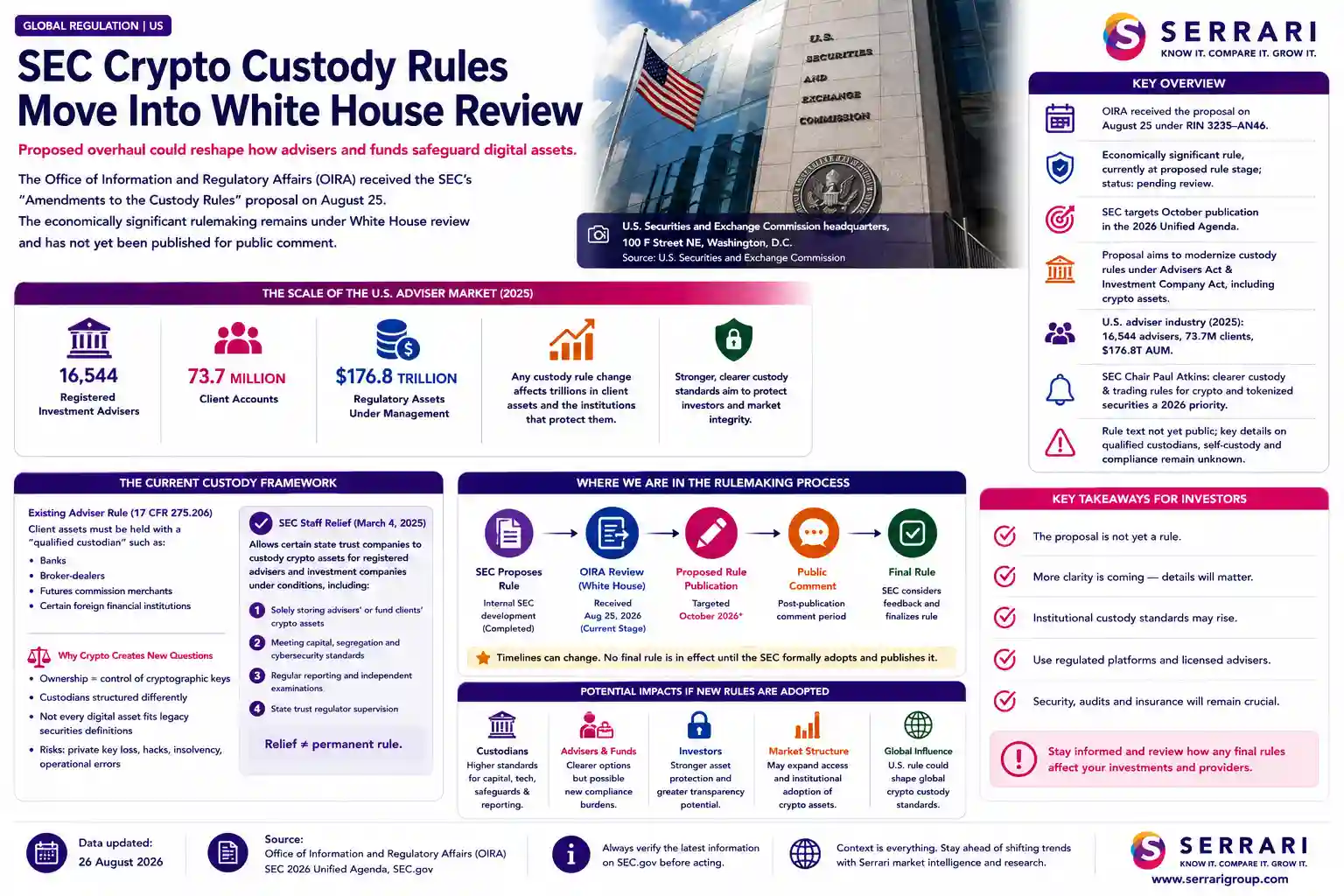
Key Overview
- OIRA received proposal August 25 under RIN 3235-AN46, titled Amendments to the Custody Rules.
- The rule is classified as economically significant, remains at the proposed rule stage, and is currently under pending review.
- SEC targets October proposed rule in the current Unified Agenda, although that timetable can change.
- The SEC says the proposal is intended to modernise custody rules under both the Investment Advisers Act and Investment Company Act, including specifically addressing crypto assets.
- The U.S. registered-adviser industry included 16,544 advisers, 73.7 million clients and $176.8 trillion of regulatory assets under management in 2025.
- SEC Chair Paul Atkins has identified clearer custody and trading rules for crypto assets and tokenized securities as part of the Commission’s 2026 regulatory agenda.
- The actual proposed rule text is not yet public, so it is premature to say which institutions will qualify, whether self-custody will receive any accommodation, or what exact compliance requirements will apply.
Crypto Custody Has Reached White House Review
The regulatory process has moved beyond the SEC’s internal agenda.
OIRA received proposal August 25, and its official record identifies the action as economically significant and at the proposed-rule stage. The status remains pending review.
That is an important procedural milestone, but not an approval.
OIRA review allows the Office of Management and Budget’s regulatory arm to examine significant agency proposals before publication. The SEC can still revise the proposal, and review timing can change.
More importantly, investors still cannot read the actual rule text.
The current regulatory agenda provides the objective rather than the mechanics. The SEC says crypto questions persist among advisers and investment companies trying to determine how digital assets can be held consistently with existing custody requirements.
The agency says the rulemaking is intended both to clarify crypto custody and remove burdens associated with outdated provisions where market practices have evolved.
The Existing Rule Was Built Before Crypto
The fundamental custody principle is straightforward: client assets should not simply sit under an adviser’s uncontrolled possession.
Under the existing investment-adviser framework, qualified custodians include banks dealers, futures commission merchants and certain foreign financial institutions. Assets generally must be maintained in accounts designed to separate and identify client property.
Those protections were designed primarily around conventional funds and securities.
Crypto creates additional questions because ownership is represented by control of cryptographic keys, custody providers can be structured differently from traditional banks or brokers, and not every digital asset fits neatly into older securities-market infrastructure.
The potential modernisation therefore sits at the intersection of technology and investor protection.
The SEC Already Tried Once
This is not the Commission’s first attempt to rewrite adviser custody requirements.
In 2023, the SEC proposed a broader Safeguarding Advisory Client Assets rule that would have expanded the existing custody regime beyond funds and securities to cover essentially all advisory client assets, including crypto.
But SEC withdrew prior safeguarding proposal in June 2025 and explicitly said it did not intend to issue a final rule from that proposal. Any future action would require a fresh proposal.
That history matters.
The 2026 rulemaking is therefore not simply the old safeguarding proposal moving forward again. It is a new regulatory process under different SEC leadership.
Atkins has signalled a different policy direction, saying the Commission wants clearer rules that bring more crypto activity onshore while retaining investor-protection safeguards.
In July, Atkins prioritises tokenized securities custody alongside clearer rules for crypto capital raising and onchain trading.
Context is everything. Stay ahead of shifting trends with today’s market updates, and uncover emerging opportunities using the Serrari Group Market Index and Marketplace. Then, take control of your own financial future by exploring our Money & Life Reset Transformation Blueprint ™ to build stronger habits, create better systems, and design a path toward lasting wealth.
State Trust Companies Already Have Interim Relief
The regulatory baseline is also no longer completely binary.
In September 2025, SEC staff issued no-action relief concerning certain state-chartered trust companies.
Under that relief, registered advisers and regulated funds can treat qualifying state trust companies as permitted institutions for custody of crypto assets and related cash or cash equivalents under specified conditions.
The state trust relief arrived 2025 after advisers and funds raised uncertainty over whether such institutions qualified under existing custody provisions.
That relief is important, but it is not the same as a Commission rule.
A no-action position generally indicates that staff will not recommend enforcement action under defined circumstances. A formal custody rule could provide a more durable and comprehensive framework—or impose different requirements altogether.
That makes specialist trust companies and digital-asset custodians some of the businesses most exposed to the eventual proposal.
The Addressable Adviser Market Is Enormous
The scale of the regulated adviser sector explains why the rule is classified as economically significant.
The latest Investment Adviser Association and Comply snapshot says advisers manage $176.8 trillion assets, up 22.3% during 2025.
The industry serves 73.7 million clients across 16,544 SEC-registered advisers, with non-clerical employment reaching 1.1 million.
Almost none of that $176.8 trillion should be interpreted as potential crypto custody assets automatically.
The figure is useful because it shows the institutional ecosystem into which crypto custody is trying to integrate.
Even modest digital-asset allocations across advisers, private funds, registered investment companies and tokenized securities could create meaningful demand for regulated custody infrastructure.
Custodians Could Face Opportunity and Cost
A modernised framework could create winners and losers.
Banks and broker-dealers may benefit if rules reinforce traditional qualified-custodian structures. State trust companies could gain if the Commission formalises or expands the approach reflected in the 2025 no-action relief.
Specialist crypto custodians could gain access to a larger institutional market if they satisfy whatever standards emerge.
But compliance may become expensive.
Potential requirements around asset segregation, private-key controls, audits, recordkeeping, loss protections, internal controls and adviser oversight could increase operating costs even while regulatory clarity expands the market.
The exact trade-off cannot yet be calculated because the proposal itself is not public.
Investor Protection Remains the Other Side
Custody regulation is not simply a barrier to crypto adoption.
Its core purpose is to protect client property from theft, misuse, loss and insolvency risk.
The existing SEC framework requires advisers with custody to satisfy safeguards including qualified-custodian arrangements, direct client statements and, in certain circumstances, independent examinations.
That protection becomes particularly important for digital assets because compromised keys or operational failures can make losses difficult to reverse.
The policy challenge is therefore to modernise old rules without weakening the separation, verification and accountability that custody regulation is meant to provide.
What Investors Should Watch Next
The first milestone is publication of the proposal itself.
The Unified Agenda currently anticipates an NPRM in October, but rule remains at proposed stage and the timetable is not legally binding.
Once the text appears, investors should focus on several questions: which entities qualify as custodians; whether state trust companies receive formal recognition; how tokenized securities are treated; what standards apply to control of private keys; and what audit, segregation and recordkeeping obligations fall on advisers and custodians.
Until then, claims that the SEC has already relaxed or tightened crypto custody rules go beyond the available evidence.
Conclusion
The SEC’s custody overhaul has reached an important regulatory checkpoint, but the investment implications remain unresolved.
OIRA received the economically significant proposal on August 25, and the SEC currently anticipates publication of a proposed rule in October.
The eventual text could determine which institutions compete for regulated crypto custody, how advisers and funds build digital-asset offerings, and how much compliance infrastructure that business requires.
For investors, this is therefore not primarily a crypto-price catalyst.
It is a contest over who gets to become the trusted vault for institutional digital assets.
FAQs
What happened to the SEC crypto custody rules on August 25?
OIRA received SEC rulemaking RIN 3235-AN46, Amendments to the Custody Rules, on August 25, 2026. The official regulatory record lists the action as an economically significant proposed rule currently under pending review. This means the proposal is undergoing Executive Order regulatory review; it does not mean OIRA or the White House has approved the substance of the rule.
What is the SEC trying to change?
The SEC’s Unified Agenda says the Division of Investment Management is considering changes under both the Investment Advisers Act and Investment Company Act to modernise custody requirements for adviser client and fund assets, including crypto. The agency says advisers and investment companies have raised questions about complying with current requirements when holding digital assets and that some outdated provisions may also need modernisation.
Who currently qualifies as a custodian for investment advisers?
The existing adviser custody rule generally recognises qualified custodians including banks, registered broker-dealers, futures commission merchants and certain foreign financial institutions. SEC staff also issued no-action relief in September 2025 allowing registered advisers and regulated funds, under specified circumstances, to maintain crypto assets with certain state trust companies. That staff relief is not equivalent to a permanent Commission rule.
Will the new SEC rule allow self-custody of crypto?
That is not yet known. The actual 2026 proposed-rule text has not been publicly released. Although outside parties have submitted models suggesting alternative safeguarding arrangements, those proposals should not be confused with the SEC’s position. Until the Commission publishes its text, Serrari should not state whether adviser self-custody, non-qualified-custodian arrangements or any particular technical custody model will be permitted.
Why does this matter to ordinary investors?
Custody rules determine how advisers and investment funds safeguard client assets and which institutions may hold them. Better-defined rules could expand regulated access to crypto and tokenized assets, but custody safeguards also protect investors from theft, misappropriation and custodian failure. With 16,544 SEC-registered advisers serving 73.7 million clients, even limited crypto adoption within the adviser sector could make the final framework financially significant.
Sources: Office of Information and Regulatory Affairs, Reginfo.gov — SEC 2026 Unified Agenda, SEC, Investment Adviser Association, Comply, SEC Commissioner Hester Peirce — Crypto Custody Statement
Your financial future isn’t something you wait for—it’s something you build.
The real question is: when do you begin?
Move beyond simply staying informed.
Navigate the markets with clarity—track trends through the Serrari Group Market Index, uncover opportunities in the Serrari Marketplace, and build practical knowledge with our Curated Wealth Builder Platform.
Stay connected to what truly matters.
Get daily insights on macro trends and financial movements across Kenya, Africa, and global markets—delivered through the Serrari Newsletter.
Growth opens doors.
Advance your career through professional programs including ACCA, HESI A2, ATI TEAS 7 , HESI EXIT , NCLEX – RN and NCLEX – PN, Financial Literacy!🌟—designed to move you forward with confidence.
See where money is flowing—clearly and in real time.
Track Money Market Funds, Treasury Bills, Treasury Bonds, Green Bonds, and Fixed Deposits, alongside global and African indexes, key economic indicators, and the evolving Crypto and stablecoin landscape—all within Serrari’s Market Index.