
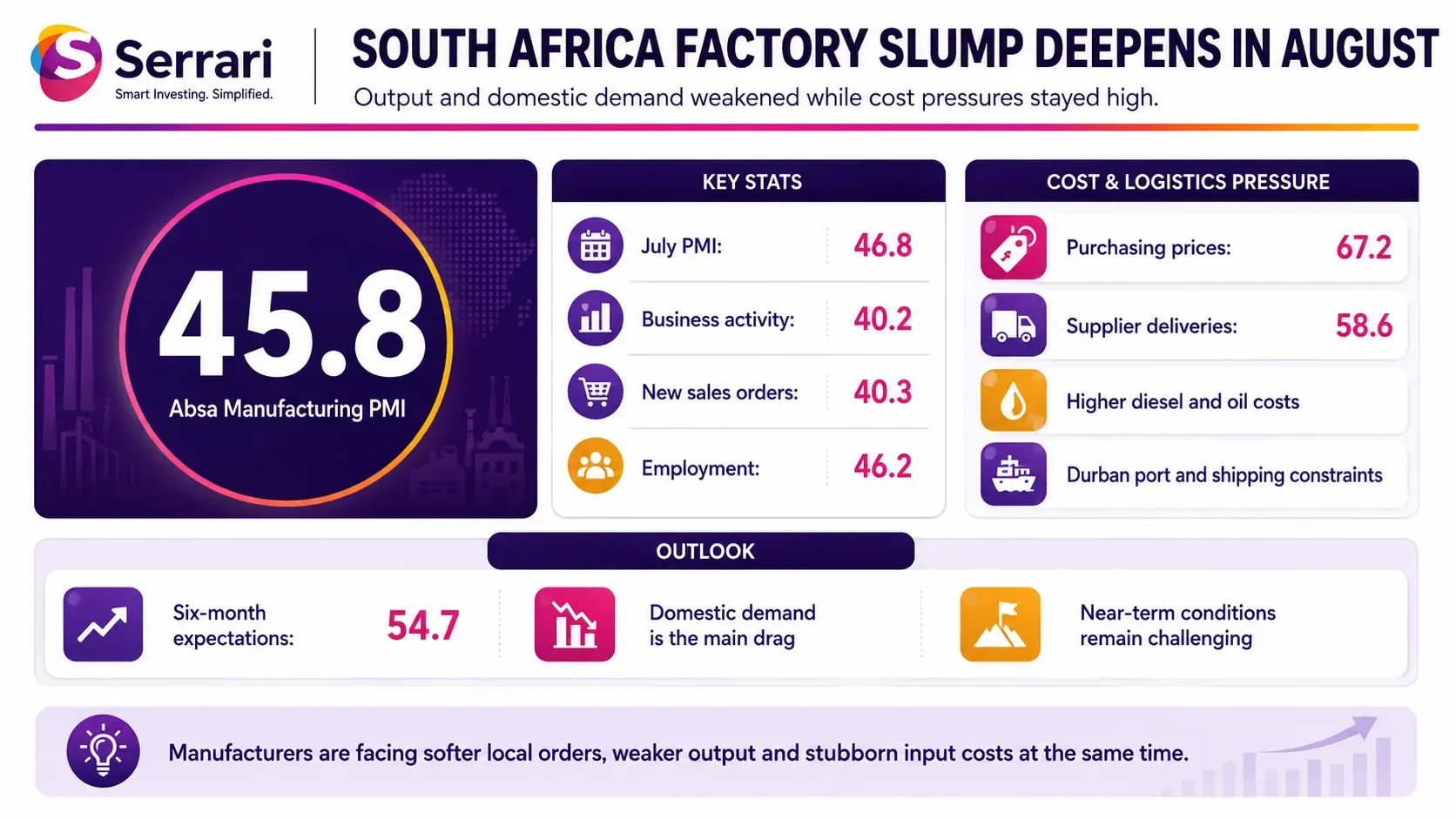
South Africa’s manufacturing sector weakened further in August, with the Absa Purchasing Managers’ Index falling to 45.8 from 46.8 in July, its fourth consecutive monthly decline and lowest reading of 2026. The latest manufacturing survey showed particularly sharp deterioration in factory output and new orders, indicating that manufacturers entered the latter part of the third quarter with considerably less momentum.
Domestic demand emerged as the main source of weakness. Although export sales improved slightly, subdued consumer demand, weak confidence and soft spending on non-essential products continued to suppress local orders. At the same time, manufacturers faced elevated fuel, freight and logistics expenses, creating a difficult combination of declining demand and persistent cost pressure.
Key Overview
- Absa Manufacturing PMI: 45.8, down from 46.8
- Business activity index: 40.2, down from 48.8
- New sales orders: 40.3, down from 44.1
- Employment index: 46.2, up from 42.2
- Purchasing price index: 67.2, unchanged from July
- Supplier deliveries: 58.6, up from 55.5
- Six-month business expectations: 54.7, up from 49.3
- Main demand weakness: Domestic consumers and businesses
Factory Output Suffers a Sharp August Drop
The biggest deterioration came from actual factory activity. The business activity sub-index plunged 8.6 points to 40.2 from 48.8, reaching its lowest level this year and signalling a substantial decline in manufacturing output.
The headline PMI has now been below the neutral 50-point threshold for three consecutive months. A reading below 50 indicates worsening manufacturing conditions, while a reading above 50 signals improvement.
The detailed August PMI breakdown also showed manufacturers continuing to reduce inventories, with the stock index broadly unchanged at 43.6 as companies responded to weaker orders by limiting the amount of goods and materials held.
This suggests manufacturers are prioritising cash preservation and avoiding excessive stock accumulation until there is clearer evidence of a recovery in demand.
Domestic Demand Becomes the Main Weak Point
New sales orders fell to 40.3 from 44.1, reversing the improvement recorded during July.
Export orders remained weak but improved modestly during August, indicating that the renewed deterioration was largely concentrated in South Africa’s domestic economy rather than being driven entirely by overseas markets.
Survey respondents highlighted weak consumer confidence and particularly subdued spending on non-essential products. This matters because discretionary goods are among the first areas where households typically cut expenditure when budgets are squeezed.
Manufacturers selling into consumer-facing industries may therefore face continued pressure on volumes until household purchasing power and confidence recover.
Factory employment also remained under strain. The employment sub-index improved to 46.2 from 42.2, suggesting that job losses slowed compared with July, but its continued position below 50 indicates manufacturers were still reducing overall employment.
Context is everything. Stay ahead of shifting trends with today’s market updates, and uncover emerging opportunities using the Serrari Group Market Index and Marketplace. Then, take control of your own financial future by exploring our Money & Life Reset Transformation Blueprint ™ to build stronger habits, create better systems, and design a path toward lasting wealth.
Fuel and Freight Costs Keep Input Pressures High
Manufacturers are simultaneously dealing with stubbornly high operating costs. The purchasing price index remained at 67.2 in August, showing that input inflation stayed elevated even after easing substantially from its May peak of 84.8.
Higher diesel and international oil prices pushed costs upward, while a stronger rand provided some relief by reducing the local-currency cost of imported inputs. Businesses also reported higher freight and delivery expenses.
These pressures create a difficult margin environment. When consumer demand is weak, manufacturers may struggle to pass higher costs on through price increases without further reducing sales volumes.
The situation could remain challenging in September, particularly as manufacturers anticipate another increase in diesel costs.
Durban Logistics Disruptions Add Supply-Chain Pressure
Factory supply chains also showed signs of renewed strain. The supplier deliveries index rose to 58.6 from 55.5, reflecting longer delivery times rather than stronger demand.
Manufacturers reported container shortages, limited shipping capacity and renewed congestion at Durban harbour. These disruptions can increase freight costs, delay production schedules and force businesses to carry additional buffer inventory where critical materials cannot be sourced reliably.
This distinction is important because slower supplier deliveries sometimes support the headline PMI during periods of strong demand. In August, however, the longer delivery times appeared to reflect logistical constraints instead.
Manufacturers Still Expect Conditions to Improve
Despite the weakness in current conditions, sentiment about the next six months improved significantly.
The index measuring expected business conditions rose to 54.7 from 49.3, returning above the neutral 50 level and suggesting manufacturers expect the downturn to ease.
That optimism provides a notable contrast with the deterioration in present output and orders. It suggests businesses may view some of the current pressures as temporary rather than the beginning of a prolonged manufacturing contraction.
The near-term picture nevertheless remains difficult. South African factories are facing weaker domestic orders, falling production, declining employment and elevated input costs simultaneously. A meaningful recovery will likely require stronger household and business demand alongside fewer logistics disruptions and some relief from energy and transport expenses.
Until those conditions improve, the manufacturing sector is likely to remain one of the softer areas of South Africa’s economy even as businesses become cautiously more optimistic about the months ahead.
Sources: Reuters / Polity / Briefs
Your financial future isn’t something you wait for—it’s something you build.
The real question is: when do you begin?
Move beyond simply staying informed.
Navigate the markets with clarity—track trends through the Serrari Group Market Index, uncover opportunities in the Serrari Marketplace, and build practical knowledge with our Curated Wealth Builder Platform.
Stay connected to what truly matters.
Get daily insights on macro trends and financial movements across Kenya, Africa, and global markets—delivered through the Serrari Newsletter.
Growth opens doors.
Advance your career through professional programs including ACCA, HESI A2, ATI TEAS 7 , HESI EXIT , NCLEX – RN and NCLEX – PN, Financial Literacy!🌟—designed to move you forward with confidence.
See where money is flowing—clearly and in real time.
Track Money Market Funds, Treasury Bills, Treasury Bonds, Green Bonds, and Fixed Deposits, alongside global and African indexes, key economic indicators, and the evolving Crypto and stablecoin landscape—all within Serrari’s Market Index.