Asia’s manufacturing sector strengthened in August as global demand for semiconductors, computers and other artificial intelligence-related hardware supported factories across several major export economies. Manufacturing surveys across the region showed expansion in China, Japan and South Korea, alongside growth in Taiwan, Malaysia and the Philippines.
The improvement underscores how investment in AI infrastructure is spreading beyond software companies and chip designers into manufacturing supply chains. However, the regional recovery remains uneven. China’s official factory gauge continued to signal contraction, Indonesia slipped below the expansion threshold and India’s manufacturing growth slowed to its weakest pace in five years.
Key Overview
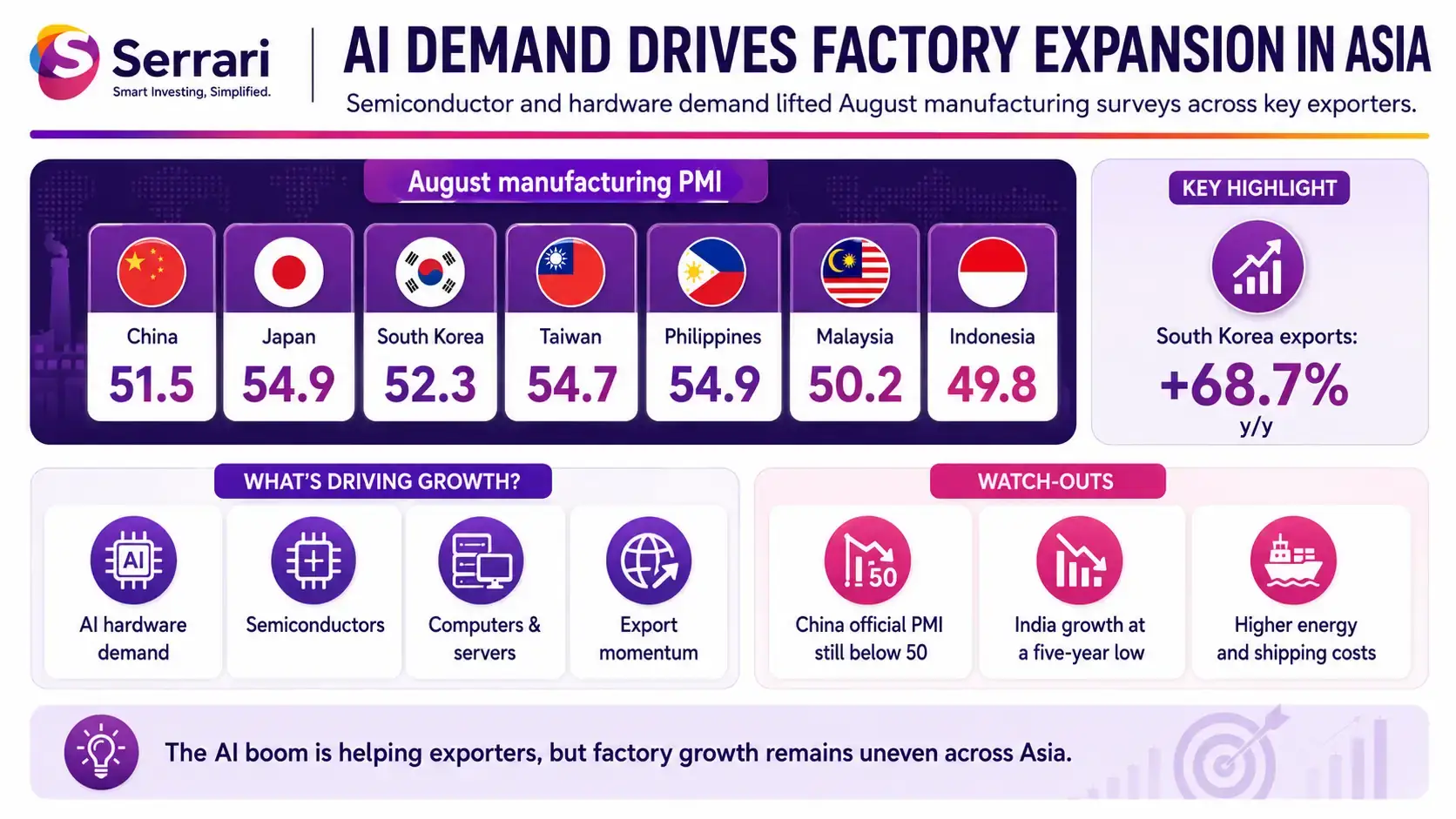
- China private manufacturing PMI: 51.5, up from 50.9
- Japan manufacturing PMI: 54.9, up from 54.5
- South Korea manufacturing PMI: 52.3, down from 53.1 but still expanding
- South Korean exports: Up 68.7% year-on-year
- Taiwan manufacturing PMI: 54.7
- Philippines manufacturing PMI: 54.9
- Malaysia manufacturing PMI: 50.2
- Indonesia manufacturing PMI: 49.8
- Main growth driver: AI, semiconductor and technology hardware demand
AI Hardware Demand Strengthens Asia’s Factory Base
AI investment is increasingly translating into physical demand for semiconductors, memory chips, servers, computers and supporting electronic components. Economies heavily integrated into these supply chains are consequently gaining a manufacturing boost from the rapid expansion of data centres and AI computing infrastructure worldwide.
Recent research found that economies central to AI development, including China, Japan, Taiwan and South Korea, have outperformed the global manufacturing benchmark since late 2025, with technology equipment among the strongest-performing industrial categories.
The trend is particularly important for Asia because the region occupies key positions across the semiconductor value chain. Taiwan is a major producer of advanced chips, South Korea dominates important memory-chip segments, while Japan remains a significant supplier of semiconductor equipment, components and materials.
As global technology companies increase AI-related capital spending, orders are filtering through these interconnected supply chains.
China Improves but Broader Recovery Remains Fragile
China’s RatingDog General Manufacturing PMI rose to 51.5 in August from 50.9 in July, moving further above the 50-point level separating expansion from contraction.
The August private-sector survey showed stronger production and new orders, while export orders recorded their fastest increase in six months. Manufacturers also resumed purchasing activity as demand improved.
However, China’s factory picture remains divided. The country’s official manufacturing PMI increased to 49.8 from 49.2 in July but remained below 50.
The gap suggests stronger conditions among export-oriented and private manufacturers than in the industrial sector as a whole. Weak domestic consumption, continuing property-sector problems and softer investment remain significant constraints even as technology exports provide support.
Context is everything. Stay ahead of shifting trends with today’s market updates, and uncover emerging opportunities using the Serrari Group Market Index and Marketplace. Then, take control of your own financial future by exploring our Money & Life Reset Transformation Blueprint ™ to build stronger habits, create better systems, and design a path toward lasting wealth.
Japan and South Korea Ride the Semiconductor Cycle
Japan recorded one of the strongest performances among major Asian manufacturing economies. Its manufacturing PMI increased to 54.9 from 54.5, marking an eighth consecutive month of expansion.
New business grew at its fastest rate since January 2018 as demand for technology products strengthened. The August manufacturing survey showed that improved semiconductor and AI-related demand was helping sustain production even as manufacturers continued to contend with elevated input costs.
South Korea also remained firmly in expansion territory despite its PMI easing to 52.3 from 53.1. August represented the country’s ninth consecutive month of factory expansion.
The strength is even clearer in trade figures. South Korean exports surged 68.7% year-on-year to $98.26 billion in August, extending export growth to a 15th consecutive month.
Strong global demand for technology products, particularly semiconductors and AI-related memory chips, has helped manufacturers such as Samsung Electronics and SK Hynix benefit from the continuing investment cycle.
Growth Extends Across Several Asian Manufacturing Hubs
The manufacturing improvement was not limited to Northeast Asia. Taiwan’s PMI stood at 54.7, remaining firmly above the expansion threshold despite easing from 55.1 in July.
The Philippines recorded one of the sharpest improvements, with its index climbing to 54.9 from 51.8. Malaysia remained marginally expansionary at 50.2, although growth slowed from 50.7.
Indonesia moved in the opposite direction, slipping to 49.8 from 50.2 and returning to contraction territory.
India also provided an important counterpoint to the regional technology boom. Its factory growth slowed to a five-year low as weaker domestic and overseas orders weighed on activity, resulting in manufacturing job losses for the first time in more than two years.
Cost Pressures Cloud the Manufacturing Outlook
The AI-driven export cycle is providing significant support to Asian factories, but manufacturers continue to face risks from energy prices, geopolitical tensions and disrupted shipping routes linked to the prolonged Middle East conflict.
Higher energy and transportation costs could squeeze margins even where order books remain strong. Persistent inflation could also keep global interest rates elevated, potentially weakening investment and consumer demand outside technology-related industries.
For now, AI hardware is acting as an important counterweight. The August data show that countries deeply embedded in semiconductor and technology supply chains are gaining disproportionately from the global investment boom.
The bigger question is whether AI demand can remain strong enough to support manufacturing if broader global growth weakens. August’s figures suggest it can provide substantial momentum, but the divergence across China, Southeast Asia and India shows that it cannot eliminate wider economic pressures.
Sources: Reuters / S&P Global
Your financial future isn’t something you wait for—it’s something you build.
The real question is: when do you begin?
Move beyond simply staying informed.
Navigate the markets with clarity—track trends through the Serrari Group Market Index, uncover opportunities in the Serrari Marketplace, and build practical knowledge with our Curated Wealth Builder Platform.
Stay connected to what truly matters.
Get daily insights on macro trends and financial movements across Kenya, Africa, and global markets—delivered through the Serrari Newsletter.
Growth opens doors.
Advance your career through professional programs including ACCA, HESI A2, ATI TEAS 7 , HESI EXIT , NCLEX – RN and NCLEX – PN, Financial Literacy!🌟—designed to move you forward with confidence.
See where money is flowing—clearly and in real time.
Track Money Market Funds, Treasury Bills, Treasury Bonds, Green Bonds, and Fixed Deposits, alongside global and African indexes, key economic indicators, and the evolving Crypto and stablecoin landscape—all within Serrari’s Market Index.