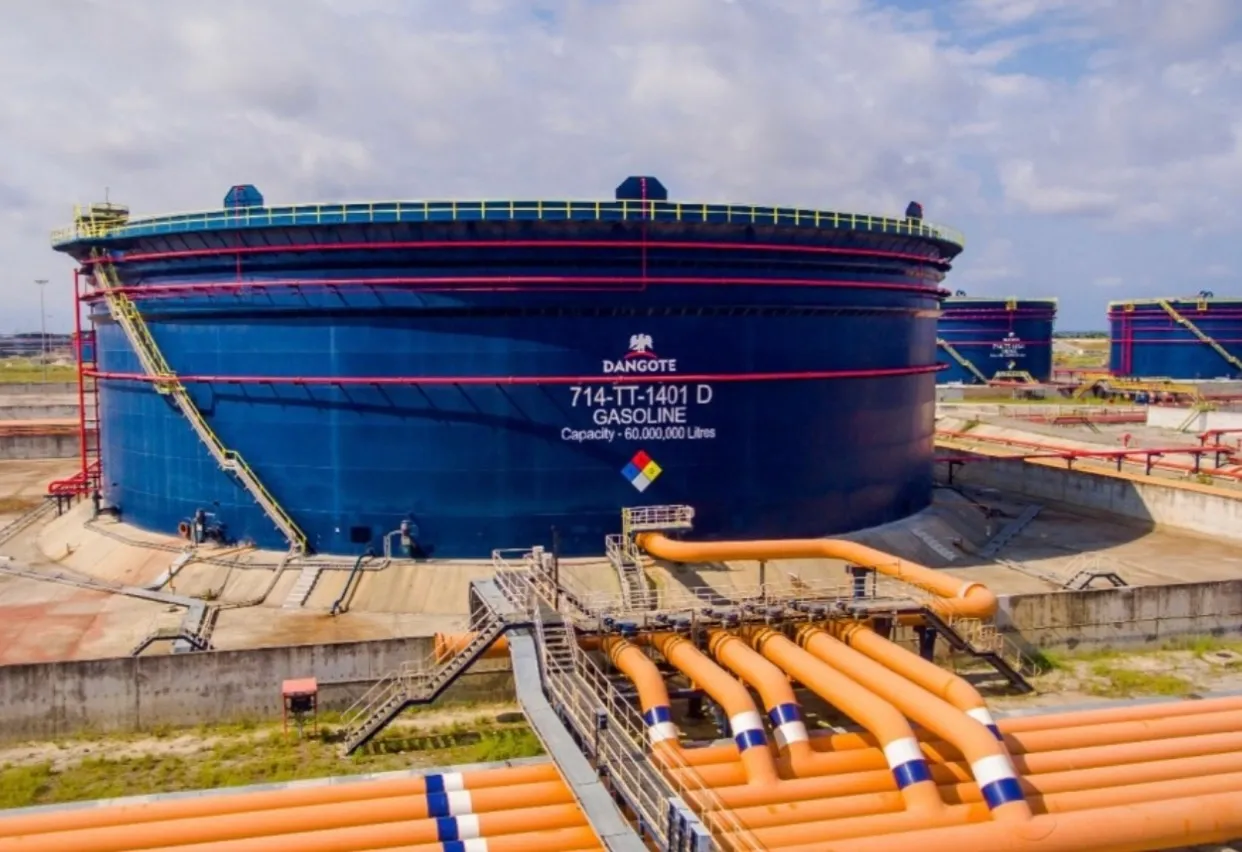
Nigeria’s Dangote Petroleum Refinery has moved to restrict petrol sales to six major fuel marketers holding active import licences, escalating tensions over how imported fuel should compete with the country’s rapidly expanding domestic refining capacity.
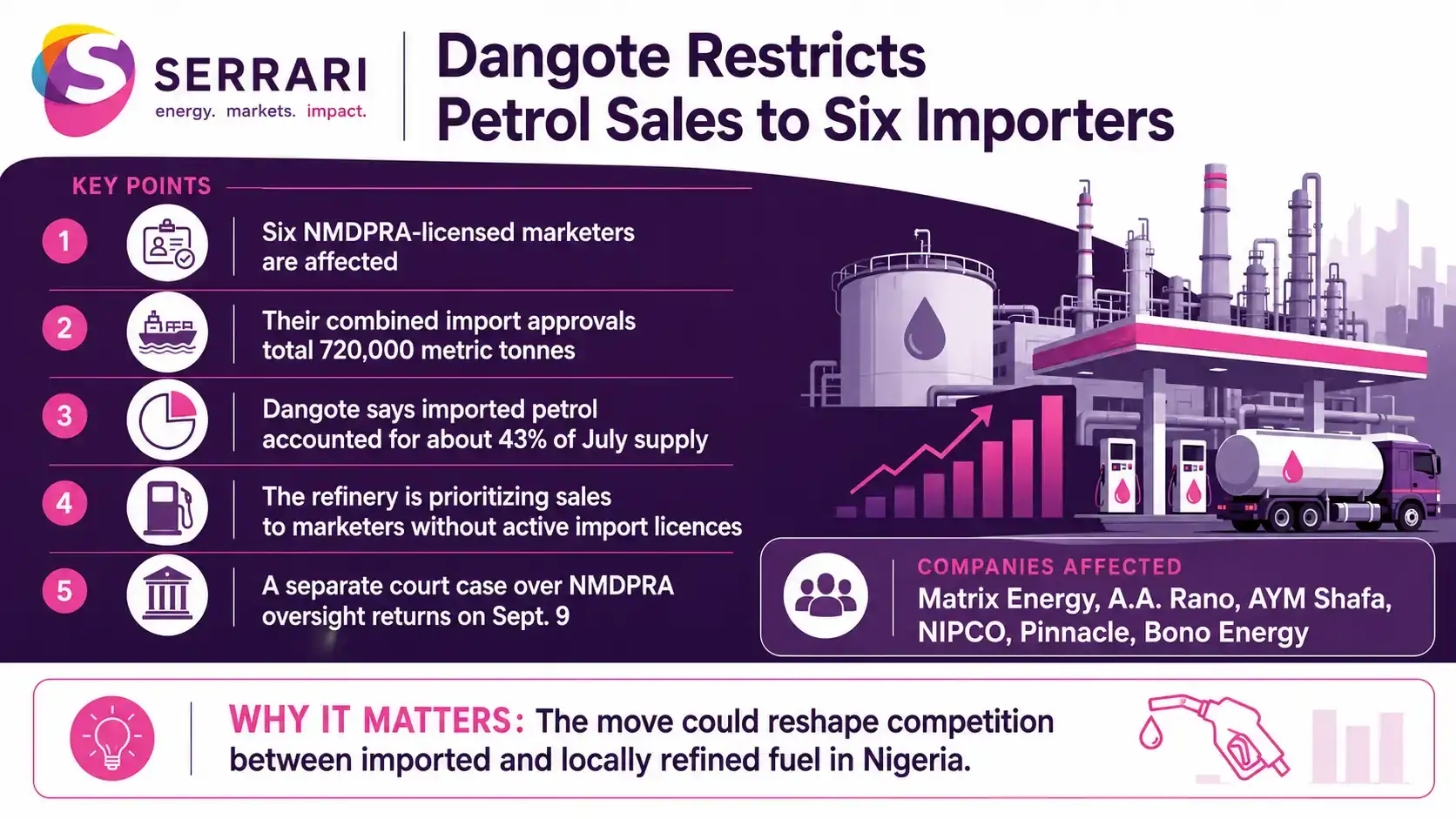
The affected companies are Matrix Energy, A.A. Rano, AYM Shafa, NIPCO, Pinnacle Oil and Gas, and Bono Energy. The six firms were authorised to import a combined 720,000 metric tonnes of Premium Motor Spirit in May, with individual allocations ranging from 60,000 to 150,000 metric tonnes.
The commercial move is separate from an ongoing court dispute between Dangote and the Nigerian Midstream and Downstream Petroleum Regulatory Authority over regulatory powers and petroleum product loading at the Lekki Free Zone.
Key Overview
- Dangote is restricting PMS sales to six marketers holding active import licences.
- The affected companies have combined import approvals of 720,000 metric tonnes.
- Dangote says imported petrol accounted for approximately 43% of Nigeria’s PMS supply in July.
- The refinery argues that continued imports reduce demand visibility for domestic refiners and complicate production planning.
- A Federal High Court has separately restrained NMDPRA from enforcing an August 24 directive suspending product loading and truck-out.
- The injunction case returns to court on September 9, 2026.
- Nigeria’s wider dispute centres on domestic refining, fuel security, competition and the circumstances under which imports should continue.
Six Importers Face Dangote Supply Restriction
The refinery’s new position could create a sharper divide between marketers sourcing petrol domestically and those retaining the ability to import fuel.
According to industry reporting, Dangote intends to prioritise petrol sales to marketers without active import licences, potentially forcing licensed importers to depend more heavily on international cargoes if the restriction is sustained.
The May allocations gave A.A. Rano and Matrix Energy approvals for 150,000 metric tonnes each. NIPCO, AYM Shafa and Pinnacle were allocated 120,000 metric tonnes each, while Bono Energy received approval for 60,000 metric tonnes.
Dangote has repeatedly questioned why large-scale petrol imports remain necessary as domestic refining expands. The refinery says imported PMS represented about 43% of total petrol supplied in July, arguing that unpredictable import volumes make domestic production and inventory planning more difficult.
The company has warned that excessive domestic inventories could eventually push locally refined fuel into export markets rather than allowing stock to accumulate at significant storage and financing costs.
Context is everything. Stay ahead of shifting trends with today’s market updates, and uncover emerging opportunities using the Serrari Group Market Index and Marketplace. Then, take control of your own financial future by exploring our Money & Life Reset Transformation Blueprint ™ to build stronger habits, create better systems, and design a path toward lasting wealth.
Fuel Quality Concerns Add Another Dimension
Dangote’s concerns extend beyond market share. Industry sources say the refinery is worried that imported petrol could be blended with domestically produced fuel before reaching consumers, potentially making responsibility for any quality problem difficult to establish.
The refinery has also questioned whether existing independent testing infrastructure is sufficient to verify imported products before they enter domestic distribution.
However, the existence of import licences does not by itself establish that imported fuel is substandard. The quality argument therefore remains part of the broader dispute between the refinery, importers and regulators rather than proof that the affected marketers are supplying inferior products.
The commercial restriction could nevertheless make sourcing strategies increasingly important for Nigerian marketers. Companies that retain import licences may gain flexibility when international fuel is competitively priced, while companies relying on Dangote could benefit from shorter domestic supply chains.
Separate Court Battle Tests NMDPRA’s Authority
Alongside the commercial dispute, Dangote is fighting a separate legal battle over regulatory oversight at its refinery within the Lekki Free Zone.
A Federal High Court in Lagos issued an interim injunction after NMDPRA’s August 24 letter allegedly directed the suspension of petroleum-product loading and truck-out from the facility.
Justice Akintayo Aluko restrained the regulator from enforcing the directive or interfering with refinery operations pending consideration of Dangote’s substantive application.
Dangote’s legal argument centres on whether NMDPRA can exercise the disputed regulatory powers over operations inside a designated free zone. The court referred to a March 2 letter from Nigeria’s Attorney-General which, according to the ruling, stated that NMDPRA was not entitled to exercise regulatory oversight within free zones.
The injunction is temporary rather than a final determination that the regulator lacks jurisdiction. The court is scheduled to hear the motion on notice on September 9.
Import Licences Remain at the Heart of Wider Dispute
Dangote has also challenged the issuance of fuel import licences through separate litigation, arguing that imports should principally cover verified domestic supply shortfalls.
Nigeria’s state-owned oil company has pushed back against that interpretation. In court filings, it has argued that fuel imports remain legally permissible where they are required to maintain supply security and that stopping imports could reduce competition or expose consumers to shortages.
That debate reflects a difficult policy balance. Nigeria wants to encourage billions of dollars of domestic refinery investment while also ensuring competition, reliable fuel availability and protection against disruption at any single facility.
Dangote’s sales restriction raises that tension further because the refinery is increasingly important to domestic PMS supply while licensed marketers still provide an alternative import channel.
The eventual market structure will depend not only on Dangote’s production capacity but also on how regulators and courts interpret Nigeria’s petroleum laws, competition principles and domestic refining policies. For consumers, the critical question is whether the resulting system delivers reliable fuel supplies at competitive prices without undermining investment in domestic refining.
Sources: Nigerian Tribune / Punch / TheCable / Reuters / Vanguard / THISDAY
Your financial future isn’t something you wait for—it’s something you build.
The real question is: when do you begin?
Move beyond simply staying informed.
Navigate the markets with clarity—track trends through the Serrari Group Market Index, uncover opportunities in the Serrari Marketplace, and build practical knowledge with our Curated Wealth Builder Platform.
Stay connected to what truly matters.
Get daily insights on macro trends and financial movements across Kenya, Africa, and global markets—delivered through the Serrari Newsletter.
Growth opens doors.
Advance your career through professional programs including ACCA, HESI A2, ATI TEAS 7 , HESI EXIT , NCLEX – RN and NCLEX – PN, Financial Literacy!🌟—designed to move you forward with confidence.
See where money is flowing—clearly and in real time.
Track Money Market Funds, Treasury Bills, Treasury Bonds, Green Bonds, and Fixed Deposits, alongside global and African indexes, key economic indicators, and the evolving Crypto and stablecoin landscape—all within Serrari’s Market Index.