Venezuela’s crude oil production could double in the next few years following new agreements expected with the U.S. and other foreign energy companies, according to the U.S. Energy Secretary Chris Wright. Production, which peaked at about 3 million barrels per day in the late 1990s, has fallen to around 1.25 million barrels per day this year amid sanctions and underinvestment.
Key Overview
- Venezuela’s crude oil production could double in the next few years, according to Chris Wright.
- Production has fallen from about 3 million barrels per day in the late 1990s to around 1.25 million barrels per day this year.
- Exports are running slightly above 1 million barrels per day, with the largest portion going to U.S. Gulf Coast refiners.
- Rystad Energy estimates that increasing Venezuelan production could require about $180 billion over 10 years.
- Chevron, Eni, ONGC, GeoPark and GE Vernova are expected to sign energy project agreements.
- Wright said limited refining capacity remains the biggest bottleneck affecting gasoline and diesel prices.
- A separate agreement involving North American Blue Energy Partners (NABEP) would cover 17 Venezuelan oil fields.
Venezuela Crude Oil Production Could Double
Venezuela’s crude oil production could double in the next few years following new deals expected to be signed with U.S. and other foreign energy companies, U.S. Energy Secretary Chris Wright has said.
“The investment in these deals will massively grow available oil production, which will give downward pressure on oil prices, but the biggest kink right now in gasoline and diesel prices is refining capacity,” Wright said during a one-day visit to Caracas, as quoted by Reuters.
Venezuela’s oil production peaked at about 3 million barrels daily in the late 1990s. Since then, amid U.S. sanctions and underinvestment, production has dropped to around 1.25 million barrels daily this year.
Exports are running slightly above 1 million barrels daily, with the biggest portion going to U.S. refiners along the Gulf Coast.
Foreign Investment Could Boost Venezuela’s Oil Output
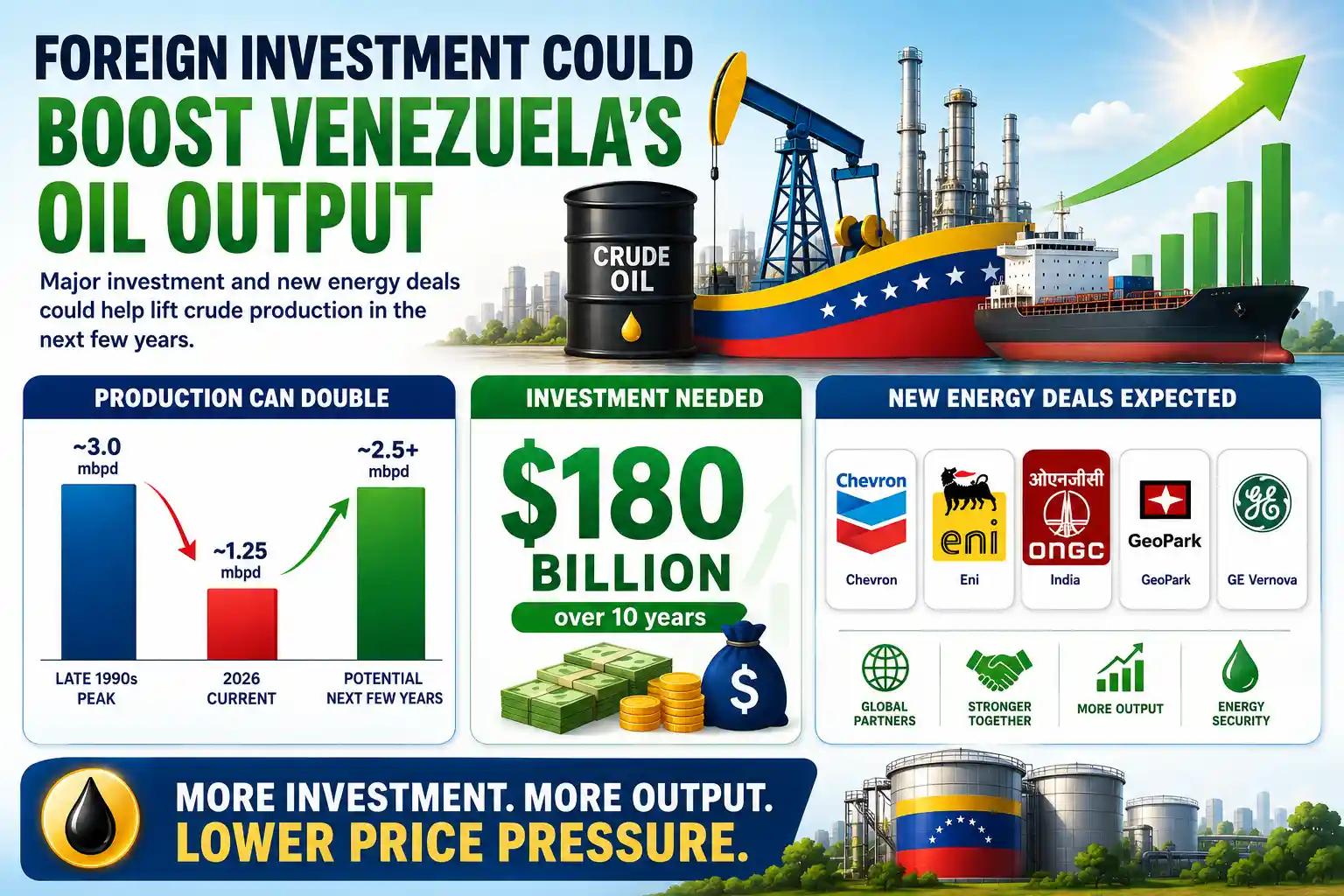
Analysts have said that a major increase in Venezuelan crude production would require substantial investment. Rystad Energy estimates the total investment at about $180 billion, which would need to be invested over the next 10 years.
The expected agreements could bring new investment into Venezuela’s oil sector through U.S. and other international energy companies.
Chevron, the largest U.S. oil producer operating in Venezuela, is expected to sign agreements on energy projects this week alongside Italy’s Eni, India’s ONGC, Colombia’s GeoPark and U.S.-based GE Vernova.
The deals come as Washington seeks greater involvement in Venezuela’s energy sector and increased access to its crude oil resources.
U.S. Government Negotiates Stake in Venezuelan Oil Company
A major component of the developments involves North American Blue Energy Partners (NABEP), Venezuela’s second-largest private oil company, run by businessman Alejandro Betancourt.
The U.S. government is set to take a 35 percent stake in NABEP, while Washington will receive the right to purchase 20 percent of the oil produced by the company at production cost, according to the White House.
US citizens will hold a majority of the company’s board seats, giving Washington effective control, while the U.S. government will have veto power over board appointments.
NABEP has already been granted 14 oil deals by the Venezuelan government.
Last week, reports emerged that the U.S. federal government was negotiating a direct ownership stake in a Venezuelan oil field with combined reserves of 90 billion barrels of crude.
President Donald Trump subsequently described the deal as “historic,” covering 17 fields with target production of 1.5 million barrels per day.
Under a separate arrangement, NABEP would receive 100-year concessions for 17 oil fields with estimated reserves of about 65 billion barrels.
The U.S. government would also have access to 20% of North American Blue Energy Partners’ production at cost, as well as the right of first refusal to purchase the remaining 80% of NABEP’s production from Venezuelan fields.
Venezuela Oil Output Fell After Peak Production
Venezuela’s crude production reached more than 3 million barrels per day in the late 1990s before declining sharply amid underinvestment, mismanagement and U.S. sanctions.
Output has ranged between 1.1 million and 1.2 million barrels per day in recent months, according to the supplied reports.
The potential increase in production would therefore represent a major expansion from current levels and would require significant investment in Venezuela’s oil industry.
The U.S. government has said its involvement could help combat corruption in Venezuela’s deteriorating oil industry and prevent Caracas from diverting large quantities of oil to its ally Cuba.
The agreement also gives Washington a direct economic stake in restoring Venezuela’s oil production while reducing the role previously played by Moscow and Beijing in the country’s energy sector.
Context is everything. Stay ahead of shifting trends with today’s market updates, and uncover emerging opportunities using the Serrari Group Market Index and Marketplace. Then, take control of your own financial future by exploring our Money & Life Reset Transformation Blueprint ™ to build stronger habits, create better systems, and design a path toward lasting wealth.
Refining Capacity Remains Fuel Price Bottleneck
While increased Venezuela crude oil production could put downward pressure on crude prices, Wright said refining capacity remains the biggest bottleneck affecting gasoline and diesel prices.
He said U.S. gasoline prices were expected to fall in the coming weeks following measures by the U.S. administration to ease regulatory restrictions on refiners.
Wright’s comments highlight the distinction between crude oil supply and refined fuel availability. Even if additional Venezuelan crude reaches the market, limited refining capacity could constrain the impact on gasoline and diesel prices.
Venezuela Oil Deal Has Political Dimension
Wright’s visit came days after Trump announced a separate agreement providing the United States with long-term access to one-fifth of Venezuela’s proven oil reserves.
For the Trump administration, increased Venezuelan production could also have a political dimension, with lower oil prices a key priority ahead of crucial U.S. midterm elections in November, when Republicans are seeking to retain control of Congress.
Betancourt has previously faced accusations of involvement in a corruption scheme involving Venezuela’s state-run oil company PDVSA. A U.S. official nevertheless described him as a “proven operator,” acknowledging that geopolitical agreements can sometimes require dealing with “imperfect” partners.
Outlook
New agreements with U.S. and foreign energy companies could significantly increase Venezuela’s crude oil production from current levels. However, the expansion would require substantial investment, with Rystad Energy estimating about $180 billion over 10 years.
Wright also emphasized that increased crude supply alone may not immediately translate into lower gasoline and diesel prices because refining capacity remains the biggest bottleneck.
FAQs
1. How much could Venezuela’s crude oil production increase?
Venezuela’s crude oil production could double in the next few years following new deals with the U.S. and other foreign energy companies.
2. What is Venezuela’s current oil production rate?
Venezuela’s production has fallen to around 1.25 million barrels per day this year, compared with a peak of about 3 million barrels per day in the late 1990s.
3. How much investment could Venezuela need to increase oil production?
Rystad Energy estimates that boosting Venezuelan crude oil production could require about $180 billion in investment over the next 10 years.
4. What is the biggest bottleneck affecting U.S. gasoline and diesel prices?
According to U.S. Energy Secretary Chris Wright, limited refining capacity remains the biggest bottleneck affecting gasoline and diesel prices.
Sources: Crude Oil Prices Today, NTD News, Kurdistan24, Syrian Arab News Agency
Your financial future isn’t something you wait for—it’s something you build.
The real question is: when do you begin?
Move beyond simply staying informed.
Navigate the markets with clarity—track trends through the Serrari Group Market Index, uncover opportunities in the Serrari Marketplace, and build practical knowledge with our Curated Wealth Builder Platform.
Stay connected to what truly matters.
Get daily insights on macro trends and financial movements across Kenya, Africa, and global markets—delivered through the Serrari Newsletter.
Growth opens doors.
Advance your career through professional programs including ACCA, HESI A2, ATI TEAS 7 , HESI EXIT , NCLEX – RN and NCLEX – PN, Financial Literacy!🌟—designed to move you forward with confidence.
See where money is flowing—clearly and in real time.
Track Money Market Funds, Treasury Bills, Treasury Bonds, Green Bonds, and Fixed Deposits, alongside global and African indexes, key economic indicators, and the evolving Crypto and stablecoin landscape—all within Serrari’s Market Index.