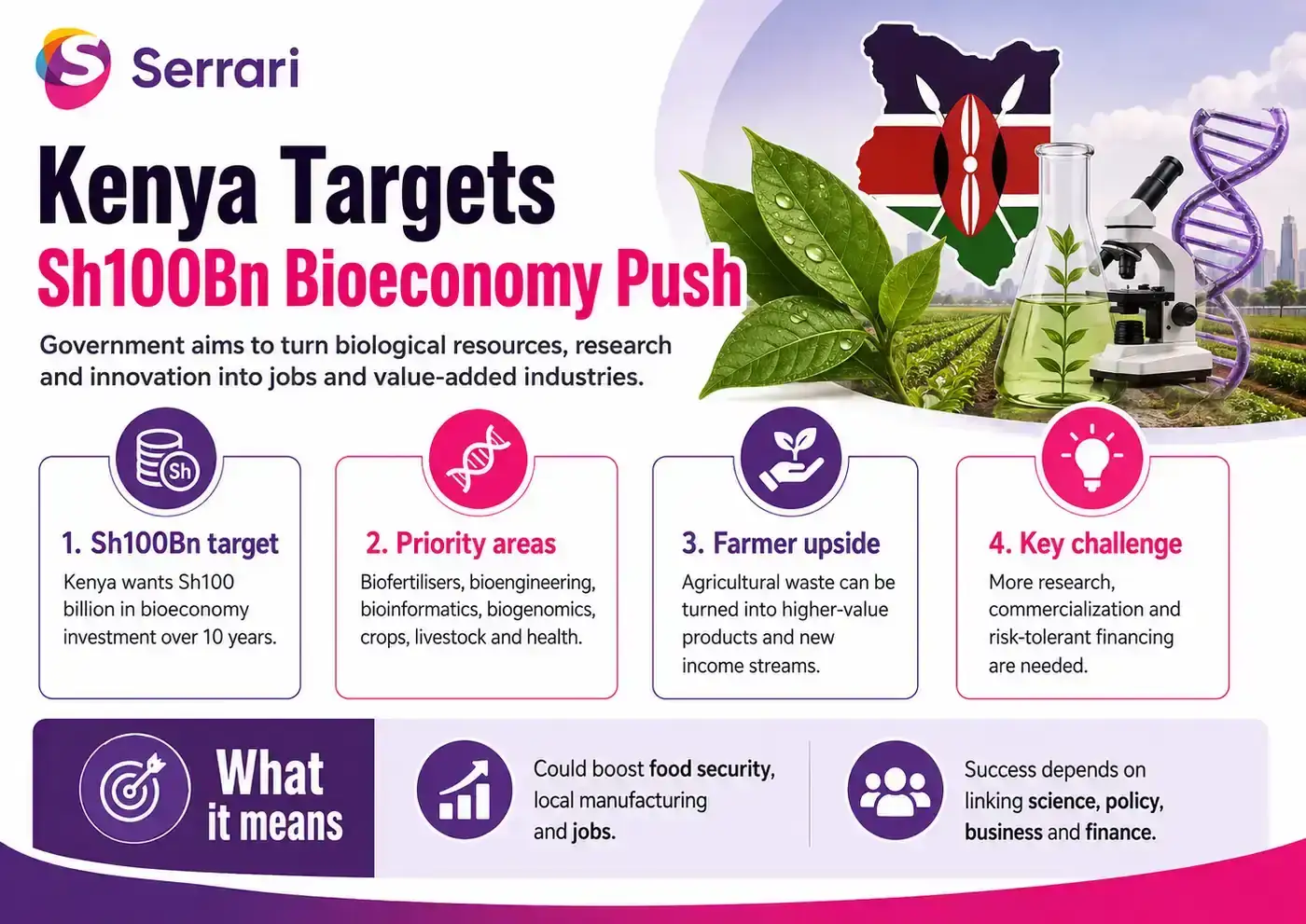
Kenya is targeting Sh100 billion in bioeconomy investment over the next decade, seeking to turn the country’s biological resources, scientific research and agricultural waste into higher-value products, businesses and jobs.
The proposed investment target forms part of a wider effort to establish a coordinated national bioeconomy ecosystem covering agriculture, health, biotechnology, manufacturing, fisheries and environmental resources. The government’s National Bioeconomy Strategy is intended to connect research institutions, universities, businesses, investors and communities so that more biological resources are processed and commercialised locally rather than exported primarily in raw form.
Key Overview
- Kenya is targeting Sh100 billion of bioeconomy investment over 10 years.
- The strategy seeks to commercialise biological resources through research, technology and local value addition.
- Priority areas include biofertilisers, biotechnology, genomics, health, agriculture, fisheries and bio-based manufacturing.
- Smallholder farmers could benefit from converting agricultural waste and other biological materials into commercially useful products.
- Financing remains a major hurdle, particularly for emerging businesses and projects involving small-scale producers.
- Kenya ultimately wants to develop a stronger research ecosystem, including specialised bioeconomy institutions and centres of excellence.
Kenya Wants More Value From Its Biological Resources
At the centre of the strategy is a straightforward economic objective: Kenya wants to capture more of the value generated from the biological resources it already produces.
Agricultural products, biodiversity, livestock, forests, aquatic resources and indigenous knowledge can support industries ranging from food processing and biomaterials to pharmaceuticals and biotechnology. Yet much of their economic potential can be lost when materials leave farms or communities with minimal processing.
Kenya’s ongoing bioeconomy strategy development process aims to change this by creating stronger links between research and commercial production, while aligning agriculture, health, forestry, fisheries, manufacturing, education and finance within a common framework.
The approach also recognises that opportunities vary geographically. Coastal counties could combine biotechnology with marine and blue-economy resources, while agricultural regions could focus on crop residues, biofertilisers, animal resources and value-added food production.
This could support new businesses while helping diversify incomes for farmers and rural communities.
Context is everything. Stay ahead of shifting trends with today’s market updates, and uncover emerging opportunities using the Serrari Group Market Index and Marketplace. Then, take control of your own financial future by exploring our Money & Life Reset Transformation Blueprint ™ to build stronger habits, create better systems, and design a path toward lasting wealth.
Turning Agricultural Waste Into Commercial Products
Agricultural waste is emerging as one of the clearest examples of how the bioeconomy could create additional income.
Banana stems, leaves and other materials that historically had limited commercial value can be converted into fibres, textiles, sanitary products, biofertilisers and other materials. Research into banana-fibre value addition has already explored products including sanitary pads, diapers, wet wipes, textiles and bio-based materials, illustrating how waste streams can become inputs for new industries.
This model could be especially important for smallholder farmers. Instead of earning income only from the primary crop, producers could participate in additional value chains based on materials previously discarded or left to decompose.
Kenya is also exploring how bioeconomy technologies could increase agricultural productivity through more precise nutrient use, better pest and disease detection and reduced post-harvest losses.
Artificial intelligence could complement these systems by helping farmers identify diseases, monitor crops and make better decisions about inputs, while biotechnology could support improved crop varieties, biofertilisers and other agricultural innovations.
Research Must Move Beyond the Laboratory
Kenya already has universities, research institutes and scientific expertise capable of developing bio-based technologies. The larger challenge is moving successful research into commercially viable products.
The EU-backed Bio-KE initiative is a 48-month programme involving institutions in Kenya, Germany and Denmark, focused on strengthening bioeconomy education, research, policy and innovation. It is intended to help create the human and institutional capacity required for a larger national bioeconomy.
The government has also proposed progressively building specialised facilities and institutions capable of linking universities, researchers and businesses.
A broader national innovation-platform model has been proposed around biotechnology hubs, genomics centres, biosensor laboratories, demonstration biorefineries and startup incubators, with the aim of converting scientific discoveries into businesses and commercial products.
Such infrastructure could help address one of the longstanding weaknesses of research-driven economies: promising discoveries often struggle to attract capital, reach industrial scale or find reliable markets.
Financing Will Determine Whether the Target Is Reached
The Sh100 billion ambition is an investment target rather than committed government spending, making private capital central to its success.
Financing young bioeconomy businesses can be difficult because many technologies require lengthy research periods, specialised equipment and uncertain early-stage markets. Projects involving smallholder farmers can face additional challenges because lenders may view fragmented production and limited collateral as higher risk.
This is why the government’s strategy places emphasis on collaboration between public institutions, universities, development partners, commercial banks and private investors.
The current Sh100 billion investment ambition therefore depends not only on scientific capability but also on developing bankable projects, reducing investment risk and creating commercial markets for bio-based products.
If Kenya can bridge that gap, the bioeconomy could become more than an environmental or research initiative. It could provide a new route to industrialisation built around resources the country already possesses, while creating jobs, improving food security and allowing farmers and businesses to capture a larger share of the value generated from Kenya’s biological wealth.
Sources: People Daily / State Department for Science, Research and Innovation / Bio-KE / Government Advertising Agency / SMEP
Your financial future isn’t something you wait for—it’s something you build.
The real question is: when do you begin?
Move beyond simply staying informed.
Navigate the markets with clarity—track trends through the Serrari Group Market Index, uncover opportunities in the Serrari Marketplace, and build practical knowledge with our Curated Wealth Builder Platform.
Stay connected to what truly matters.
Get daily insights on macro trends and financial movements across Kenya, Africa, and global markets—delivered through the Serrari Newsletter.
Growth opens doors.
Advance your career through professional programs including ACCA, HESI A2, ATI TEAS 7 , HESI EXIT , NCLEX – RN and NCLEX – PN, Financial Literacy!🌟—designed to move you forward with confidence.
See where money is flowing—clearly and in real time.
Track Money Market Funds, Treasury Bills, Treasury Bonds, Green Bonds, and Fixed Deposits, alongside global and African indexes, key economic indicators, and the evolving Crypto and stablecoin landscape—all within Serrari’s Market Index.