The BankChain Alliance has been formed by 39 U.S. state bankers associations to develop a blockchain network owned and governed by the banking industry. Announced on August 25, 2026, the initiative represents approximately 3,283 banks with $21.8 trillion in assets and is targeting a 2027 launch. The planned infrastructure could support tokenized deposits, stablecoins, smart payments and automated settlement while allowing banks to participate directly in the expansion of blockchain-based financial services.
Key Overview
The BankChain Alliance brings together banking associations representing thousands of U.S. financial institutions. Led on an interim basis by Florida Bankers Association President and CEO Kathy Kraninger, the initiative aims to create regulated, bank-controlled blockchain infrastructure. Its formation comes as large, regional and community banks increasingly experiment with tokenization and blockchain payments.
BankChain Alliance Brings Together 39 Banking Association
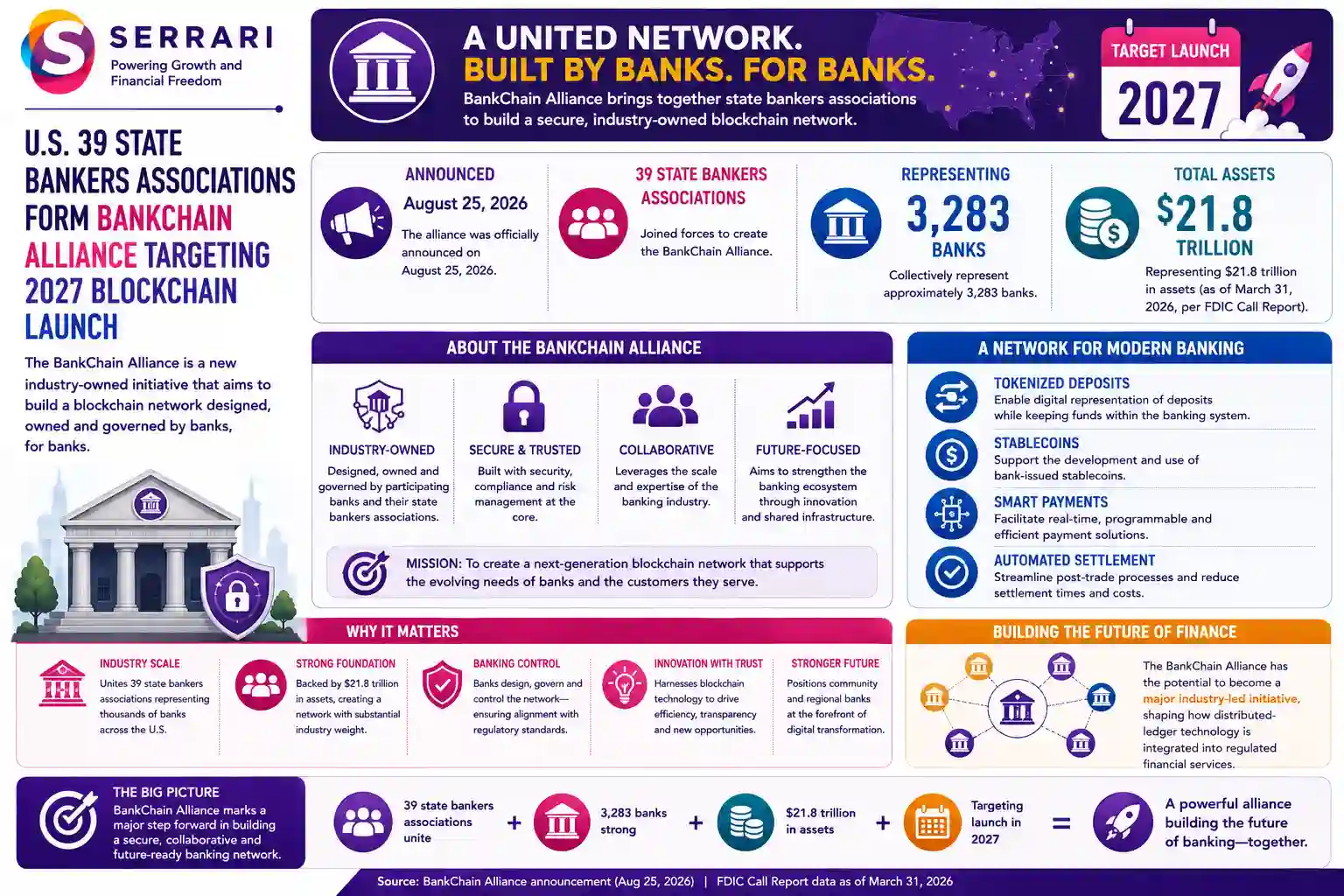
Thirty-nine state bankers associations in the United States have jointly established the BankChain Alliance as the banking industry increases its involvement in blockchain-based financial infrastructure.
The alliance was announced on August 25 and intends to build a network that is designed, owned and governed by participating members of the banking sector.
The initiative is targeting a 2027 launch.
Collectively, the participating associations represent approximately 3,283 banks holding $21.8 trillion in assets, based on March 31, 2026 FDIC Call Report data cited by the alliance.
The scale gives BankChain Alliance the potential to become a significant industry-led initiative as traditional banks explore how distributed-ledger technology can be integrated into regulated financial services.
Blockchain Network Designed for U.S. Banks
Unlike blockchain infrastructure developed primarily by cryptocurrency companies, the BankChain Alliance intends its network to be controlled by the banking industry itself.
The proposed system could provide infrastructure for U.S. banks of different sizes, including community, regional and larger financial institutions.
Kathy Kraninger, president and CEO of the Florida Bankers Association, has been appointed interim chair of the alliance.
Kraninger, who previously served as director of the Consumer Financial Protection Bureau, described the initiative as an opportunity for banks of all sizes to collectively build their future.
The alliance intends to establish a secure and regulated network that can support institutions serving customers in rural, regional and urban markets.
Tokenized Deposits and Stablecoins Could Play Key Roles
One of the most significant potential applications for the new network is tokenized deposits.
Tokenized deposits represent conventional bank deposits using blockchain or distributed-ledger infrastructure. They can potentially allow banks to retain traditional deposit relationships while improving the programmability and settlement capabilities of payments.
The network could also provide infrastructure involving stablecoins, another rapidly expanding part of digital finance.
The distinction matters for banks. As stablecoins and other digital payment instruments become more widely used, financial institutions face the challenge of ensuring that payments and deposits do not migrate entirely outside the regulated banking system.
Industry-controlled blockchain infrastructure could give banks a way to offer similar technological functionality while keeping customer funds and financial relationships within established institutions.
Context is everything. Stay ahead of shifting trends with today’s market updates and uncover emerging opportunities using the Serrari Group Market Index and Marketplace. Then, take control of your own financial future by exploring our Money & Life Reset Transformation Blueprint ™ to build stronger habits, create better systems, and design a path toward lasting wealth.
Smart Payments and Automated Settlement
The BankChain Alliance could also support smart payments and automated settlement.
Traditional financial transactions often involve multiple intermediaries and separate systems for messaging, clearing and settlement. Distributed-ledger infrastructure has the potential to combine or streamline some of these processes.
Programmable transactions could allow payments to execute automatically when predetermined conditions are satisfied.
For banks, the potential benefits include faster settlement, reduced reconciliation requirements and improved interoperability between participating institutions.
However, achieving those advantages across thousands of banks will require more than deploying blockchain technology. Regulatory compliance, cybersecurity, governance, interoperability and integration with existing banking systems will all be important to the project’s success.
U.S. Banking Blockchain Adoption Accelerates
The formation of the alliance comes amid increasing experimentation with blockchain across the financial sector.
Swift has been working with major financial institutions on tests involving tokenized digital assets and blockchain-based infrastructure, including banks such as Citi, BNY and Wells Fargo.
Regional banks are also developing their own systems.
Huntington, First Horizon, M&T Bank, KeyBank and Old National have participated in Cari, a bank-focused blockchain network that released its minimum viable product in March 2026. More than 30 banks had reportedly joined the initiative by July.
Community banks are exploring similar infrastructure through the DTX Consortium, established by the Independent Bankers Association of Texas. More than 50 banks had joined by June as the consortium prepared a tokenized-deposit pilot.
These initiatives suggest blockchain development is moving beyond isolated experiments by individual financial institutions toward shared industry infrastructure.
Banks Respond to Growth of Digital Assets
The expansion of bank-led blockchain initiatives coincides with broader growth in digital assets and tokenized financial products.
Stablecoin developers are also increasingly adopting consortium structures.
In June 2026, Open Standard identified more than 140 organisations across banking, payments, cryptocurrency and technology connected with its planned Open USD stablecoin.
These developments are increasing competitive pressure on conventional financial institutions to modernise payment and settlement infrastructure.
BankChain Alliance’s approach is notable because it attempts to put banks collectively at the centre of that transition rather than making them dependent on infrastructure controlled entirely by external technology or cryptocurrency companies.
What BankChain Alliance Could Mean for Banking
The alliance could represent an important shift in how traditional financial institutions approach banking technology.
Rather than treating blockchain exclusively as competition from the cryptocurrency industry, participating banks are seeking to build infrastructure around the technology themselves.
With 39 state banking associations representing more than 3,000 banks, the initiative has considerable potential scale.
Still, the 2027 launch target remains prospective. The project’s eventual impact will depend on successful development, regulatory acceptance and adoption by participating financial institutions.
If those hurdles are overcome, BankChain Alliance could provide U.S. banks with shared infrastructure for tokenized deposits, stablecoin-related services and blockchain-based settlement while maintaining banking-industry governance.
FAQs
What is the BankChain Alliance?
The BankChain Alliance is an initiative formed by 39 U.S. state bankers associations to develop a secure, regulated blockchain network designed, owned and governed by the banking industry. The network is targeting a launch in 2027.
How many banks does the BankChain Alliance represent?
The participating state banking associations collectively represent approximately 3,283 banks with $21.8 trillion in assets, according to figures based on FDIC Call Report data as of March 31, 2026.
What will the BankChain Alliance blockchain be used for?
The planned network could support financial applications including tokenized deposits, stablecoins, smart payments, blockchain payments and automated settlement. Its broader goal is to help banks participate directly in the development of digital financial infrastructure.
When will the BankChain Alliance launch?
The BankChain Alliance is targeting 2027 for the launch of its banking blockchain network. Development and implementation will need to address regulatory, technological, cybersecurity and interoperability requirements before the network can operate at scale.
Sources: Kucoin, Biggo Finance, Finance Feeds, Crypto News, Unlock
Your financial future isn’t something you wait for—it’s something you build.
The real question is: when do you begin?
Move beyond simply staying informed.
Navigate the markets with clarity—track trends through the Serrari Group Market Index, uncover opportunities in the Serrari Marketplace, and build practical knowledge with our Curated Wealth Builder Platform.
Stay connected to what truly matters.
Get daily insights on macro trends and financial movements across Kenya, Africa, and global markets—delivered through the Serrari Newsletter.
Growth opens doors.
Advance your career through professional programs including ACCA, HESI A2, ATI TEAS 7 , HESI EXIT , NCLEX – RN and NCLEX – PN, Financial Literacy!🌟—designed to move you forward with confidence.
See where money is flowing—clearly and in real time.
Track Money Market Funds, Treasury Bills, Treasury Bonds, Green Bonds, and Fixed Deposits, alongside global and African indexes, key economic indicators, and the evolving Crypto and stablecoin landscape—all within Serrari’s Market Index.