


















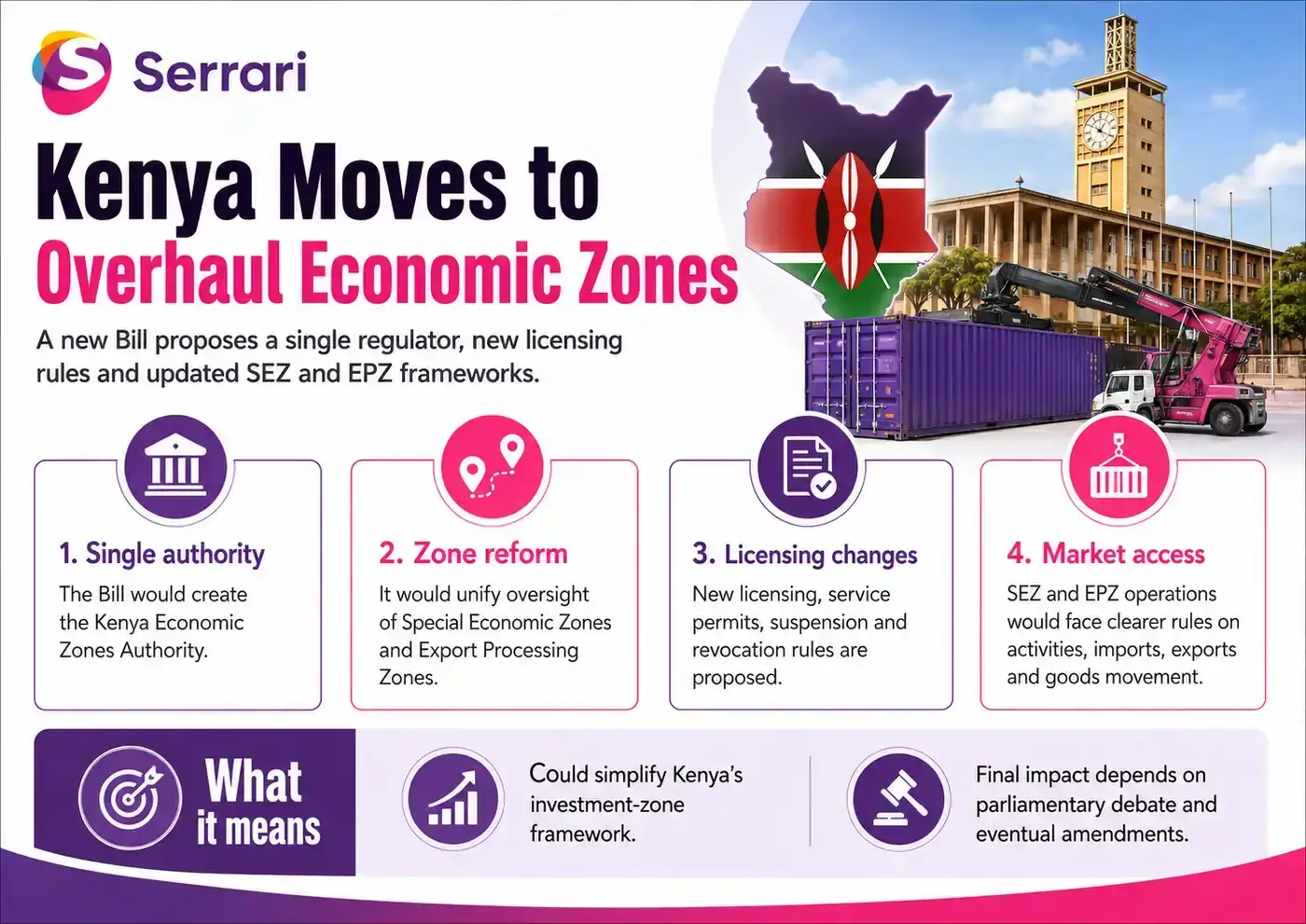
Kenya is considering a major restructuring of the rules governing its Special Economic Zones and Export Processing Zones, bringing the two systems under a single regulatory authority while changing licensing, domestic-market access and investment requirements.
The Kenya Economic Zones Bill, 2026, published on July 2 as National Assembly Bill No. 46 of 2026, would establish the Kenya Economic Zones Authority and consolidate functions currently divided between the Special Economic Zones Authority and Export Processing Zones Authority. The Bill remains proposed legislation and must complete the parliamentary process before its provisions can take effect.
Key Overview
- The Bill would create a single Kenya Economic Zones Authority to regulate both SEZs and EPZs.
- Existing SEZA and EPZA functions, staff, assets and liabilities would move to the new regulator.
- Both economic-zone categories would carry a proposed Sh5 billion minimum investment threshold.
- SEZ enterprises could sell up to 100% of their output domestically, while EPZ enterprises would remain subject to a 20% domestic-sales ceiling.
- Licences would run for at least 10 years, alongside new permitting and enforcement rules.
- The framework provides clearer rules for declaring zones, permitted activities and treatment of imported and exported goods.
- The Bill is still before lawmakers and its provisions may change before enactment.
Kenya Moves Toward One Economic Zones Regulator
One of the most significant proposals is the consolidation of two regulatory systems that have developed separately.
Kenya’s current special economic zones framework is administered by SEZA, which was created under the Special Economic Zones Act of 2015. Export Processing Zones operate under a separate institutional structure focused heavily on export-oriented production.
The new legislation would replace those parallel regulators with the Kenya Economic Zones Authority, giving a single body responsibility for zone designation, licensing, administration and investor oversight.
Reporting on the detailed provisions indicates the proposed consolidation would transfer staff, assets and pending liabilities from the existing authorities to the new institution while repealing the legislation underpinning the two separate bodies.
For investors, a unified regulator could potentially reduce duplication when projects involve activities that previously fell between the SEZ and EPZ systems. Much will depend on how efficiently the new authority coordinates customs, taxation, county approvals and other government agencies.
Sh5 Billion Threshold Raises the Entry Bar
The Bill goes beyond institutional restructuring by introducing significant requirements for investors seeking economic-zone licences.
Both SEZ and EPZ enterprises would face a minimum investment threshold of Sh5 billion, although the Treasury Cabinet Secretary would have authority to alter that threshold through a Gazette notice.
Licences would generally run for at least 10 years, while developers would also be expected to demonstrate sufficiently long-term rights over the land on which economic zones are established.
The investment threshold could favour large industrial, manufacturing and infrastructure projects while creating questions about whether smaller technology, logistics, business-process outsourcing or specialised-service investments would qualify. Stakeholders have already raised concerns that a high uniform threshold could exclude projects that generate substantial employment or exports without requiring billions of shillings in physical capital.
Context is everything. Stay ahead of shifting trends with today’s market updates, and uncover emerging opportunities using the Serrari Group Market Index and Marketplace. Then, take control of your own financial future by exploring our Money & Life Reset Transformation Blueprint ™ to build stronger habits, create better systems, and design a path toward lasting wealth.
SEZs Could Gain Greater Access to Kenyan Consumers
Another important distinction concerns how much production can be sold into Kenya’s domestic market.
Under the proposed framework, SEZ enterprises could sell up to 100% of their output domestically, whereas companies operating under an EPZ licence would generally remain capped at 20%.
This could materially change how investors choose between the two categories. EPZs have traditionally been built around export-oriented businesses, while SEZs accommodate a wider range of industrial, commercial and service activities.
Allowing SEZ producers extensive access to Kenyan consumers could make the regime more attractive for businesses serving both domestic and regional markets. However, it could also intensify debate around competition between firms receiving zone incentives and companies operating outside those zones under ordinary tax and regulatory structures.
How taxes, customs duties and incentives are ultimately applied to domestically sold goods will therefore be an important consideration as lawmakers scrutinise the Bill.
Licensing and Goods Movement Face Clearer Rules
The legislation also attempts to codify how economic zones are created and how businesses operate inside them.
Clauses 24 and 25 establish procedures and criteria for declaring Special Economic Zones, while Clauses 26 and 27 deal separately with Export Processing Zones and their categories. The proposed framework also specifies permitted and prohibited EPZ activities and addresses when zone status can be revoked.
Rules governing goods and services are also more explicit. The Bill defines circumstances in which transactions are treated as exports or imports and provides controls around removing goods from economic zones.
Enforcement could be substantial in cases involving unauthorised movement. The proposed framework includes penalties of up to Sh20 million for improperly removing goods, alongside possible imprisonment and forfeiture under applicable customs rules.
A Kenya Economic Zones Service Permit would additionally provide a specific authorisation mechanism for service providers operating within zones.
Reform Comes as Kenya Courts Major Investment
The legislation arrives as Kenya increasingly uses economic zones as part of its industrialisation and foreign-investment strategy.
Recent investment plans associated with the zones have included manufacturing projects in fertiliser, textiles, solar-panel assembly, glass and recycling, alongside substantial proposed agricultural investments. One estimate cited in recent reporting puts the investment pipeline connected to these zones at more than $2.9 billion with over 63,000 potential direct jobs.
That makes the regulatory overhaul commercially significant. A clearer single system could make Kenya easier for large investors to navigate, but issues including the Sh5 billion entry threshold, domestic sales privileges and treatment of existing licences could materially affect businesses already operating in the zones.
The Bill is currently recorded at the First Reading stage, meaning its present provisions should not be treated as final law. Parliamentary debate, committee scrutiny and amendments will ultimately determine whether Kenya adopts the proposed unified economic-zones regime in its current form.
Sources: Parliament of Kenya / People Daily / The Kenyan Wall Street / Special Economic Zones Authority / Mzalendo
Your financial future isn’t something you wait for—it’s something you build.
The real question is: when do you begin?
Move beyond simply staying informed.
Navigate the markets with clarity—track trends through the Serrari Group Market Index, uncover opportunities in the Serrari Marketplace, and build practical knowledge with our Curated Wealth Builder Platform.
Stay connected to what truly matters.
Get daily insights on macro trends and financial movements across Kenya, Africa, and global markets—delivered through the Serrari Newsletter.
Growth opens doors.
Advance your career through professional programs including ACCA, HESI A2, ATI TEAS 7 , HESI EXIT , NCLEX – RN and NCLEX – PN, Financial Literacy!🌟—designed to move you forward with confidence.
See where money is flowing—clearly and in real time.
Track Money Market Funds, Treasury Bills, Treasury Bonds, Green Bonds, and Fixed Deposits, alongside global and African indexes, key economic indicators, and the evolving Crypto and stablecoin landscape—all within Serrari’s Market Index.