
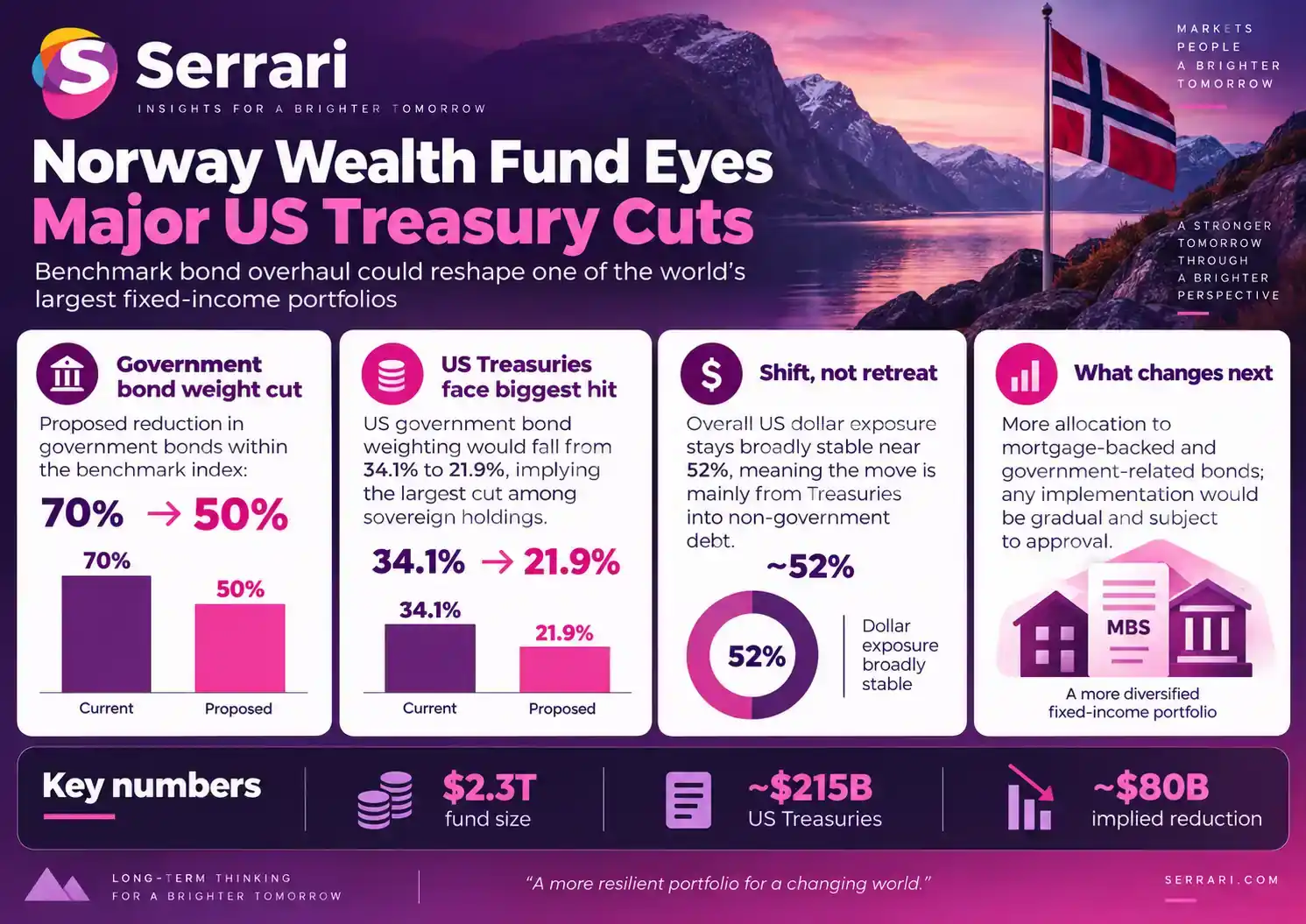
Norway’s Government Pension Fund Global is considering one of the most significant changes to its bond benchmark in years. Norges Bank Investment Management has recommended reducing the government-bond portion of the benchmark from 70% to 50% and shifting more capital toward mortgage-backed, government-related and other investment-grade debt.
Because US Treasuries are the largest government-bond exposure, they would absorb the biggest reduction. Based on the proposed benchmark weights and the fund’s holdings at the end of June, a calculation of the proposed shift indicates that US Treasury holdings could fall by nearly $80 billion from roughly $215 billion if the new structure is ultimately adopted.
Key Overview
- The proposal would cut government bonds to 50% of the bond benchmark from 70%.
- US government bonds would fall from 34.1% to 21.9% of the bond index, while US non-government debt would rise sharply.
- Overall US dollar exposure would remain broadly stable at just above 50%, meaning this is mainly a change in the type of US bonds held rather than a broad retreat from dollar assets.
- Mortgage-backed securities would become a major new benchmark component, while government-related bonds would also gain weight.
- The proposal still requires government consideration and would be implemented gradually if approved.
Why the Government-Bond Weight Could Fall
The fund’s bond portfolio has three formal jobs: reducing volatility in the overall portfolio, providing liquidity and earning risk premiums. In its September bond-strategy review, Norges Bank concluded that those roles remain appropriate but that the current 70% government-bond allocation may be larger than necessary.
Its simulations suggest that even a 40% government share could cover estimated liquidity needs during severe market stress. The bank nevertheless recommends 50%, arguing that this provides a comfortable liquidity buffer while allowing the benchmark to capture more return sources beyond sovereign debt.
The proposal would also replace GDP-based weighting inside the government-bond segment with market-value weighting. Norges Bank argues that high public debt is now common across developed economies, weakening the case for using GDP weights to reduce exposure to highly indebted sovereign issuers.
Context is everything. Stay ahead of shifting trends with today’s market updates, and uncover emerging opportunities using the Serrari Group Market Index and Marketplace. Then, take control of your own financial future by exploring our Money & Life Reset Transformation Blueprint ™ to build stronger habits, create better systems, and design a path toward lasting wealth.
US Treasuries Would Take the Largest Cut
The biggest numerical change would occur in US government debt. The proposed benchmark would reduce US government bonds from 34.1% to 21.9% of the bond index. Based on the reported end-June holdings, this could translate into a reduction of almost $80 billion from approximately $215 billion of Treasuries.
That does not amount to a wholesale move away from US fixed income. The allocation to US non-government debt would rise from 16.2% to 27.6%, while the overall US dollar share of the bond benchmark would edge down only slightly, from 52.9% to 52.5%.
The shift is therefore better understood as a rebalancing inside the dollar bond market: fewer Treasuries, but more mortgage-backed and government-related securities.
Why Mortgage-Backed Bonds Matter
Norges Bank wants the benchmark to move closer to the broad global investment-grade bond market. Under its proposal, mortgage-backed securities would represent about 13% of the recommended bond index, compared with zero in the current benchmark, while government-related bonds would rise from about 4% to roughly 11%.
The fund argues that these segments can provide additional risk premiums. Its historical bond analysis found that mortgage-backed securities delivered higher average returns than government bonds over 1995–2025 and also showed useful diversification characteristics during periods of market stress.
There are trade-offs. Mortgage-backed securities introduce prepayment risk, and a lower sovereign-bond allocation reduces some portfolio liquidity. Even so, Norges Bank estimates that the overall effect of the proposed benchmark would be a marginal increase in expected return and a marginal reduction in volatility.
What Happens Before Any Treasuries Are Sold
This is a recommendation, not an approved divestment plan. The fund manager has said any transition would be gradual to reduce transaction costs and avoid unnecessary market impact.
The recommendations are expected to feed into the Ministry of Finance’s broader review process, with further advice due in early 2027 and the issue expected to be considered through Norway’s annual sovereign-wealth-fund policy process. That means substantial portfolio changes are unlikely to begin until well into 2027 at the earliest.
Separately, Norges Bank has also suggested that Norway consider a larger long-term allocation to unlisted assets. Its separate concentration-risk assessment says broader unlisted exposure could reduce the significance of concentration in the listed-equity benchmark, although any expansion would require further review and gradual implementation.
For global bond markets, the Treasury proposal is notable because of the fund’s scale, but its design also limits the signal. Norway is not proposing to abandon US dollar assets. It is proposing to diversify how it earns fixed-income returns within a portfolio that remains heavily exposed to the United States.
Sources: Norges Bank Investment Management / Reuters
Your financial future isn’t something you wait for—it’s something you build.
The real question is: when do you begin?
Move beyond simply staying informed.
Navigate the markets with clarity—track trends through the Serrari Group Market Index, uncover opportunities in the Serrari Marketplace, and build practical knowledge with our Curated Wealth Builder Platform.
Stay connected to what truly matters.
Get daily insights on macro trends and financial movements across Kenya, Africa, and global markets—delivered through the Serrari Newsletter.
Growth opens doors.
Advance your career through professional programs including ACCA, HESI A2, ATI TEAS 7 , HESI EXIT , NCLEX – RN and NCLEX – PN, Financial Literacy!🌟—designed to move you forward with confidence.
See where money is flowing—clearly and in real time.
Track Money Market Funds, Treasury Bills, Treasury Bonds, Green Bonds, and Fixed Deposits, alongside global and African indexes, key economic indicators, and the evolving Crypto and stablecoin landscape—all within Serrari’s Market Index.