The Japanese yen’s sharp appreciation is putting renewed pressure on one of global finance’s most persistent strategies: borrowing cheaply in yen and shifting the proceeds into higher-yielding currencies and assets.
The currency recently reached a seven-month high as expectations strengthened that Japanese interest rates could rise again. Recent currency-market reporting shows that dollar-yen carry returns have narrowed substantially, leaving investors with less compensation for the risk that further yen appreciation could erase their interest-rate gains.
Unlike the violent 2024 unwind, markets are currently adjusting more gradually. The danger is that a faster-than-expected yen rally could still force leveraged investors to close positions simultaneously, spreading selling pressure across currencies, bonds and equities.
Key Overview
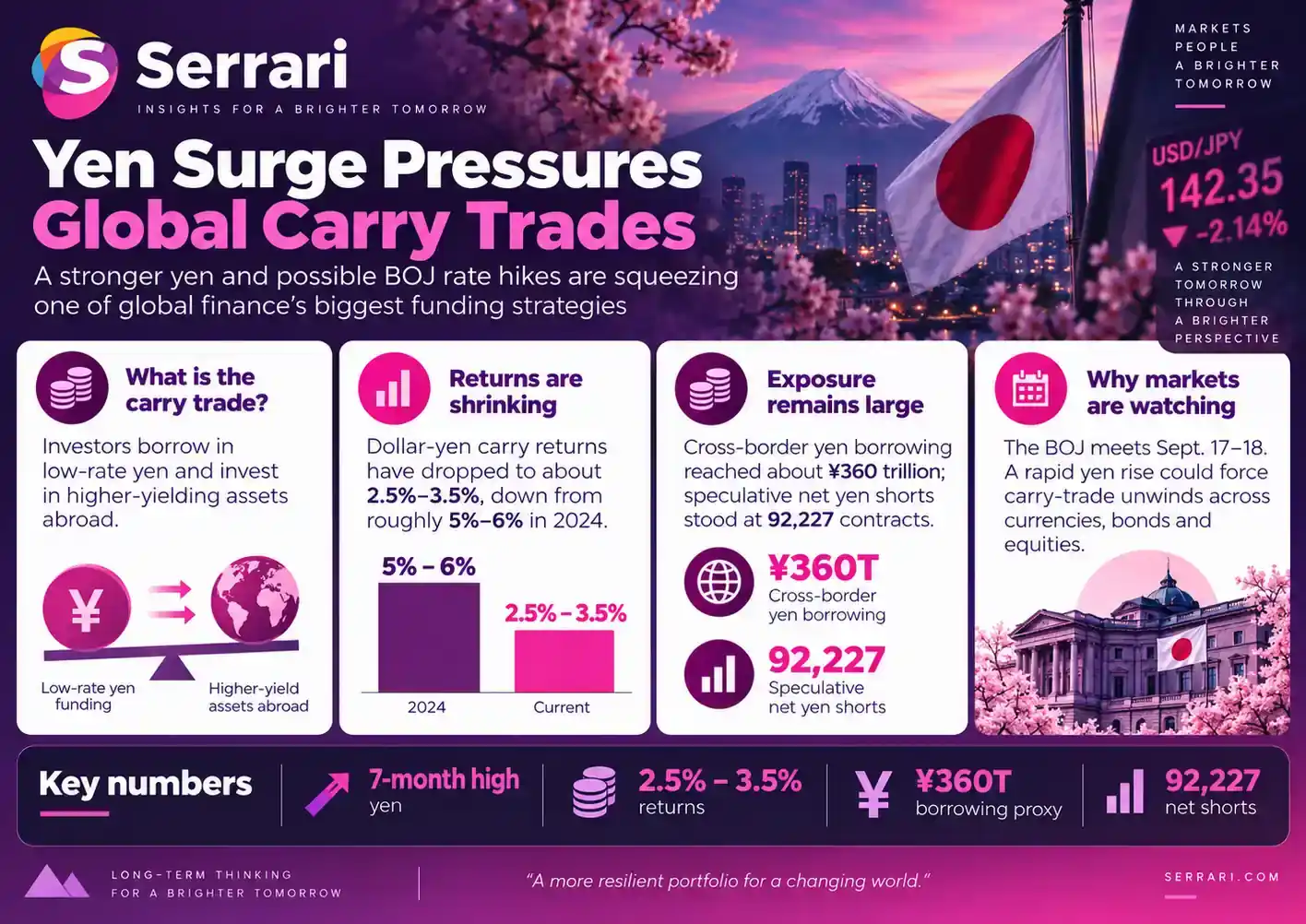
- Dollar-yen carry returns are now roughly 2.5%–3.5% annualised, down from about 5%–6% in 2024.
- The yen has climbed to a seven-month high as investors anticipate additional Japanese monetary tightening.
- Speculative net short positions in yen stood at 92,227 contracts in the week ended September 1.
- Cross-border yen borrowing reached an estimated ¥360 trillion by March, although this is only a proxy for the size of carry-trade activity.
- The next Bank of Japan policy meeting is scheduled for September 17–18, making interest-rate guidance a major trigger for global markets.
Why a Stronger Yen Hurts the Carry Trade
A yen carry trade works because investors borrow in a currency with relatively low interest rates and deploy the money into assets offering higher yields. The attraction is the interest-rate difference, but the trade also contains a major currency risk.
If the yen weakens, investors can earn both the yield spread and a favourable exchange-rate move. If the yen strengthens, however, converting foreign investments back into yen becomes more expensive and can quickly reduce or eliminate the trade’s profit.
That cushion has already narrowed. Current carry-trade estimates place annualised dollar-yen returns at about 2.5%–3.5%, compared with roughly 5%–6% during 2024. With less income available to absorb adverse exchange-rate moves, even a moderate yen rally now matters more to investors.
BOJ Tightening Is Changing the Funding Equation
Japan is no longer operating under the ultra-low-rate conditions that made the yen exceptionally attractive as a funding currency for years. The central bank’s July monetary-policy decision targets an overnight call rate of around 1.0%, following a series of steps away from the negative-rate regime that previously supported carry trades.
Its official policy calendar confirms that the next monetary policy meeting will take place on September 17 and 18. Market expectations have shifted toward another increase, potentially lifting the policy rate to 1.25%, although that remains a forecast rather than a confirmed decision.
That distinction matters. If tightening arrives broadly as expected, traders may continue reducing exposure in an orderly way. A larger increase, unexpectedly hawkish guidance or a sudden acceleration in yen strength could create much more disruptive conditions.
Context is everything. Stay ahead of shifting trends with today’s market updates, and uncover emerging opportunities using the Serrari Group Market Index and Marketplace. Then, take control of your own financial future by exploring our Money & Life Reset Transformation Blueprint ™ to build stronger habits, create better systems, and design a path toward lasting wealth.
How Large Is the Exposure?
The true size of the yen carry trade cannot be measured precisely because much of it sits across bank lending, derivatives, hedge-fund positions and leveraged strategies.
One widely watched proxy is cross-border yen borrowing. A recent analysis based on international banking statistics estimated that such borrowing reached a record ¥360 trillion, or about $2.34 trillion, in March. That figure should not be interpreted as ¥360 trillion of pure carry trades, but it illustrates the enormous pool of yen-linked funding circulating internationally.
Another indicator comes from regulated futures markets. Positioning data for September 1 show non-commercial traders holding 117,169 long yen contracts against 209,396 shorts, producing a net short position of 92,227 contracts. The short exposure had increased for a third consecutive week but remained well below the two-year peak recorded in July.
Why Markets Remember the 2024 Shock
The current anxiety reflects what happened after Japan tightened policy in July 2024. The yen strengthened rapidly from around ¥154 per dollar toward ¥141, undermining leveraged positions that had depended on a persistently weak Japanese currency.
As traders bought yen to repay funding and sold assets elsewhere, the adjustment helped intensify a broader global risk-off move. Japan’s Nikkei 225 plunged 12.4% in one session, its worst percentage decline since the 1987 crash.
The episode demonstrated why carry trades can become destabilising. Their returns often look steady while exchange rates remain favourable, but leverage can turn a rapid currency reversal into forced selling across otherwise unrelated markets.
Why 2026 May Be More Orderly
So far, the present move looks different. Policymakers have been signalling additional tightening in advance, giving investors more opportunity to reduce yen-funded positions before the September meeting.
The yen’s advance has also been relatively orderly compared with the abrupt 2024 reversal. Some investors have reportedly started considering alternative low-yielding funding currencies, including the Swiss franc, as the economics of borrowing yen become less attractive.
That does not eliminate systemic risk. The key issue is speed. A gradual appreciation can be absorbed through normal portfolio rebalancing, while a sudden surge can force leveraged investors to buy yen and sell risk assets at the same time.
For global markets, the yen is therefore becoming more than a foreign-exchange story. Its direction now provides an important signal about liquidity, leverage and whether one of the world’s most influential funding trades can unwind without triggering another cross-asset shock.
Sources: Reuters / Bank of Japan / U.S. Commodity Futures Trading Commission / Bank for International Settlements
Your financial future isn’t something you wait for—it’s something you build.
The real question is: when do you begin?
Move beyond simply staying informed.
Navigate the markets with clarity—track trends through the Serrari Group Market Index, uncover opportunities in the Serrari Marketplace, and build practical knowledge with our Curated Wealth Builder Platform.
Stay connected to what truly matters.
Get daily insights on macro trends and financial movements across Kenya, Africa, and global markets—delivered through the Serrari Newsletter.
Growth opens doors.
Advance your career through professional programs including ACCA, HESI A2, ATI TEAS 7 , HESI EXIT , NCLEX – RN and NCLEX – PN, Financial Literacy!🌟—designed to move you forward with confidence.
See where money is flowing—clearly and in real time.
Track Money Market Funds, Treasury Bills, Treasury Bonds, Green Bonds, and Fixed Deposits, alongside global and African indexes, key economic indicators, and the evolving Crypto and stablecoin landscape—all within Serrari’s Market Index.