Small and medium-sized enterprises face a growing risk of being pushed out of international supply chains as disruption in the Strait of Hormuz drives up energy, shipping, insurance and financing costs.
A new analysis of the disruption’s impact on smaller firms warns that SMEs have fewer options than large corporations to diversify suppliers, funding and markets, leaving them more vulnerable when trade routes become expensive or unreliable.
Key Overview
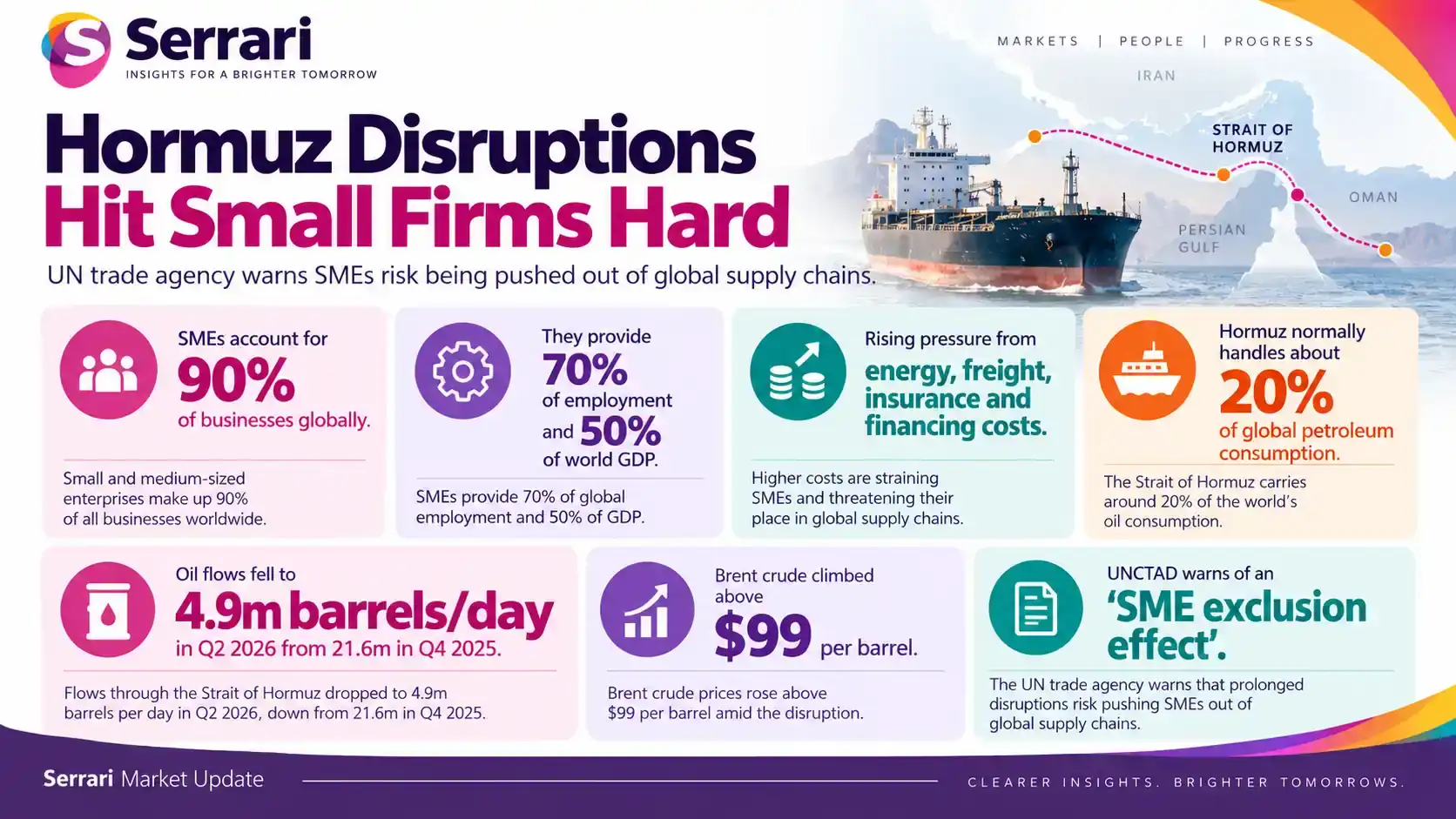
- SMEs account for about 90% of businesses globally, 70% of employment and 50% of global GDP.
- Higher energy prices, freight rates, insurance premiums and borrowing costs disproportionately affect smaller firms.
- The Strait of Hormuz normally carries roughly one-fifth of global petroleum consumption and more than 20% of global LNG trade.
- Oil movements through the strait averaged just 4.9 million barrels per day in Q2 2026, compared with 21.6 million barrels per day in Q4 2025.
- Renewed U.S.-Iran hostilities have pushed Brent crude back toward $100 per barrel.
- Smaller firms could scale back production, postpone investment or exit supply chains even if overall trade volumes later recover.
Smaller Firms Have Less Room to Absorb the Shock
The central concern is what the UN trade agency describes as an “SME exclusion effect.” Its latest assessment of smaller businesses finds that smaller companies frequently operate with thinner margins, more limited cash reserves and fewer alternative suppliers than multinational businesses, meaning sharp increases in transport or energy costs can quickly affect their ability to compete.
Large corporations may be able to move production, negotiate better shipping contracts, source from multiple markets or access cheaper financing. A small manufacturer or exporter often has less flexibility, particularly in developing economies where borrowing and logistics costs can already be relatively high.
The result can extend beyond temporary pressure on profits. Companies may reduce output, delay equipment purchases or abandon overseas customers when fulfilling contracts becomes too expensive. If that happens at scale, global supply chains could become increasingly concentrated among larger companies.
Hormuz Disruption Raises Costs Across Global Trade
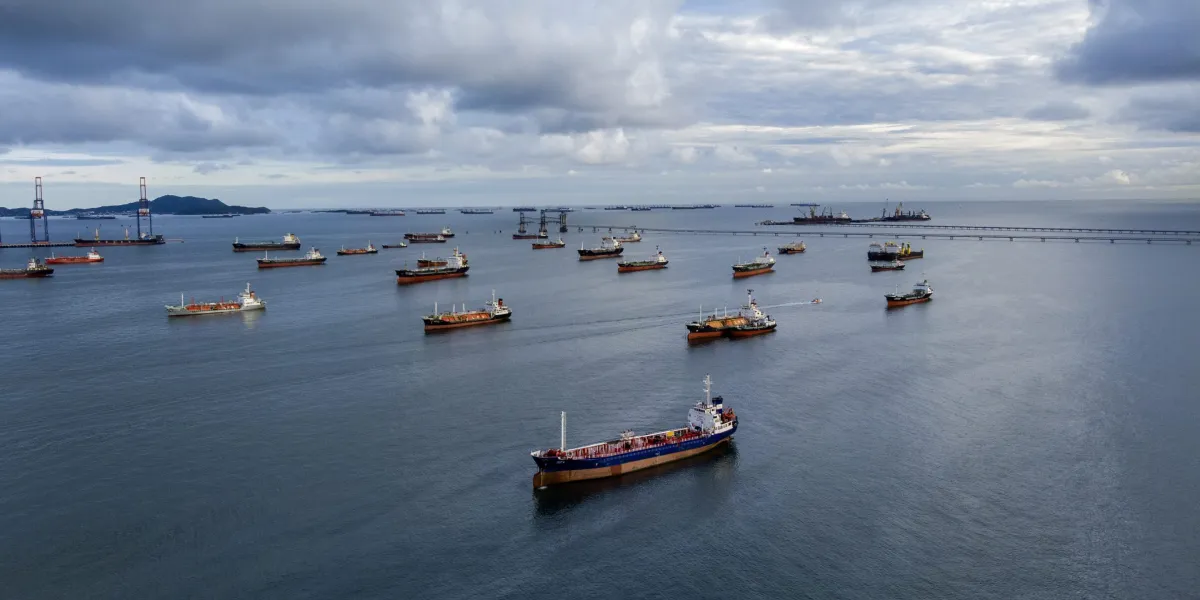
The Strait of Hormuz is one of the world’s most important energy chokepoints, connecting the Persian Gulf with global shipping routes through the Gulf of Oman.
Before the current conflict, approximately 20.9 million barrels per day moved through Hormuz during the first half of 2025, equivalent to roughly 20% of global petroleum liquids consumption. More than 20% of global LNG trade also passed through the waterway, highlighting why disruption quickly affects energy and transport costs far beyond the Gulf.
Those flows have fallen sharply. Updated energy-market estimates show Hormuz oil movements averaging 4.9 million barrels per day in the second quarter of 2026, down from 21.6 million barrels per day in the final quarter of 2025, forcing producers and traders to rely more heavily on alternative pipelines, ports and shipping arrangements.
These alternatives reduce some of the supply shock but generally involve additional distance, capacity limitations or higher operating costs.
Context is everything. Stay ahead of shifting trends with today’s market updates, and uncover emerging opportunities using the Serrari Group Market Index and Marketplace. Then, take control of your own financial future by exploring our Money & Life Reset Transformation Blueprint ™ to build stronger habits, create better systems, and design a path toward lasting wealth.
Oil Near $100 Adds Pressure to Business Costs
Renewed fighting around the Gulf has again pushed energy markets higher. Brent crude moved close to the $100-per-barrel threshold in early September as U.S.-Iran hostilities intensified and attacks threatened additional regional energy infrastructure.
Recent market data show that Middle Eastern crude shipments have fallen substantially from pre-conflict levels, although alternative export routes and increased production elsewhere have prevented an even larger rise in benchmark oil prices.
The risks are no longer limited to Hormuz. Houthi attacks have also disrupted energy operations in Saudi Arabia, creating the possibility that pressure could spread across several major regional export routes rather than remain concentrated around a single maritime chokepoint.
For SMEs, higher oil prices feed into electricity costs, fuel, air freight, road transport, packaging and manufacturing inputs. Shipping companies may also apply higher insurance and security costs to routes considered exposed to conflict.
Financing Could Become the Next Pressure Point
The trade shock can become especially damaging when higher operating costs coincide with tighter access to credit.
Smaller businesses often rely heavily on working-capital facilities and trade finance to pay suppliers before customers settle invoices. Longer shipping times increase the period during which money remains tied up in inventories, making access to affordable short-term financing increasingly important.
The UN policy recommendations therefore call for governments and financial institutions to protect SME access to trade finance and working capital while improving logistics support, market information and trade facilitation.
The warning is that recovery in headline global trade will not necessarily mean recovery for every company. If smaller suppliers lose contracts or customer relationships during the disruption, larger firms may retain that business even after shipping conditions normalise.
Protecting SMEs during the Hormuz crisis is therefore not only about helping individual businesses survive. With smaller firms accounting for most companies and a large majority of global employment, maintaining their participation in supply chains is also important for competition, job creation and the resilience of international trade.
Sources
Reuters / UN Trade and Development / U.S. Energy Information Administration
Your financial future isn’t something you wait for—it’s something you build.
The real question is: when do you begin?
Move beyond simply staying informed.
Navigate the markets with clarity—track trends through the Serrari Group Market Index, uncover opportunities in the Serrari Marketplace, and build practical knowledge with our Curated Wealth Builder Platform.
Stay connected to what truly matters.
Get daily insights on macro trends and financial movements across Kenya, Africa, and global markets—delivered through the Serrari Newsletter.
Growth opens doors.
Advance your career through professional programs including ACCA, HESI A2, ATI TEAS 7 , HESI EXIT , NCLEX – RN and NCLEX – PN, Financial Literacy!🌟—designed to move you forward with confidence.
See where money is flowing—clearly and in real time.
Track Money Market Funds, Treasury Bills, Treasury Bonds, Green Bonds, and Fixed Deposits, alongside global and African indexes, key economic indicators, and the evolving Crypto and stablecoin landscape—all within Serrari’s Market Index.