Kenya is intensifying reforms aimed at making the country easier to invest in, with changes spanning taxation, licensing, investor protection, digital approvals and green finance.
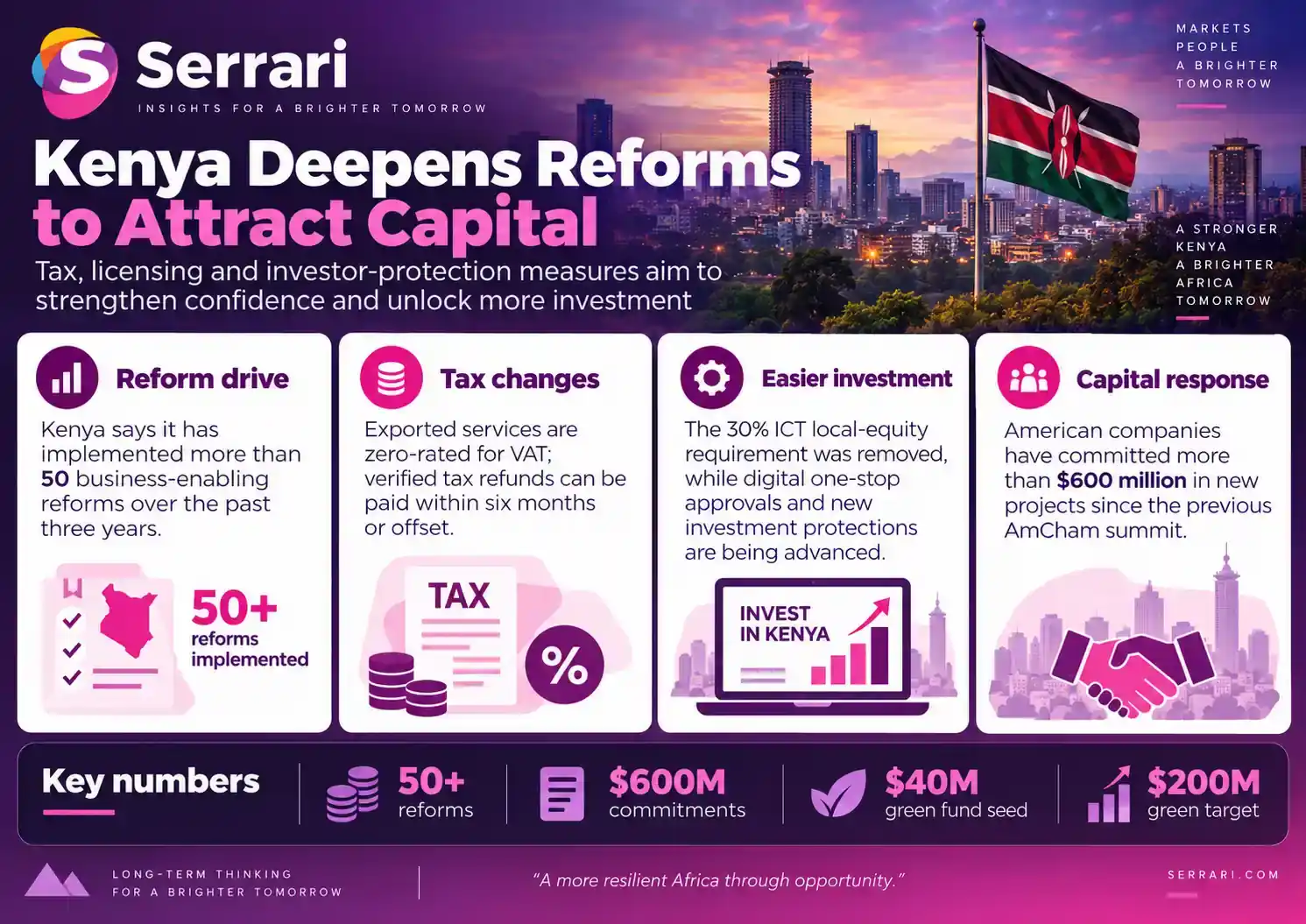
Speaking at the fifth AmCham Business Summit in Nairobi, President William Ruto said the government has implemented more than 50 business-enabling reforms over the past three years, many of them responding directly to concerns raised by investors.
The strategy is designed to improve predictability for investors while positioning Kenya as a gateway to regional and continental markets. The focus now is shifting from policy announcements toward implementation, particularly in licensing, tax administration and investment facilitation.
Key Overview
- Kenya says it has implemented more than 50 business-enabling reforms over three years.
- Exported services benefit from zero-rated VAT, while verified tax refunds can be paid within six months or offset against future liabilities.
- The 30% local equity requirement previously affecting ICT companies has been removed.
- County licensing reforms are intended to reduce duplicate permits, inconsistent procedures and cross-county business costs.
- New investment legislation is being developed to strengthen investor protection and streamline dispute resolution.
- The government says American companies have committed more than $600 million to new Kenyan projects since the previous AmCham summit.
Tax Reforms Target Longstanding Investor Concerns
Tax policy has been one of the most visible areas of reform. Government investment guidance confirms that exported services are zero-rated for VAT, while verified refund claims are intended to be settled within six months or made available for offset against future tax liabilities.
Kenya has also removed premature taxation on shares allocated to qualifying startup employees and scrapped the 30% domestic equity requirement that had applied to some ICT companies.
These measures are intended to address two issues repeatedly raised by investors: the cost of operating from Kenya while serving international markets and the uncertainty created when tax refunds remain outstanding for long periods.
County Licensing Moves Toward Greater Uniformity
Regulatory differences between counties remain another barrier for businesses operating nationally. The County Licensing (Uniform Procedures) Act establishes common principles for licensing, including simplified procedures, reduced duplication and more consistent treatment of businesses.
The law also requires counties to develop electronic application mechanisms and provides timelines for processing licence applications. The broader objective is to reduce situations where companies face different processes, fees and permit requirements simply because goods or services cross county boundaries.
Ruto has urged county governments to accelerate implementation while the national government develops additional measures. A proposed Paperwork Reduction Bill would require public agencies to justify or simplify compliance requirements, while a Food and Feed Safety Coordination Bill is intended to reduce overlapping regulatory processes affecting agricultural and food businesses.
Context is everything. Stay ahead of shifting trends with today’s market updates, and uncover emerging opportunities using the Serrari Group Market Index and Marketplace. Then, take control of your own financial future by exploring our Money & Life Reset Transformation Blueprint ™ to build stronger habits, create better systems, and design a path toward lasting wealth.
Investor Protection and Digital Approvals Take Priority
Kenya is also working on a broader legal framework for investment facilitation. Parliament currently lists the Investment and Export Promotion Authority Bill, 2026, while the government says the proposed framework is intended to strengthen safeguards for investors and improve dispute-resolution mechanisms.
The administration has also outlined plans for a digitised Investment One-Stop Centre through which investors would be able to submit applications, track approvals and engage with multiple government agencies through one platform.
If implemented effectively, the system could reduce the time investors spend navigating separate ministries and regulators. The practical test, however, will be whether approvals become measurably faster and more predictable rather than simply moving existing bureaucracy online.
US Investment Commitments Put Reforms to the Test
The government argues that the reform programme is already attracting new capital. Ruto told delegates that American companies had committed more than $600 million to new Kenyan projects since the previous summit.
Among the examples cited is Oracle’s planned Nairobi cloud region, which would expand hyperscale cloud infrastructure in East Africa. Independent industry analysis confirms that Oracle plans a Kenya cloud region, alongside additional African expansion.
Manufacturing investment is also growing, although one figure requires clarification. Mars Wrigley’s newest Athi River sugar-free gum production line represented about a $33 million additional investment, while the frequently cited $103 million figure refers to the company’s cumulative Kenya investment over roughly a decade.
Kenya Targets a Larger Share of Global FDI
Kenya’s reform drive comes as African economies compete for a still-small share of global investment. Global foreign direct investment rose to about $1.6 trillion in 2025, while Africa attracted roughly $70 billion, despite strong interest in energy, infrastructure, critical minerals and digital projects.
Kenya is positioning renewable energy, technology, manufacturing, healthcare, agro-processing and critical minerals as priority areas for new investment. Green finance is part of that strategy, with the government developing a Green Investment Fund that is intended to grow from an initial $40 million commitment toward a $200 million target.
The opportunity is significant, but investor confidence will ultimately depend on execution. Clear laws, consistent taxation, faster approvals and predictable licensing will matter more than headline reforms if Kenya is to convert global interest into sustained capital, jobs and productive capacity.
Sources: Kenya Broadcasting Corporation / Kenya Law / Parliament of Kenya / UN Trade and Development / State Department for Investment Promotion / S&P Global / Business Daily Africa / Y News
Your financial future isn’t something you wait for—it’s something you build.
The real question is: when do you begin?
Move beyond simply staying informed.
Navigate the markets with clarity—track trends through the Serrari Group Market Index, uncover opportunities in the Serrari Marketplace, and build practical knowledge with our Curated Wealth Builder Platform.
Stay connected to what truly matters.
Get daily insights on macro trends and financial movements across Kenya, Africa, and global markets—delivered through the Serrari Newsletter.
Growth opens doors.
Advance your career through professional programs including ACCA, HESI A2, ATI TEAS 7 , HESI EXIT , NCLEX – RN and NCLEX – PN, Financial Literacy!🌟—designed to move you forward with confidence.
See where money is flowing—clearly and in real time.
Track Money Market Funds, Treasury Bills, Treasury Bonds, Green Bonds, and Fixed Deposits, alongside global and African indexes, key economic indicators, and the evolving Crypto and stablecoin landscape—all within Serrari’s Market Index.