















Kenya-based electric mobility company ARC Ride has secured a $33.3 million financing package to expand its battery-swapping network, deploy more electric motorcycles and deepen its presence across Africa.
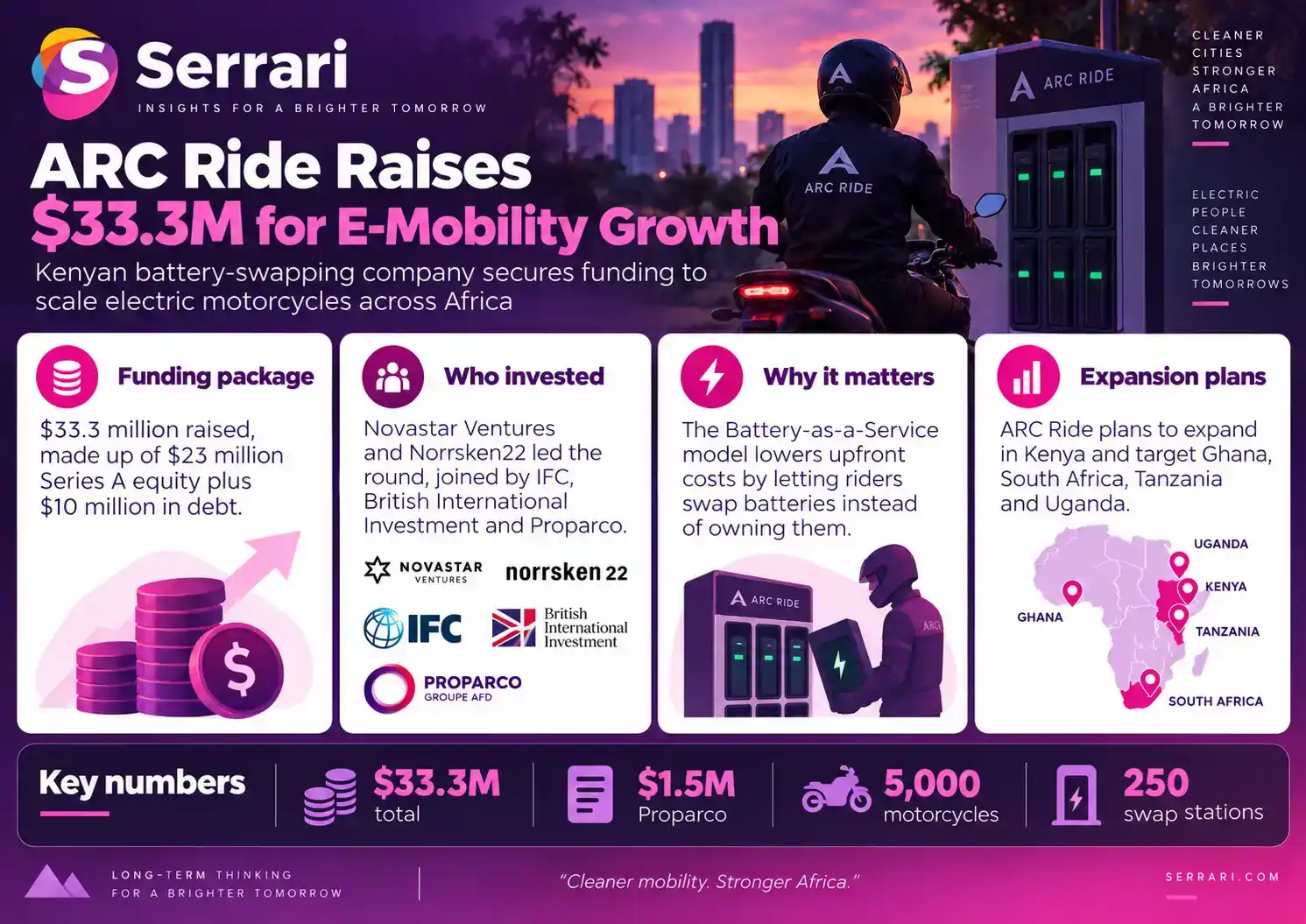
The financing combines a $23 million Series A equity round with $10 million in debt. French development finance institution Proparco has contributed a $1.5 million equity investment, while Novastar Ventures and Norrsken22 led the Series A and other development-finance investors joined the round.
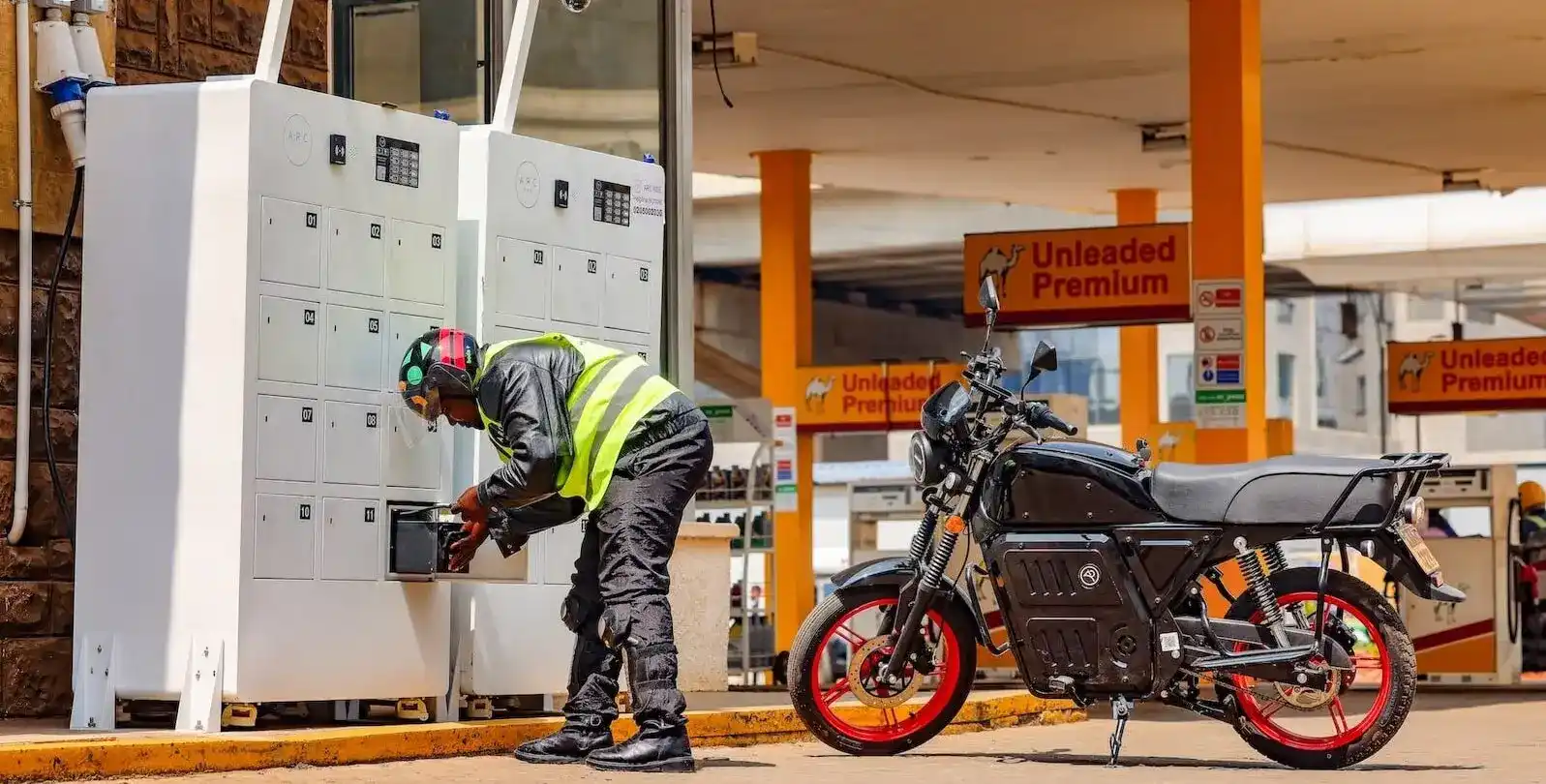
The funding strengthens ARC Ride’s push to make electric two- and three-wheelers more affordable through a Battery-as-a-Service model that separates battery ownership from vehicle ownership and allows riders to swap depleted batteries at dedicated stations.
Key Overview
- ARC Ride has assembled $33.3 million in financing, split between $23 million in Series A equity and $10 million in debt.
- Proparco invested $1.5 million in equity through the EU-backed Choose Africa VC programme.
- Novastar Ventures and Norrsken22 led the Series A, with IFC, British International Investment and Proparco participating as co-investors.
- Existing investors Musashi Seimitsu and Talanton also committed additional capital.
- The financing is expected to support the rollout of 5,000 additional electric motorcycles and more battery-swapping infrastructure.
- ARC Ride plans to expand further in Kenya while targeting Ghana, South Africa, Tanzania and Uganda.
Funding Brings Together Equity and Debt Investors
The financing structure combines venture capital, development-finance equity and debt, giving ARC Ride capital for both corporate expansion and asset-heavy infrastructure.
The $23 million Series A was led by Novastar Ventures and Norrsken22, with IFC, British International Investment and Proparco participating alongside them. A transaction summary from the company’s adviser also confirms that existing investors Musashi Seimitsu and Talanton provided further capital, while the debt portion includes financing from BII’s Kinetic programme and Mirova.
IFC had previously disclosed an equity investment of up to $5 million to support ARC Ride’s Series A, expansion in Kenya and East Africa, and further development of its technology platform.
Proparco’s $1.5 million commitment is being made under the EU-backed Choose Africa VC programme, which targets early-stage companies and aims to mobilise capital for innovation, employment and sustainable development.
Battery Swapping Targets the Cost Barrier
ARC Ride’s model is built around Battery-as-a-Service. Instead of requiring riders to purchase an expensive battery together with an electric motorcycle, batteries are managed separately and exchanged at swap stations when depleted.
This approach can reduce the initial cost of switching from petrol motorcycles while limiting the downtime associated with conventional charging. It is particularly relevant to boda-boda riders, whose motorcycles are income-generating assets and therefore need to remain on the road for long periods.
The company already operates automated battery-swapping infrastructure in Nairobi and Nakuru. A recent investment impact assessment states that ARC Ride has around 250 swapping stations facilitating roughly 10,000 battery swaps per day.
The same investment programme is supporting the deployment of 5,000 electric motorcycles, giving the new financing a direct link to both vehicle availability and the infrastructure required to keep them operating.
Context is everything. Stay ahead of shifting trends with today’s market updates, and uncover emerging opportunities using the Serrari Group Market Index and Marketplace. Then, take control of your own financial future by exploring our Money & Life Reset Transformation Blueprint ™ to build stronger habits, create better systems, and design a path toward lasting wealth.
Expansion Push Moves Beyond Nairobi
ARC Ride intends to continue building its Kenyan operations, including Nairobi and western Kenya, while expanding into Ghana, South Africa, Tanzania and Uganda.
The company is estimated to hold about 30% of Nairobi’s electric two-wheeler market, although the figure is an estimate rather than an independently audited market-share statistic.
International expansion will require ARC Ride to reproduce more than vehicle sales. Its model depends on enough battery-swap locations, maintenance capacity, battery-management systems and rider adoption to make electric motorcycles practical at scale.
That infrastructure requirement also explains why the company has combined equity with debt rather than relying exclusively on venture funding.
Climate and Employment Impact Form Part of the Case
The investment is also being framed around development and climate outcomes. Current projections indicate that the expansion could create more than 300 direct jobs and close to 2,900 indirect jobs over time.
The planned rollout is also expected to avoid approximately 100,000 tonnes of carbon emissions annually by replacing internal-combustion motorcycles with electric alternatives, although the eventual impact will depend on actual vehicle deployment, usage and electricity sources.
For riders, the more immediate investment case is economic. Fuel represents a significant operating cost for commercial motorcycle drivers, and battery swapping is intended to lower running costs while reducing the time vehicles spend unavailable for work.
What the Financing Means for African E-Mobility
ARC Ride’s round highlights how African electric mobility is moving beyond early pilot projects toward larger infrastructure-backed businesses. Funding is increasingly being directed not only toward vehicles but also toward charging networks, batteries, software and financing models that determine whether electric transport can function commercially.
The $33.3 million package gives ARC Ride more capacity to test whether its Kenyan model can be scaled across multiple African markets. Its success will depend on building sufficient network density, keeping batteries and swap stations reliable, controlling expansion costs and proving that riders consistently save money compared with petrol alternatives.
If those economics hold as the network grows, the financing could strengthen battery swapping as one of the more practical routes for electrifying Africa’s large commercial motorcycle market.
Sources: Proparco / International Finance Corporation / British International Investment / ICON Corporate Finance
Your financial future isn’t something you wait for—it’s something you build.
The real question is: when do you begin?
Move beyond simply staying informed.
Navigate the markets with clarity—track trends through the Serrari Group Market Index, uncover opportunities in the Serrari Marketplace, and build practical knowledge with our Curated Wealth Builder Platform.
Stay connected to what truly matters.
Get daily insights on macro trends and financial movements across Kenya, Africa, and global markets—delivered through the Serrari Newsletter.
Growth opens doors.
Advance your career through professional programs including ACCA, HESI A2, ATI TEAS 7 , HESI EXIT , NCLEX – RN and NCLEX – PN, Financial Literacy!🌟—designed to move you forward with confidence.
See where money is flowing—clearly and in real time.
Track Money Market Funds, Treasury Bills, Treasury Bonds, Green Bonds, and Fixed Deposits, alongside global and African indexes, key economic indicators, and the evolving Crypto and stablecoin landscape—all within Serrari’s Market Index.