


















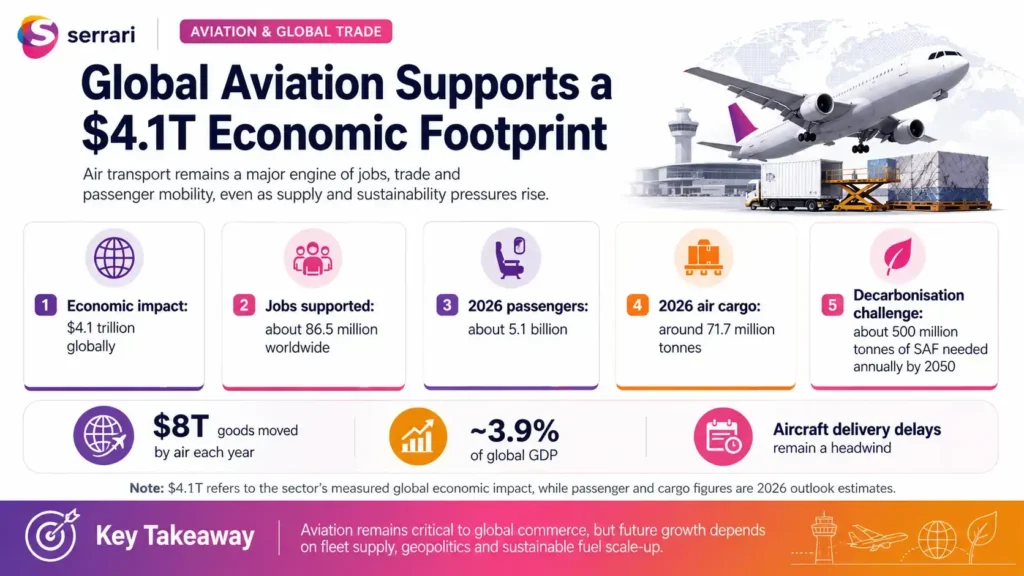
Global aviation remains one of the world economy’s most important enabling industries. According to the latest global economic-impact data (IATA), aviation supported $4.1 trillion in economic activity and approximately 86.5 million jobs worldwide. Importantly, the $4.1 trillion figure measures the industry’s 2023 economic impact rather than being a forecast for what aviation will add to the global economy in 2026.
The industry continues to expand in 2026, although geopolitical disruption and higher energy costs have moderated earlier expectations. The revised June 2026 industry outlook (IATA) now projects around 5.1 billion passengers and 71.7 million tonnes of air cargo this year, while aviation’s role in global trade remains outsized.
Key Overview
- Aviation’s global economic impact reached $4.1 trillion in 2023, equivalent to about 3.9% of global GDP.
- The sector supported approximately 86.5 million jobs worldwide.
- Airlines are now expected to carry about 5.1 billion passengers in 2026.
- Air cargo volumes are forecast to reach approximately 71.7 million tonnes this year.
- Air freight transports goods worth roughly $8 trillion annually.
- Sustainable aviation fuel production remains far below the roughly 500 million tonnes required annually by 2050 under the industry’s net-zero pathway.
Passenger Growth Continues Despite a Tougher 2026
Air travel entered 2026 with strong momentum after global passenger traffic increased 5.7% in 2025. Earlier projections had suggested airlines would carry 5.2 billion passengers this year, but that estimate was subsequently revised as conflict-related disruption in the Middle East and rising fuel costs affected airline operations.
The latest forecast of approximately 5.1 billion passengers still represents continued growth. Airlines are also expected to fill around 84% of available seats, highlighting resilient demand even as the industry deals with shortages of new aircraft, delayed deliveries and constrained capacity.
Aircraft supply has become an increasingly important issue. Carriers have been forced to operate older fleets for longer as manufacturers struggle to meet delivery schedules. That increases maintenance requirements and limits improvements in fuel efficiency just as airlines face pressure to lower emissions.
Air Cargo Remains Critical to Global Trade
Aviation’s economic importance extends well beyond passenger travel. Air freight moves goods worth more than $8 trillion annually (IATA), including pharmaceuticals, electronics, industrial components and other high-value or time-sensitive products.
Although air freight represents only a small share of global trade by physical volume, it accounts for roughly one-third of global trade by value. That makes aviation especially important for supply chains where speed, reliability and inventory efficiency are critical.
Cargo volumes are now expected to reach around 71.7 million tonnes in 2026. Growth is relatively modest as weaker global trade conditions and geopolitical uncertainty weigh on demand, but air cargo remains crucial for international commerce and e-commerce supply chains.
Context is everything. Stay ahead of shifting trends with today’s market updates, and uncover emerging opportunities using the Serrari Group Market Index and Marketplace. Then, take control of your own financial future by exploring our Money & Life Reset Transformation Blueprint ™ to build stronger habits, create better systems, and design a path toward lasting wealth.
Safety Remains a Core Industry Strength
Commercial aviation continues to maintain an exceptionally strong long-term safety record. The 2025 aviation safety results (IATA) show that airlines operated 38.7 million flights during the year and recorded 51 accidents, equivalent to 1.32 accidents per million flights.
The industry’s five-year fatal accident rate has improved significantly over the past decade. Because nearly 40 million flights are operated annually, even a small number of additional incidents can noticeably affect annual statistics, but the long-term trend continues to demonstrate the high level of safety achieved by commercial aviation.
The SAF Challenge Is Becoming More Urgent
Decarbonisation remains one of aviation’s biggest structural challenges. Sustainable aviation fuel is expected to make a major contribution because long-haul aircraft are difficult to electrify and alternative propulsion technologies are not yet ready to replace conventional jet fuel at global scale.
The latest sustainable fuel outlook (IATA) estimates that approximately 500 million tonnes of SAF will be required annually by 2050 to support aviation’s net-zero carbon target. Yet production in 2026 is projected at only about 2.4 million tonnes, equivalent to roughly 0.8% of global jet fuel consumption.
Closing that gap will require major investment in renewable energy, feedstocks, refining capacity and supportive regulation. Without substantially faster production growth, SAF availability could become one of the biggest constraints on aviation’s long-term decarbonisation plans.
The World’s Largest Aviation Economies
The economic importance of aviation varies significantly between countries. Based on 2023 economic-impact assessments, the United States aviation sector (IATA) supports around $1.3 trillion of GDP and 7.6 million jobs, making it the world’s largest national aviation economy.
China follows with approximately $253.6 billion in aviation-supported GDP, while Spain contributes approximately $172.9 billion. Other major aviation economies include the United Kingdom, France, Germany, Japan and Italy.
The Middle East also demonstrates how important aviation can become to national diversification strategies. Saudi Arabia’s aviation economic footprint (IATA) supports approximately $90.6 billion of economic activity, equivalent to around 8.5% of GDP, while the UAE’s aviation and tourism ecosystem represents an even larger proportion of its economy.
Outlook
The aviation industry enters the second half of 2026 with demand still growing but facing a more complicated operating environment. Passenger numbers remain on course for another historically strong year, cargo continues to underpin high-value global trade, and the industry’s broader economic footprint remains enormous.
The longer-term challenge is balancing that growth with constrained aircraft supply, geopolitical risks and the massive investment required to decarbonise aviation. The sector’s $4.1 trillion economic impact demonstrates its importance to the global economy, but its next phase will depend on whether infrastructure, aircraft production and sustainable fuel supply can keep pace with rising demand.
Sources: International Air Transport Association / Air Transport Action Group / Oxford Economics
Your financial future isn’t something you wait for—it’s something you build.
The real question is: when do you begin?
Move beyond simply staying informed.
Navigate the markets with clarity—track trends through the Serrari Group Market Index, uncover opportunities in the Serrari Marketplace, and build practical knowledge with our Curated Wealth Builder Platform.
Stay connected to what truly matters.
Get daily insights on macro trends and financial movements across Kenya, Africa, and global markets—delivered through the Serrari Newsletter.
Growth opens doors.
Advance your career through professional programs including ACCA, HESI A2, ATI TEAS 7 , HESI EXIT , NCLEX – RN and NCLEX – PN, Financial Literacy!🌟—designed to move you forward with confidence.
See where money is flowing—clearly and in real time.
Track Money Market Funds, Treasury Bills, Treasury Bonds, Green Bonds, and Fixed Deposits, alongside global and African indexes, key economic indicators, and the evolving Crypto and stablecoin landscape—all within Serrari’s Market Index.