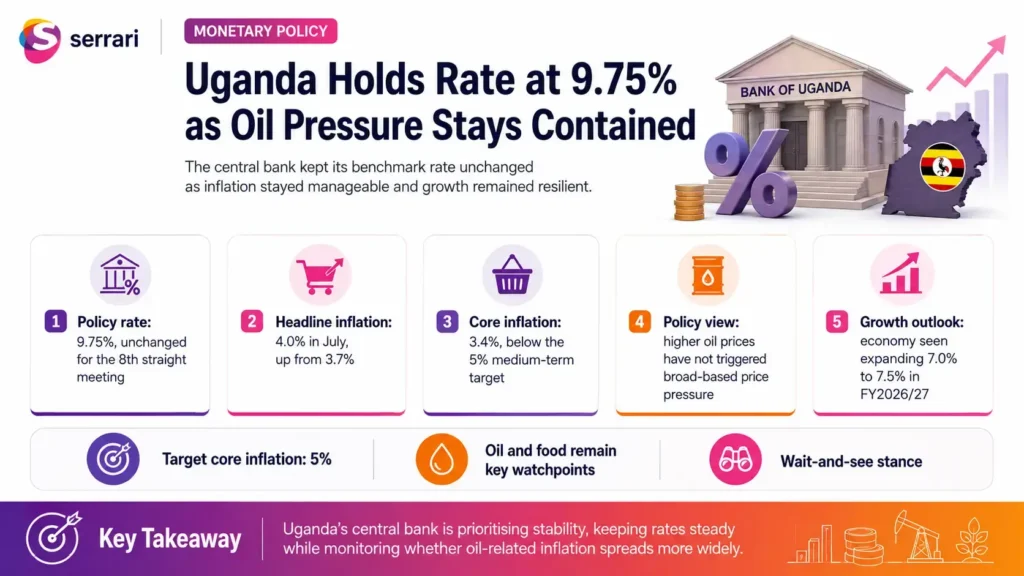
Uganda’s central bank has maintained its benchmark interest rate at 9.75%, extending one of East Africa’s longest current monetary-policy pauses as policymakers balance stronger economic growth against risks from energy prices and geopolitical instability. The August monetary policy decision marked the eighth consecutive meeting without a change in the Central Bank Rate, which has remained at 9.75% since October 2024.
Headline inflation accelerated to 4.0% in July from 3.7% in June, but underlying inflation remained contained. The central bank said higher international oil prices have so far failed to create broad-based price pressures across the economy, allowing policymakers to keep rates unchanged while monitoring how energy costs feed through to households and businesses.
Key Overview
- The Central Bank Rate remains at 9.75%.
- Headline inflation increased to 4.0% in July 2026 from 3.7% in June.
- Core inflation remained unchanged at 3.4%, below the central bank’s 5% medium-term target.
- Energy, Fuel and Utilities inflation climbed to 14.9%, highlighting the impact of higher petroleum costs.
- Uganda’s economy is estimated to have expanded 6.4% in FY2025/26.
- Growth is projected to accelerate to 7.0%-7.5% in FY2026/27.
- Policymakers remain cautious because oil prices, geopolitical tensions, weather and exchange-rate movements could still push inflation higher.
Oil Prices Raise Headline Inflation Without Wider Spillover
Uganda’s inflation has been rising gradually, but the composition of the increase is important. The latest consumer-price data showed headline inflation at 4.0% (Ubos) in July, compared with 3.7% a month earlier.
The increase was driven primarily by energy and food. Energy, Fuel and Utilities inflation rose sharply to 14.9% from 11.9%, reflecting higher petroleum-product prices and the effect of earlier weakness in the Ugandan shilling. Food-crop inflation also increased to 1.6% from zero in June.
Yet the broader inflation picture remained considerably calmer. Annual core inflation held at 3.4%, while services inflation eased from 4.9% to 4.8%. Those figures underpin the central bank’s conclusion that the oil-price shock has not yet spread significantly into the wider basket of goods and services.
That distinction is critical for monetary policy. Raising interest rates is less effective against temporary supply-driven increases in fuel prices than against persistent demand-driven inflation, particularly when underlying prices remain below target.
Context is everything. Stay ahead of shifting trends with today’s market updates, and uncover emerging opportunities using the Serrari Group Market Index and Marketplace. Then, take control of your own financial future by exploring our Money & Life Reset Transformation Blueprint ™ to build stronger habits, create better systems, and design a path toward lasting wealth.
Inflation Outlook Improves but Risks Remain
The central bank has actually revised its near-term inflation projections downward as international oil prices moved below their May 2026 peak and pressure on the shilling moderated.
Under the latest inflation outlook , core inflation is expected to average 4.0%-4.5% over the next 12 months, while headline inflation is projected to average between 5.5% and 6.0%.
The difference reflects the continued influence of volatile food and energy components. While underlying inflation is expected to remain around the central bank’s medium-term 5% objective, headline inflation could run higher as households continue absorbing elevated energy costs.
Risks nevertheless remain tilted upward. Further geopolitical escalation could disrupt global supply chains and raise international oil prices, while poor weather could reduce agricultural output and push food prices higher. Renewed global monetary tightening could also trigger capital outflows and weaken the shilling, increasing the local cost of imports.
These uncertainties explain why the central bank is resisting an immediate rate cut even though underlying inflation remains relatively modest.
Uganda’s Economy Is Accelerating
The decision also comes against a strengthening domestic economic backdrop. Uganda’s economy is estimated to have grown 6.4% in the 2025/26 financial year, supported by improving private-sector credit, household consumption, investment and government spending.
The central bank now expects growth to accelerate to between 7.0% and 7.5% in FY2026/27 before moving towards roughly 8% over the medium term.
Higher investment, stronger exports, remittance inflows and the development of Uganda’s oil industry are expected to provide additional momentum. The country’s external position has also strengthened, with the balance of payments recording a $2.4 billion surplus in the 12 months to June 2026, contributing to higher foreign-exchange reserves.
The broader outlook is consistent with a recent assessment of Uganda’s economic resilience (IMF), which highlighted robust domestic demand, low underlying inflation and improving private-sector credit as important growth supports.
Why the Central Bank Is Still Waiting
For policymakers, the current environment creates an unusual balance. Inflation is below the medium-term core target and economic activity is strengthening, conditions that could ordinarily create room for monetary easing.
However, the central bank wants clearer evidence that recent increases in food, fuel and other input costs will not develop into broader inflation. The policy statement explicitly maintained a cautious stance while allowing more time to assess global developments and their effect on domestic prices.
The decision therefore keeps monetary conditions stable rather than signalling either renewed tightening or an imminent easing cycle. The rediscount rate remains 12.75%, while the bank rate stays at 13.75%.
For Uganda, the next policy move will increasingly depend on whether oil-driven inflation remains concentrated in energy-related categories. If core inflation stays contained and the shilling remains stable, pressure for eventual easing could increase. A renewed surge in oil prices or broader pass-through into consumer prices would instead strengthen the case for keeping monetary policy restrictive for longer.
Sources: Bank of Uganda / Reuters / Uganda Bureau of Statistics / International Monetary Fund
Your financial future isn’t something you wait for—it’s something you build.
The real question is: when do you begin?
Move beyond simply staying informed.
Navigate the markets with clarity—track trends through the Serrari Group Market Index, uncover opportunities in the Serrari Marketplace, and build practical knowledge with our Curated Wealth Builder Platform.
Stay connected to what truly matters.
Get daily insights on macro trends and financial movements across Kenya, Africa, and global markets—delivered through the Serrari Newsletter.
Growth opens doors.
Advance your career through professional programs including ACCA, HESI A2, ATI TEAS 7 , HESI EXIT , NCLEX – RN and NCLEX – PN, Financial Literacy!🌟—designed to move you forward with confidence.
See where money is flowing—clearly and in real time.
Track Money Market Funds, Treasury Bills, Treasury Bonds, Green Bonds, and Fixed Deposits, alongside global and African indexes, key economic indicators, and the evolving Crypto and stablecoin landscape—all within Serrari’s Market Index.