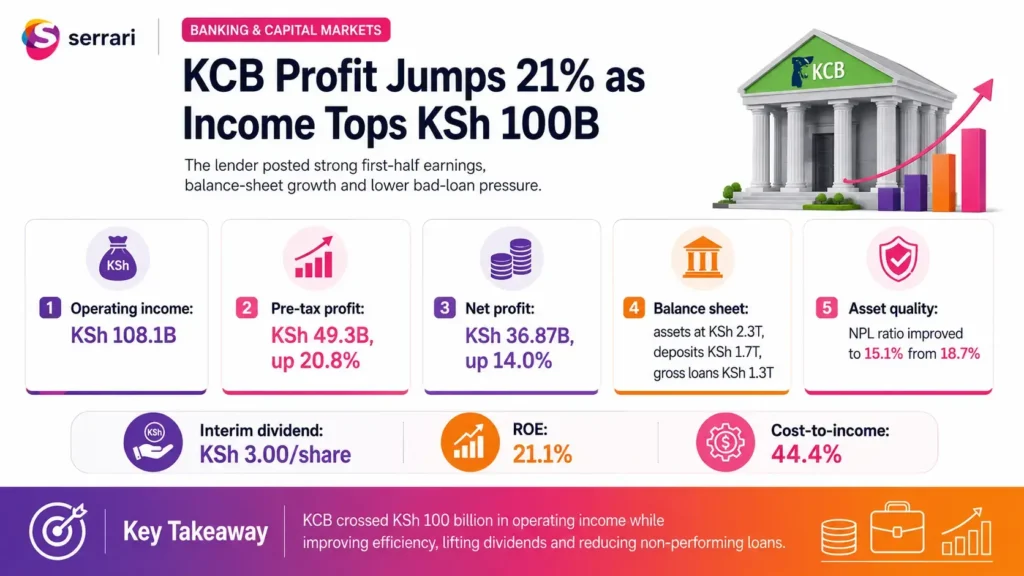
KCB Group delivered a strong first-half performance for the six months ended June 2026, with profit before tax rising to KSh 49.3 billion, up 20.8% year on year. Operating income crossed the KSh 100 billion mark for the first time, reaching KSh 108.1 billion, as growth in lending, fees and foreign-exchange income helped offset a more modest increase in interest income.
The lender also improved asset quality, reduced its stock of non-performing loans and expanded its balance sheet to KSh 2.3 trillion. That combination of earnings growth, stronger cost discipline and lower impairment charges allowed KCB to lift its interim dividend to KSh 3.00 per share, signaling confidence in both profitability and capital strength.
Key Overview
- Operating income rose 9.5% to KSh 108.1 billion.
- Profit before tax increased 20.8% to KSh 49.3 billion.
- Profit after tax climbed to KSh 36.87 billion.
- Total assets expanded 16.8% to KSh 2.3 trillion.
- Gross loans grew 14.2% to KSh 1.3 trillion while customer deposits rose 15.1% to KSh 1.7 trillion.
- Gross non-performing loans fell to KSh 203.8 billion, lowering the NPL ratio to 15.1% from 18.7%.
- The board approved an interim dividend of KSh 3.00 per share, up 50% from last year.
Lower Funding Costs and Stronger Fees Drove Revenue
KCB’s half-year results release shows a business that is benefiting not only from higher volumes but also from better income mix. Net interest income grew 7.0% to KSh 74.0 billion, helped by reduced funding costs as interest expense declined and the cost of funds eased to 3.4% from 3.9%.
The bigger boost came from non-funded income. Non-interest income rose 15.4% to KSh 34.08 billion, accounting for 31.5% of total income. Fees and commissions expanded strongly, especially from lending activity, while foreign-exchange income also improved on higher transaction volumes.
This matters because a broader earnings base reduces reliance on pure lending spreads. For investors, it suggests KCB is becoming more resilient in a lower-rate environment by earning more from payments, advisory, trading and customer activity across the franchise.
Context is everything. Stay ahead of shifting trends with today’s market updates, and uncover emerging opportunities using the Serrari Group Market Index and Marketplace. Then, take control of your own financial future by exploring our Money & Life Reset Transformation Blueprint ™ to build stronger habits, create better systems, and design a path toward lasting wealth.
Efficiency Improved as Credit Costs Fell
Another major support to earnings was improved efficiency. Operating costs excluding impairment increased, but at a slower pace than revenue, allowing the cost-to-income ratio to improve to 44.4% from 46.0%.
At the same time, asset quality metrics improved materially. Gross non-performing loans dropped by about KSh 17.3 billion to KSh 203.8 billion, and the NPL ratio fell to 15.1% from 18.7%. Loan impairment charges also declined, helping bring down the cost of risk.
The decline in bad loans points to stronger recoveries, restructuring of distressed accounts and tighter credit management. While the stock of impaired loans remains high, the direction is clearly positive and gives KCB more room to protect earnings if the operating environment stays stable.
Balance Sheet Growth Remained Strong
KCB continued to grow its core franchise aggressively. Gross loans rose 14.2% to KSh 1.3 trillion, while customer deposits increased 15.1% to KSh 1.7 trillion. That supported a 16.8% increase in total assets to KSh 2.3 trillion.
The bank’s capital and returns profile also remained strong. Return on equity stood at 21.1%, which is a high level for a large regional banking group. Core capital and total capital ratios stayed comfortably above regulatory minimums, reinforcing the bank’s ability to keep growing and maintain shareholder distributions.
The interim dividend increase to KSh 3.00 per share therefore looks well supported. It reflects not only profit growth, but also management’s confidence in liquidity, capital buffers and the sustainability of the current earnings momentum.
Regional Units and Non-Banking Businesses Added Support
KCB’s regional diversification remains a key strength. Operations outside KCB Bank Kenya contributed 27.7% of group profit before tax and represented 31.1% of the total balance sheet, showing that the business is no longer overly dependent on its home market.
Non-banking subsidiaries were also impressive. KCB Investment Bank more than tripled profit before tax, benefiting from increased advisory work and capital markets activity, while trustee and bancassurance businesses also grew.
That mix gives KCB several levers for future expansion. If interest margins come under pressure, the group can still lean on regional banking, investment banking, insurance-linked income and transaction services to support growth.
Outlook
KCB enters the second half of 2026 with momentum. Revenue is growing, loan quality is improving and capital remains strong. The biggest watch points will be whether the bank can continue reducing non-performing loans and sustain faster growth in non-funded income.
Even so, the first-half numbers show a lender that is expanding with discipline. Crossing KSh 100 billion in operating income is symbolically important, but the more meaningful takeaway is that KCB achieved it while also improving efficiency, lowering credit strain and raising shareholder payouts.
Sources: KCB Group / Kenyan Wall Street
Your financial future isn’t something you wait for—it’s something you build.
The real question is: when do you begin?
Move beyond simply staying informed.
Navigate the markets with clarity—track trends through the Serrari Group Market Index, uncover opportunities in the Serrari Marketplace, and build practical knowledge with our Curated Wealth Builder Platform.
Stay connected to what truly matters.
Get daily insights on macro trends and financial movements across Kenya, Africa, and global markets—delivered through the Serrari Newsletter.
Growth opens doors.
Advance your career through professional programs including ACCA, HESI A2, ATI TEAS 7 , HESI EXIT , NCLEX – RN and NCLEX – PN, Financial Literacy!🌟—designed to move you forward with confidence.
See where money is flowing—clearly and in real time.
Track Money Market Funds, Treasury Bills, Treasury Bonds, Green Bonds, and Fixed Deposits, alongside global and African indexes, key economic indicators, and the evolving Crypto and stablecoin landscape—all within Serrari’s Market Index.