Absa Group has agreed to sell its controlling interests in First Assurance Company and Absa Life Assurance Kenya to First Assurance Investments, according to current Kenyan reports based on an Absa notice.
The transaction covers Absa’s reported 63.32% stake in each insurer and remains subject to regulatory approvals. Existing insurance distribution through Absa Bank Kenya is expected to continue.
For investors, that distinction is more important than the ownership change itself: Absa could exit insurance manufacturing and underwriting risk while remaining involved in bancassurance distribution and fee generation.
Key Overview
- Absa is reported to be selling 63.32% of First Assurance.
- It is also selling 63.32% of Absa Life Assurance Kenya.
- Transaction consideration has not been publicly disclosed.
- Completion remains subject to regulatory approvals.
- Absa Bank Kenya is expected to continue distributing insurance products.
- Absa Group reports first-half results on 18 August 2026.
Absa Kenya Insurance Exit Shifts Focus to Bancassurance
Absa Group’s planned disposal of its Kenyan insurance companies raises a useful question for investors:
Why sell the insurer while continuing to sell insurance?
Current Kenyan transaction coverage of the sale says Absa has agreed to transfer its 63.32% controlling stakes in First Assurance Company and Absa Life Assurance Kenya to First Assurance Investments.
The deal still needs regulatory approval, and the consideration has not been disclosed.
Crucially, existing distribution relationships through Absa Bank Kenya are expected to remain.
That potentially leaves Absa participating in insurance sales without directly owning the companies underwriting the policies.
Manufacturing and Distribution Are Different Businesses
Insurance manufacturing means actually underwriting the policy.
The insurer prices risk, collects premiums, maintains regulatory capital, invests reserves, processes claims and carries the financial risk that claims may be higher than expected.
Bancassurance is different.
A bank uses its branches, digital channels and customer relationships to distribute insurance products. It may earn commissions and fees without necessarily carrying the policy’s underlying underwriting risk.
Kenya’s regulator separately licenses bancassurance intermediaries, and Absa Bancassurance Intermediary is included among regulated participants.
Absa could therefore remain an important insurance distributor even after giving up ownership of the manufacturing businesses.
Why Might Absa Prefer Distribution?
The attraction is partly capital intensity.
An insurer needs capital against the risks it underwrites. It also needs actuarial, claims, compliance, investment and operational infrastructure.
A distributor can focus more heavily on customer acquisition and fee income.
That does not mean bancassurance has no risk. Poor product selection, customer complaints and weak claims experiences can still damage a bank’s reputation.
But the financial risk profile is different from directly underwriting insurance liabilities.
For shareholders, the relevant question is whether Absa can preserve attractive insurance-related fee income while releasing capital and management attention from businesses it no longer wants to manufacture directly.
Context is everything. Stay ahead of shifting trends with today’s market updates, and uncover emerging opportunities using the Serrari Group Market Index and Marketplace. Then, take control of your own financial future by exploring our Money & Life Reset Transformation Blueprint ™ to build stronger habits, create better systems, and design a path toward lasting wealth.
Absa Life Is Not a Small Business
The disposal includes an insurer with a meaningful position in Kenya’s life market.
Official IRA data show Absa Life produced KSh2.973 billion in gross premium income during Q1 2025 and held 5.56% of Kenya’s long-term insurance market.
Within group life specifically, its market share was much larger at 19.51%.
Absa Life describes itself as Kenya’s first life insurer to adopt a fully bancassurance-based distribution model when it began operating in 2015.
That history makes the proposed ownership change especially interesting: distribution has been central to the business model from the beginning.
First Assurance Completes the Manufacturing Exit
First Assurance covers the general-insurance side of the transaction.
Its official corporate history still identifies Absa as its majority shareholder following the acquisition of approximately 63.3% in 2015.
The website continuing to show Absa ownership is not inconsistent with the proposed sale: the transaction has not yet completed.
Policyholders should therefore distinguish between a signed ownership transaction and an immediate change to their insurance contract.
Regulatory approval and legal completion come first.
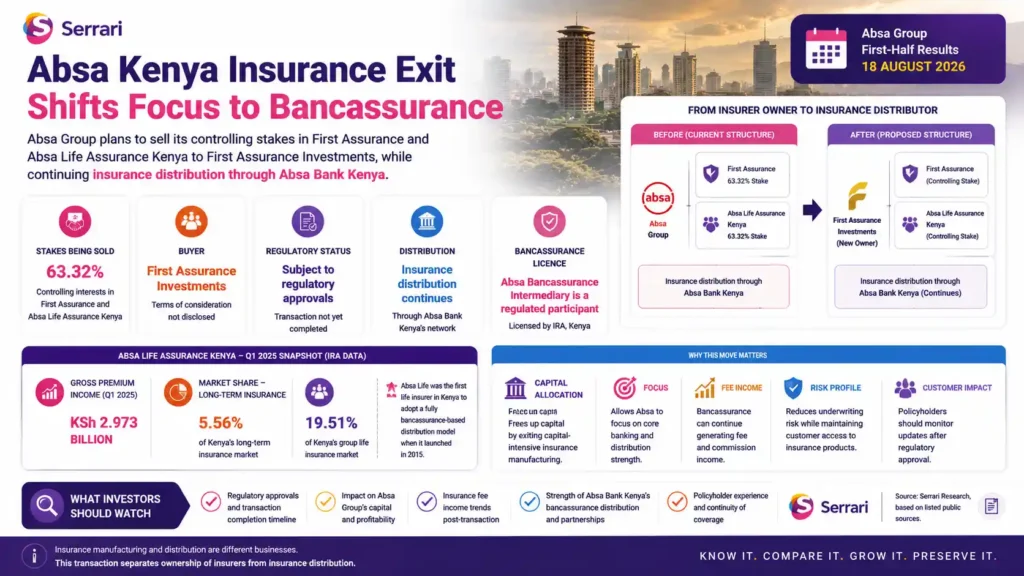
Before the proposed sale, Absa owns controlling interests in First Assurance and Absa Life while also distributing insurance through Absa Bank Kenya. After completion, insurance-company ownership moves to First Assurance Investments, while Absa Bank is expected to retain bancassurance distribution. The graphic separates underwriting risk and capital requirements from product distribution and commission income.
Earnings Arrive Immediately After the Deal
The timing gives investors another catalyst.
Absa will release its first-half results on 18 August 2026.
In its June pre-close update, management said Africa Regions headline earnings were expected to decline because of lower net interest income and higher credit impairments. It specifically highlighted margin pressure from lower policy rates across several African markets, including Kenya.
That makes the insurance disposal relevant to a wider capital-allocation discussion.
Investors can ask whether management sees greater returns from deploying capital into banking, wealth, payments and distribution rather than owning Kenyan insurance underwriting operations.
What Investors Should Watch
The next important signals are:
- Regulatory approvals;
- Final completion date;
- Any disclosed transaction consideration;
- Treatment of existing policyholders;
- Future bancassurance agreements;
- Insurance fee and commission income; and
- Management commentary at the 18 August results.
The sale price will be particularly important in determining whether Absa crystallises a gain or loss on disposal.
Conclusion
Absa’s proposed Kenyan insurance exit should not be interpreted as an exit from insurance altogether.
The more useful distinction is between manufacturing insurance and distributing insurance.
Selling First Assurance and Absa Life could remove direct underwriting exposure and associated capital requirements, while continued bancassurance relationships allow Absa Bank Kenya to remain a route through which customers buy cover.
For investors, the success of that strategy will depend on whether Absa can retain meaningful fee income while using the released capital more productively elsewhere.
The 18 August results should provide the next opportunity to test that logic.
FAQs
1. Has Absa completed the sale?
No. Current reports say an agreement has been reached, but completion remains subject to regulatory approvals. A final completion date has not been announced.
2. Is Absa leaving insurance in Kenya entirely?
Not necessarily. Absa is proposing to exit direct ownership of the insurance manufacturers, while insurance products are expected to continue being distributed through Absa Bank Kenya.
3. What is the difference between bancassurance and underwriting?
Underwriting means the insurer accepts and financially carries insurance risk. Bancassurance is the distribution of insurance products through a bank’s customer network, normally generating fee or commission income.
4. How significant is Absa Life in Kenya?
IRA data show KSh2.973 billion of Q1 2025 gross premium income, an overall 5.56% long-term market share and a 19.51% share of group-life premiums.
Sources: Kenyan Wall Street transaction coverage, Kenya Times sale coverage, Absa Group 1H26 results event, Absa 1H26 pre-close transcript, IRA Q1 2025 industry statistics, First Assurance official company history, Absa Life official company information.
Your financial future isn’t something you wait for—it’s something you build.
The real question is: when do you begin?
Move beyond simply staying informed.
Navigate the markets with clarity—track trends through the Serrari Group Market Index, uncover opportunities in the Serrari Marketplace, and build practical knowledge with our Curated Wealth Builder Platform.
Stay connected to what truly matters.
Get daily insights on macro trends and financial movements across Kenya, Africa, and global markets—delivered through the Serrari Newsletter.
Growth opens doors.
Advance your career through professional programs including ACCA, HESI A2, ATI TEAS 7 , HESI EXIT , NCLEX – RN and NCLEX – PN, Financial Literacy!🌟—designed to move you forward with confidence.
See where money is flowing—clearly and in real time.
Track Money Market Funds, Treasury Bills, Treasury Bonds, Green Bonds, and Fixed Deposits, alongside global and African indexes, key economic indicators, and the evolving Crypto and stablecoin landscape—all within Serrari’s Market Index.