World Liberty Financial’s USD1 stablecoin has moved closer to operating through a federally supervised national trust bank after the OCC granted World Liberty Trust Company preliminary conditional approval.
The decision does not mean the bank is operational. World Liberty Trust must satisfy OCC conditions and pass a pre-opening examination before receiving final approval.
The development matters because USD1 already has more than $4 billion in circulation. If final approval follows, issuance, redemption, reserve management and institutional custody could move under one OCC-supervised entity.
Key Overview
- OCC approval is preliminary and conditional.
- USD1 has more than $4 billion in circulation.
- WLTC could issue, redeem and safeguard USD1.
- Reserves are currently custodied with BitGo.
- The OCC decision requires $20 million minimum Tier 1 capital.
- Eligible liquidity must include at least 50% of Tier 1 capital, subject to a $10 million minimum liquid-asset floor.
- A national trust bank is not the same as a normal deposit-taking commercial bank.
USD1 Stablecoin Wins Preliminary OCC Trust Bank Approval
USD1 is moving closer to a fundamentally different regulatory structure.
In its OCC decision dated August 14, 2026, the Office of the Comptroller of the Currency granted preliminary conditional approval for World Liberty Trust Company, N.A. to become a national trust bank.
That approval potentially brings several important functions under one federally supervised institution: USD1 issuance and redemption, reserve management and institutional digital-asset custody.
But preliminary approval is not final approval.
World Liberty Trust still has regulatory conditions to satisfy and must successfully complete an OCC pre-opening examination before commencing operations.
What Would Actually Change for USD1?
Today, USD1’s reserve and custody infrastructure involves BitGo. The proposed trust-bank model would bring more of those functions directly inside World Liberty Trust.
The original OCC World Liberty application says the institution plans to issue and redeem USD1, manage the reserve supporting outstanding tokens and provide institutional custody.
For investors, that potentially creates clearer regulatory accountability around who issues the stablecoin, who manages its reserve and who is responsible for key operational controls.
It does not make the stablecoin risk-free.
What Actually Backs USD1?
World Liberty says USD1 is redeemable at 1:1 for U.S. dollars and backed by dollars, U.S. government money-market funds and other cash equivalents.
The company describes USD1 as 100% backed by reserve assets and publishes monthly reserve reports alongside a proof-of-reserves system.
For investors, however, “backed” and “safe” are different concepts.
Reserve quality matters, but so do custody, redemption processes, liquidity, operational resilience and governance.
That is where direct OCC supervision could become important if the bank receives final approval.
Capital and Liquidity Add Another Layer
The charter conditions also demonstrate that regulatory supervision is not simply about putting “bank” in the institution’s name.
The OCC decision requires $20 million minimum Tier 1 capital.
It also requires eligible liquid assets equal to at least 50% of Tier 1 capital, subject to a $10 million minimum liquid-asset requirement.
Those requirements provide resources for the trust bank itself.
They should not be confused with the separate reserve assets backing circulating USD1 tokens.
Context is everything. Stay ahead of shifting trends with today’s market updates, and uncover emerging opportunities using the Serrari Group Market Index and Marketplace. Then, take control of your own financial future by exploring our Money & Life Reset Transformation Blueprint ™ to build stronger habits, create better systems, and design a path toward lasting wealth.
Trust Bank Does Not Mean Commercial Bank
The word “bank” can create the wrong impression.
World Liberty Trust would be a specialised national trust bank rather than a conventional commercial bank.
The proposed institution would not make ordinary loans or take normal customer deposits.
Its own OCC application also states that it would not have FDIC deposit insurance.
USD1 holders therefore should not interpret national trust-bank status as meaning their stablecoins become ordinary FDIC-insured bank deposits.
The principal benefit is federal supervision of the institution performing the authorised trust and stablecoin activities.
Why Institutional Investors May Care
USD1 is already large enough for institutional infrastructure to matter.
With more than $4 billion currently circulating, operational questions around reserve management, redemption and custody become increasingly significant.
A federally supervised entity may make some institutions more comfortable with counterparty and operational arrangements.
But investors should still monitor reserve composition, attestations, redemption performance and whether the token remains close to its dollar peg during periods of market stress.
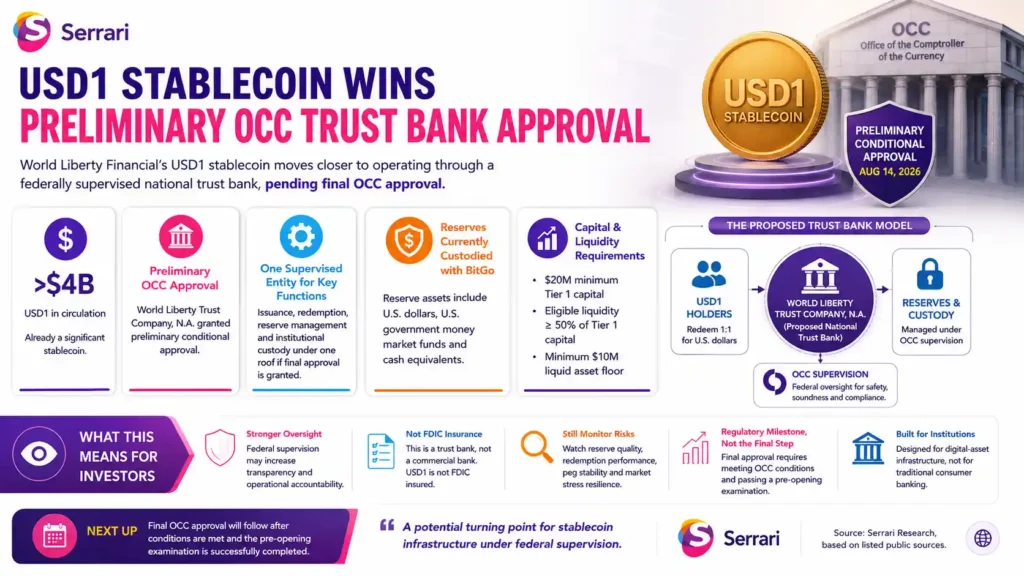
USD1 holders connect to World Liberty Trust through issuance and redemption, while the proposed national trust bank manages reserve assets and institutional custody under OCC supervision. USD1 has more than $4 billion in circulation, while the trust-bank conditions include $20 million of minimum Tier 1 capital and minimum eligible liquidity requirements. Preliminary OCC approval is shown as completed, while final approval remains pending.
Political Scrutiny Remains Separate
World Liberty Financial’s relationship with President Donald Trump and his family has also created political controversy around the charter.
Democratic lawmakers have raised conflict-of-interest concerns, while the White House has denied that the President or his family has engaged in conflicts of interest.
For investors, that governance debate is relevant regulatory context, but it should remain separate from the financial analysis of reserve quality, redemption, custody and capital requirements.
What Investors Should Watch
The next important developments are:
- Final OCC approval;
- Migration of reserve and custody responsibilities;
- Reserve attestations;
- Redemption performance;
- USD1 liquidity and peg stability; and
- Institutional adoption after the trust bank becomes operational.
Conclusion
USD1 has not become a fully operational federally chartered bank product.
What it has gained is an important step toward a new operating model.
If final OCC approval follows, World Liberty Trust could combine issuance, redemption, reserve management and custody under direct federal supervision.
For holders of a stablecoin with more than $4 billion in circulation, that could strengthen regulatory accountability.
But OCC supervision does not remove stablecoin risk.
Investors should still ask the fundamental questions:
What backs the token? Can it be redeemed reliably? Who controls the reserves? How liquid are those reserves? And what happens under stress?
FAQs
1. Has USD1 received a full banking licence?
No. World Liberty Trust has received preliminary conditional approval. The bank must still satisfy OCC requirements and pass a pre-opening examination before final approval and commencement of operations.
2. What would World Liberty Trust do?
The proposed national trust bank would issue and redeem USD1, manage its reserves and provide institutional digital-asset custody.
3. Would USD1 become an FDIC-insured deposit?
No. The OCC application states that World Liberty Trust would not have FDIC deposit insurance, and the institution is not being structured as an ordinary deposit-taking commercial bank.
4. Does OCC supervision remove stablecoin risk?
No. Federal supervision can strengthen regulatory oversight, but holders still need to monitor reserve quality, liquidity, redemption, custody, operational resilience and governance.
Sources: OCC Corporate Decision No. 1385, OCC World Liberty Trust application, World Liberty official USD1 page, USD1 Proof of Reserves, USD1 Attestation Reports, Wall Street Journal current coverage, Financial Times regulatory coverage.
Your financial future isn’t something you wait for—it’s something you build.
The real question is: when do you begin?
Move beyond simply staying informed.
Navigate the markets with clarity—track trends through the Serrari Group Market Index, uncover opportunities in the Serrari Marketplace, and build practical knowledge with our Curated Wealth Builder Platform.
Stay connected to what truly matters.
Get daily insights on macro trends and financial movements across Kenya, Africa, and global markets—delivered through the Serrari Newsletter.
Growth opens doors.
Advance your career through professional programs including ACCA, HESI A2, ATI TEAS 7 , HESI EXIT , NCLEX – RN and NCLEX – PN, Financial Literacy!🌟—designed to move you forward with confidence.
See where money is flowing—clearly and in real time.
Track Money Market Funds, Treasury Bills, Treasury Bonds, Green Bonds, and Fixed Deposits, alongside global and African indexes, key economic indicators, and the evolving Crypto and stablecoin landscape—all within Serrari’s Market Index.