
South Africa’s JSE Top 40 enters Monday’s trading session after a sharp mid-August loss of momentum.
The index fell 1.38% on August 11, 0.81% on August 12 and 0.90% on August 13, before finishing Friday almost unchanged.
The Top 40 closed August 14 at approximately 106,231.66 points, down about 0.02% for the session.
The investor question is whether that retreat represents a healthy reset after a strong run or the beginning of a more sustained loss of large-cap momentum.
Key Overview
- August 11: −1.38%
- August 12: −0.81%
- August 13: −0.90%
- August 14 close: approximately 106,231.66
- Friday move: approximately −0.02%
- Recent 52-week range: approximately 92,853–121,330
- Monday, August 17, is the next trading session.
JSE Top 40 Enters Monday After Three-Day Market Retreat
South African large-cap equities enter the new week with a question investors have not had to ask as often during the market’s stronger periods:
Is the latest pullback simply cooling an extended rally, or is leadership beginning to weaken?
The JSE official Top 40 methodology describes the benchmark as the 40 most investable companies within the All Share Index. It is weighted by free-float market capitalisation, meaning larger constituents have a greater influence on the index than smaller ones.
That structure matters when interpreting the recent decline.
Three Down Sessions Changed Momentum
The Top 40 fell 1.38% on August 11, followed by losses of 0.81% on August 12 and 0.90% on August 13.
Friday then produced little follow-through in either direction, with the index ending near 106,231.66, approximately 0.02% lower.
A flat session after several declines can mean selling pressure is stabilising.
It can also mean investors are waiting for a new catalyst before deciding whether to buy the dip or reduce risk further.
Monday should provide the next useful test.
A Pullback Is Not Automatically a Broken Trend
Context matters.
The index remains comfortably above the lower end of its recent 52-week range of roughly 92,853 to 121,330.
That makes the August retreat very different from a market collapsing from already weak levels.
Strong markets regularly experience corrections as investors take profits, valuations reset and positioning becomes less crowded.
What matters is what happens next.
If previous leaders recover quickly and broader participation improves, the decline may look like a healthy reset.
If rebounds repeatedly fail and heavyweight sectors continue weakening, the probability of a deeper correction increases.
Why the Top 40 Can Move Quickly
The JSE confirms that the index is free-float market-cap weighted.
That means companies such as Naspers, Richemont, major banks, telecom groups and large mining companies can have an outsized effect on the benchmark.
Investors should therefore avoid interpreting a Top 40 move as meaning every South African listed company moved in the same direction.
Sector leadership matters.
A recovery driven by banks and miners together would look more convincing than a rebound carried by only one or two heavyweight shares.
Context is everything. Stay ahead of shifting trends with today’s market updates, and uncover emerging opportunities using the Serrari Group Market Index and Marketplace. Then, take control of your own financial future by exploring our Money & Life Reset Transformation Blueprint ™ to build stronger habits, create better systems, and design a path toward lasting wealth.
The Rand Is Part of the Equity Story
South African shares cannot be analysed entirely separately from the currency.
The rand traded around R16.18 per U.S. dollar during Friday’s market reporting.
Currency movements affect sectors differently.
A stronger rand can reduce the translated value of foreign earnings for globally exposed companies while helping businesses that rely heavily on imported inputs.
A weaker rand can support rand-reported earnings for some offshore earners while increasing imported inflation and input costs elsewhere.
Offshore investors must also consider currency returns alongside the Top 40’s local-market performance.
Miners Could Decide Monday’s Direction
Commodity stocks are another major variable.
Gold and other resource companies can benefit when commodity prices rise, but mining shares also react to the dollar, global economic expectations, geopolitical risk and company-specific factors.
South Africa’s status as a major metals producer means global commodity movements can quickly flow through to the JSE.
Investors should therefore watch gold and broader mining shares alongside the headline Top 40 level.
If resources rebound strongly, they could help stabilise the benchmark.
Banks Give a Domestic Read
Banks such as Standard Bank and FirstRand provide a different signal.
Their performance is more closely linked to domestic credit conditions, economic growth, interest rates, consumer health and South African bond markets.
That makes bank and mining leadership particularly useful together.
Miners provide a global and commodity read. Banks provide a domestic financial read.
If both groups weaken simultaneously, the Top 40 could struggle to regain momentum.
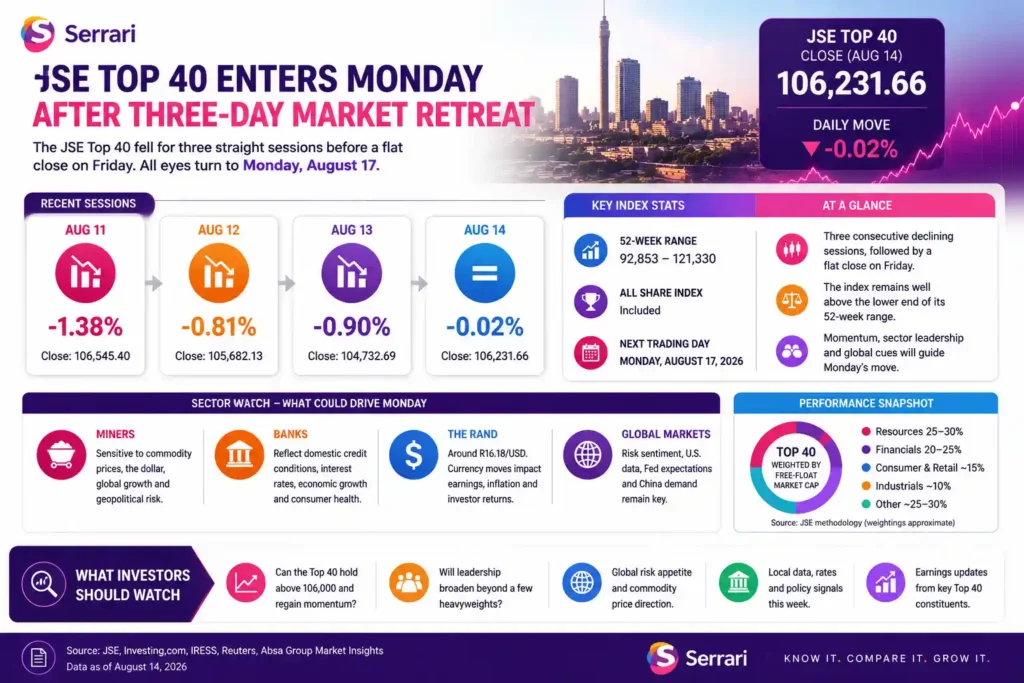
The JSE Top 40 timeline shows three consecutive declines of 1.38%, 0.81% and 0.90% from August 11 to August 13, followed by a near-flat August 14 session around 106,232 points. Beside the timeline are three variables investors should monitor for August 17: the rand, South African bond yields and gold and commodity prices.
What Investors Should Watch Monday
Rather than focusing only on whether the Top 40 opens green or red, investors should monitor:
- Whether early gains survive through the session;
- Bank versus mining-sector leadership;
- USD/ZAR direction;
- Gold and other commodity prices;
- South African government-bond yields; and
- Global risk appetite.
The quality of the rebound matters more than the first move.
A broad recovery accompanied by a firmer rand and stable bond market would send a different signal from an index gain driven by only a few heavyweight stocks.
Conclusion
The JSE Top 40 enters Monday after its strongest short-term loss of momentum in several sessions.
Three consecutive declines followed by a flat Friday have removed some of the market’s earlier momentum, but they do not by themselves prove that the wider uptrend has failed.
Monday’s session should help distinguish between a healthy reset and a deeper change in trend.
For investors, the best signal will not be the Top 40 level alone.
It will be whether banks, miners, the rand and the bond market begin moving in the same direction again.
FAQs
1. What did the JSE Top 40 close at Friday?
The index closed August 14 at approximately 106,231.66 points, almost unchanged for the day after three consecutive declining sessions.
2. How large was the three-day retreat?
The Top 40 declined 1.38% on August 11, 0.81% on August 12 and 0.90% on August 13. The sequence represents a clear loss of short-term momentum, though it does not by itself establish a new bear trend.
3. What exactly does the JSE Top 40 measure?
The JSE describes it as the 40 most investable companies from the broader All Share Index, selected and weighted using investable market-capitalisation measures.
4. What should investors watch when markets reopen?
Key indicators include heavyweight bank and mining shares, the rand, commodities, South African government bonds and global risk sentiment. A broad-based rebound would provide stronger evidence of stabilisation than an index gain concentrated in only a few large companies.
Sources: Johannesburg Stock Exchange Top 40 methodology, FTSE Russell JSE index family, Investing.com Top 40 historical data, Trading Economics South Africa 40, Reuters market context via CNBC Africa.
Your financial future isn’t something you wait for—it’s something you build.
The real question is: when do you begin?
Move beyond simply staying informed.
Navigate the markets with clarity—track trends through the Serrari Group Market Index, uncover opportunities in the Serrari Marketplace, and build practical knowledge with our Curated Wealth Builder Platform.
Stay connected to what truly matters.
Get daily insights on macro trends and financial movements across Kenya, Africa, and global markets—delivered through the Serrari Newsletter.
Growth opens doors.
Advance your career through professional programs including ACCA, HESI A2, ATI TEAS 7 , HESI EXIT , NCLEX – RN and NCLEX – PN, Financial Literacy!🌟—designed to move you forward with confidence.
See where money is flowing—clearly and in real time.
Track Money Market Funds, Treasury Bills, Treasury Bonds, Green Bonds, and Fixed Deposits, alongside global and African indexes, key economic indicators, and the evolving Crypto and stablecoin landscape—all within Serrari’s Market Index.