African startup funding slowed sharply in July 2026, with startups raising $102 million across 44 deals worth at least $100,000. The total was the lowest monthly figure since March 2025, but the bigger development was the financing mix. Debt accounted for approximately $75 million, or 74% of funding, while equity funding fell to just $25 million, its lowest monthly level since April 2019. The shift suggests investors remain interested in African startups but are increasingly favouring financing structures that reduce risk and limit exposure to uncertain valuations.
Key Overview
African startups raised $102 million across 44 deals in July 2026, down sharply from approximately $515 million raised in June.
Debt represented 74% of July funding at approximately $75 million, while equity contributed only $25 million.
Egypt, Nigeria, Kenya and South Africa remain the dominant startup markets, while fintech continues to attract a substantial share of investment.
African Startup Funding Slows in July
African startup funding entered the second half of 2026 on weaker footing, with companies across the continent raising $102 million during July.
According to figures compiled by Africa: The Big Deal, the capital was distributed across 44 transactions worth at least $100,000. July recorded the lowest monthly funding total since March 2025.
The headline decline is significant, but the composition of financing provides an even clearer indication of changing investor behaviour.
Approximately $75 million came through debt, representing 74% of the total. Only about $25 million, or one-quarter of the capital raised, came through equity.
That represents a substantial departure from the financing patterns recorded during the first half of the year.
Equity Funding Drops to Lowest Level Since 2019
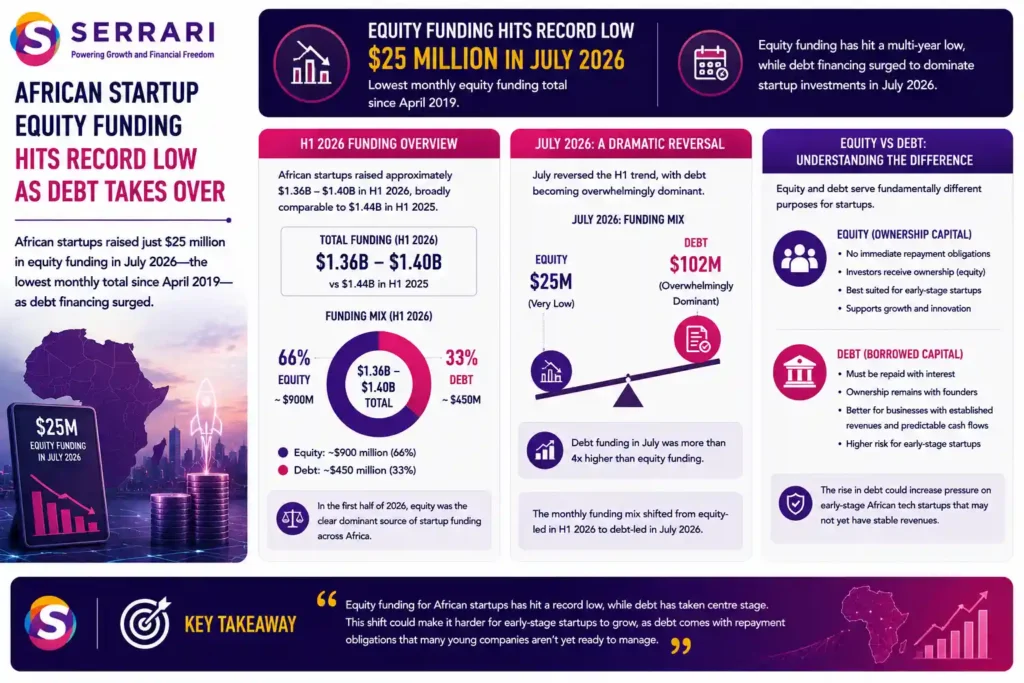
The $25 million raised through equity funding was reportedly the lowest monthly total since April 2019.
During H1 2026, African startups raised approximately $1.36 billion to $1.4 billion across equity, debt and grants, broadly comparable with the $1.44 billion secured during H1 2025.
Around $900 million, or 66% of first-half financing, came through equity transactions. Debt contributed approximately $450 million, equivalent to around one-third of the total.
July therefore reversed that relationship, with debt becoming overwhelmingly dominant.
The shift could create additional challenges for early-stage African tech startups because debt and equity serve fundamentally different purposes.
Equity allows companies to obtain capital without immediate repayment obligations in exchange for ownership. Debt preserves ownership but creates repayment and interest obligations, making it generally more suitable for businesses with established revenues and predictable cash flows.
Context is everything. Stay ahead of shifting trends with today’s market updates, and uncover emerging opportunities using the Serrari Group Market Index and Marketplace. Then, take control of your own financial future by exploring our Money & Life Reset Transformation Blueprint ™ to build stronger habits, create better systems, and design a path toward lasting wealth.
July Funding Drops Sharply From June
July’s weak performance followed an exceptionally strong June.
About 48 startups raised approximately $515 million during June, representing a 281.4% increase from May and the strongest monthly result since July 2025, when African startups secured around $550 million.
The decline from $515 million in June to $102 million in July represents a drop of roughly 80%.
However, monthly figures can be heavily influenced by a small number of large transactions. June’s surge therefore did not necessarily indicate a broad-based recovery, just as July’s decline does not mean African venture capital activity has stopped.
Instead, the volatility highlights how concentrated funding has become.
Deal Activity Remains Relatively Resilient
Despite the steep decline in funding value, transaction numbers remained comparatively stable.
July recorded 44 deals compared with 48 in June. Dividing the $102 million total by 44 transactions produces an average of approximately $2.3 million per deal.
That figure should be treated cautiously because a few larger rounds can distort the average. Nevertheless, relatively stable deal activity alongside much lower total funding suggests startups are still completing transactions but generally raising smaller amounts.
This could indicate that investors are negotiating lower valuations, writing smaller checks and demanding stronger financial fundamentals before committing capital.
For funds with available capital, compressed valuations could also create more attractive entry opportunities than during the funding boom of 2021 and 2022.
Nigeria, Egypt, Kenya and South Africa Lead
African startup investment remains concentrated in a handful of markets.
During H1 2026, Egypt attracted approximately $327 million, followed by Nigeria with $254 million, Kenya with $126 million and South Africa with $83 million.
Together, the four ecosystems accounted for around 58% of the continent’s total startup funding.
Nigeria performed particularly strongly in equity financing. Nigerian startups secured approximately $214 million in equity during H1, ahead of Egypt’s $183 million, South Africa’s $66 million and Kenya’s $46 million.
Nigeria also recorded the largest number of funded startups, with 40 ventures raising at least $100,000.
The figures underline the continued dominance of Africa’s four largest technology and investment ecosystems.
African Fintech Remains a Major Investment Sector
African fintech continued to attract a substantial share of capital during the first half of 2026, accounting for 41% of funding.
The sector’s appeal reflects the continued demand for digital payments, banking infrastructure, cross-border transfers and other financial technology services across African markets.
Climate technology has also become an important destination for capital as investors increasingly target businesses addressing energy, infrastructure and environmental challenges.
However, greater reliance on debt could favour established fintech and climate companies with measurable revenues over early-stage ventures still developing their business models.
What the Debt Shift Means for Startups
The growing role of debt does not necessarily indicate a weaker startup ecosystem, but it does change the financial risks facing founders.
For established companies, debt can fund expansion without forcing founders and existing investors to surrender additional ownership. Businesses with predictable revenue can also use debt strategically to finance working capital or expansion.
For early-stage startups, the calculation is different.
Interest and repayment obligations can place pressure on cash flows before a company reaches profitability. Companies without predictable revenues may also struggle to qualify for attractive debt financing.
If equity remains scarce, founders may increasingly need to demonstrate clearer paths to profitability, stronger unit economics and disciplined spending to secure private capital.
Outlook for African Startup Funding
The first seven months of 2026 present a mixed picture for Africa’s startup ecosystem.
Funding during the first half remained broadly comparable with 2025, but July revealed a sharp deterioration in equity investment and growing dependence on debt.
The next few months will determine whether July represents a temporary slowdown or a longer-term shift in investor behaviour.
Deal volume will be particularly important. If transaction numbers remain relatively stable while funding totals stay low, it would suggest the ecosystem remains active but is adjusting to smaller rounds and more conservative valuations.
For investors, that environment could create opportunities to negotiate more attractive terms. For founders, competition for traditional equity financing is likely to intensify.
Ultimately, July’s $102 million funding total shows that capital continues to reach African startups. But with equity representing only about one-quarter of the month’s financing, the market is increasingly rewarding businesses capable of supporting more structured and potentially less forgiving forms of capital.
FAQs
How much did African startups raise in July 2026?
African startups raised approximately $102 million across 44 deals worth at least $100,000.
How much came from equity funding?
Approximately $25 million, or 25% of July’s total, came from equity financing.
Why is debt becoming more important?
Investors may prefer debt because it can provide greater downside protection, while established startups can raise capital without diluting existing shareholders.
Which countries attract the most African startup funding?
Egypt, Nigeria, Kenya and South Africa remain the leading markets, accounting for approximately 58% of funding during H1 2026.
Sources: Streamline Feed, Leadership Nigeria, Nook, The Guardian, Ngn Market
Your financial future isn’t something you wait for—it’s something you build.
The real question is: when do you begin?
Move beyond simply staying informed.
Navigate the markets with clarity—track trends through the Serrari Group Market Index, uncover opportunities in the Serrari Marketplace, and build practical knowledge with our Curated Wealth Builder Platform.
Stay connected to what truly matters.
Get daily insights on macro trends and financial movements across Kenya, Africa, and global markets—delivered through the Serrari Newsletter.
Growth opens doors.
Advance your career through professional programs including ACCA, HESI A2, ATI TEAS 7 , HESI EXIT , NCLEX – RN and NCLEX – PN, Financial Literacy!🌟—designed to move you forward with confidence.
See where money is flowing—clearly and in real time.
Track Money Market Funds, Treasury Bills, Treasury Bonds, Green Bonds, and Fixed Deposits, alongside global and African indexes, key economic indicators, and the evolving Crypto and stablecoin landscape—all within Serrari’s Market Index.