The SSE green bond issuance has raised A$1 billion (£520 million) through the UK energy group’s first entry into the Australian debt market. The transaction comprised A$600 million of five-year bonds carrying a 5.6% coupon and A$400 million of 10-year bonds paying 6.3%. Strong institutional investors’ demand resulted in the deal being 2.5 times oversubscribed, generating the third-largest senior corporate Kangaroo bond order book on record. The issuance is SSE’s 12th green bond since 2017 and increases its outstanding green bonds to £5.9 billion.
Key Overview
SSE raised A$1 billion through its first Australian-dollar green bond issuance, expanding its financing beyond traditional UK and European debt markets.
The transaction was split between A$600 million of five-year bonds at a 5.6% coupon and A$400 million of 10-year bonds at 6.3%.
Investor demand reached 2.5 times the amount offered, while currency swaps converted the proceeds into sterling at a weighted average funding cost of 5.7%.
SSE Enters Australian Bond Market
SSE has expanded its global financing strategy by entering the Australian bond market for the first time with A$1 billion of green Kangaroo bonds.
Kangaroo bonds are Australian-dollar-denominated securities issued in Australia by foreign borrowers. The structure gives SSE access to another major institutional funding market as it finances its long-term investment programme.
The first tranche comprised A$600 million of five-year bonds carrying a fixed 5.6% coupon and maturing on August 20, 2031.
The remaining $400 million was issued through 10-year bonds carrying a 6.3% coupon and maturing on August 20, 2036.
Together, the two tranches raised approximately £520 million.
SSE Green Bond Attracts Strong Demand
Demand for the SSE green bond substantially exceeded the securities available.
The issuance was approximately 2.5 times oversubscribed and generated the third-largest senior corporate Kangaroo bond order book on record.
Oversubscription occurs when investor orders exceed the amount an issuer intends to raise. Strong demand can provide issuers with greater flexibility in pricing and allocating bonds while demonstrating confidence in the company’s credit profile.
For SSE, the reception also demonstrates its ability to attract investors outside its established UK and European funding markets.
The transaction therefore provides more than additional capital. It broadens the company’s investor base and establishes a presence in a market that could potentially be used again for future bond issuance.
Context is everything. Stay ahead of shifting trends with today’s market updates, and uncover emerging opportunities using the Serrari Group Market Index and Marketplace. Then, take control of your own financial future by exploring our Money & Life Reset Transformation Blueprint ™ to build stronger habits, create better systems, and design a path toward lasting wealth.
Australian Proceeds Converted Into Sterling
Although SSE issued the bonds in Australian dollars, both tranches were swapped back into sterling.
Following the currency swaps, the transaction produced a weighted average funding cost of 5.7% on approximately £520 million of debt with an average maturity of seven years.
Currency swaps allow international companies to access overseas investors while converting their resulting financial exposure into their preferred currency.
However, the financing cost highlights the relatively expensive environment for long-term corporate borrowing.
SSE’s 5.7% weighted average cost is above the average cost of some of its other recent hybrid and senior debt transactions. The company is therefore accepting a somewhat higher financing cost in exchange for greater diversification and access to another substantial capital pool.
Green Bond Portfolio Reaches £5.9 Billion
The Australian transaction is SSE’s 12th green bond since the company began issuing sustainable debt in 2017.
Following the transaction, outstanding green bonds issued by SSE and its subsidiaries have reached approximately £5.9 billion.
Green bonds function similarly to conventional corporate debt, but their proceeds are directed toward projects meeting specified environmental criteria.
For energy companies, eligible investments can include renewable generation, electricity networks and infrastructure supporting the transition toward lower-carbon energy systems.
The latest issuance consequently strengthens SSE’s position within international sustainable finance markets while providing capital for its broader investment programme.
Why Australia Matters for SSE’s Financing
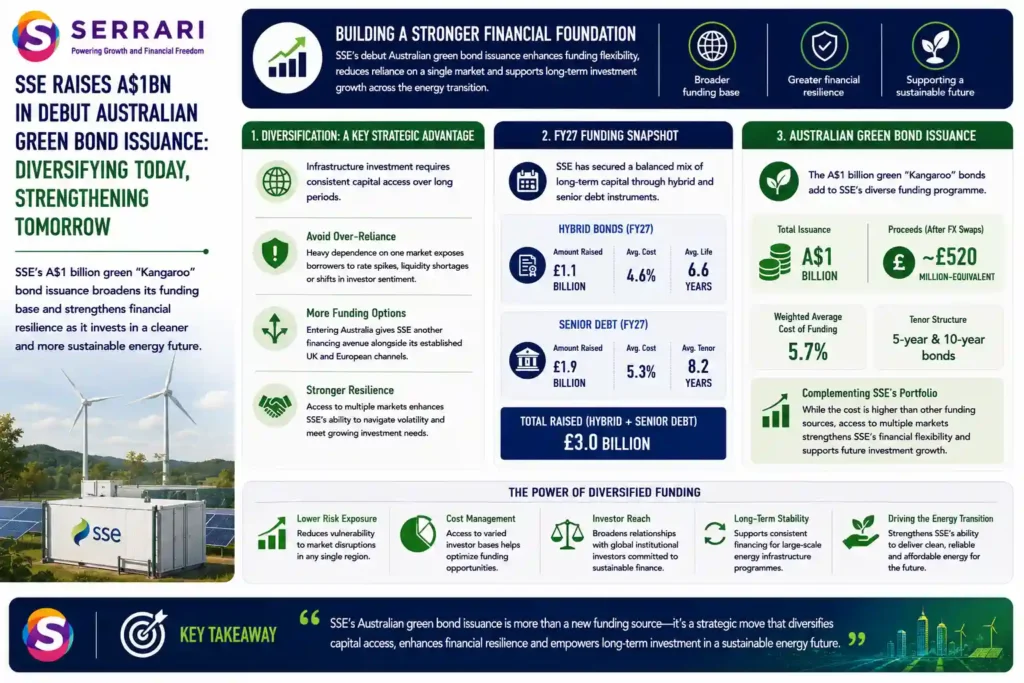
Diversification is one of the transaction’s most important strategic benefits.
Companies undertaking large infrastructure programmes require reliable access to capital over extended periods. Heavy dependence on one market can leave borrowers exposed when interest rates, liquidity or investor sentiment deteriorate.
Entering Australia gives SSE another financing option alongside its established UK and European channels.
During FY27, SSE has raised approximately £1.1 billion of hybrid bonds at an average cost of 4.6% and an average life of 6.6 years. It has also raised £1.9 billion of new senior debt at an average cost of 5.3% and an average tenor of 8.2 years.
The Australian transaction adds another £520 million-equivalent to that financing programme.
Although its 5.7% cost is higher, the ability to access multiple markets can strengthen SSE’s financial resilience as investment requirements increase.
Green Bonds Support Energy Investment
SSE’s financing strategy is closely connected to its investment in energy infrastructure and the transition toward cleaner electricity systems.
Large-scale renewable energy and electricity network projects require significant upfront capital, while their economic returns may extend across decades. Long-term bonds can therefore provide a useful financing structure by spreading funding obligations over longer periods.
Green financing also connects these projects with investors specifically seeking exposure to environmentally aligned assets.
The strong demand for SSE’s Australian transaction indicates that this appetite remains substantial even when borrowing costs are relatively elevated.
For climate finance markets, the transaction also demonstrates how capital can move internationally. Australian investors can finance environmentally focused projects associated with a UK energy company while investing through their domestic bond market.
What the SSE Green Bond Means for Investors
SSE’s Australian debut demonstrates both the opportunities and trade-offs associated with international green financing.
The company has diversified its investor base, raised A$1 billion and established access to an important global debt market. Investors gained access to green corporate securities carrying fixed coupons across five- and 10-year maturities.
The 2.5-times oversubscription also suggests continued appetite among institutional investors for sustainable fixed-income investments.
However, a green designation does not eliminate conventional bond risks. Investors must still consider SSE’s creditworthiness, interest-rate exposure, maturity and broader financial position.
With £5.9 billion of outstanding green bonds, sustainable debt has become a significant component of SSE’s financing strategy. Its successful Australian debut suggests international green bonds could continue playing an important role as the company funds its long-term energy investment programme.
FAQs
How much did SSE raise from its Australian green bond?
SSE raised A$1 billion, equivalent to approximately £520 million, through its first green bond issuance in the Australian market. The transaction consisted of two separate maturities, giving the company access to both medium- and longer-term financing.
What interest rates are SSE’s new green bonds paying?
The A$600 million five-year tranche carries a fixed coupon of 5.6% and matures in August 2031. The A$400 million 10-year tranche carries a 6.3% coupon and matures in August 2036. After currency swaps into sterling, SSE’s weighted average funding cost was 5.7%.
How strong was investor demand for the SSE green bond?
Investor demand was strong, with the transaction approximately 2.5 times oversubscribed. SSE said the deal generated the third-largest senior corporate Kangaroo bond order book on record, indicating substantial institutional demand for the issuance.
How many green bonds has SSE issued?
The Australian transaction is SSE’s 12th green bond since 2017. Following the issuance, the total outstanding green bonds issued by SSE and its subsidiaries reached approximately £5.9 billion, reflecting the growing importance of sustainable financing within the company’s funding strategy.
Your financial future isn’t something you wait for—it’s something you build.
The real question is: when do you begin?
Move beyond simply staying informed.
Navigate the markets with clarity—track trends through the Serrari Group Market Index, uncover opportunities in the Serrari Marketplace, and build practical knowledge with our Curated Wealth Builder Platform.
Stay connected to what truly matters.
Get daily insights on macro trends and financial movements across Kenya, Africa, and global markets—delivered through the Serrari Newsletter.
Growth opens doors.
Advance your career through professional programs including ACCA, HESI A2, ATI TEAS 7 , HESI EXIT , NCLEX – RN and NCLEX – PN, Financial Literacy!🌟—designed to move you forward with confidence.
See where money is flowing—clearly and in real time.
Track Money Market Funds, Treasury Bills, Treasury Bonds, Green Bonds, and Fixed Deposits, alongside global and African indexes, key economic indicators, and the evolving Crypto and stablecoin landscape—all within Serrari’s Market Index.