US life insurance sales continued to expand in the second quarter of 2026, with total new annualized premium with excess premium (AWEP) reaching $4.7 billion, up 3% from a year earlier. LIMRA data shows whole life insurance delivered particularly strong results, with premium increasing 9% and policy count rising 11%. Variable universal life recorded even faster premium growth of 11%, while term life also expanded. However, indexed universal life premiums declined 11%, showing that growth across the U.S. individual life insurance market remains uneven.
Key Overview
The U.S. individual life insurance market generated $4.7 billion in new AWEP during Q2 2026, representing 3% year-over-year growth. More significantly, the overall number of policies sold increased 8%, suggesting that growth extended beyond higher premium values.
Whole life was the largest product category, generating $1.78 billion in new premiums and accounting for 37% of total AWEP. Variable universal life premiums increased 11% to $800 million, while term life premiums advanced 7% to $829 million.
Indexed universal life was the notable exception. IUL premiums declined 11% to nearly $1.1 billion despite policy sales increasing 5%, partly reflecting comparison with exceptionally strong growth during Q2 2025.
US Life Insurance Sales Reach $4.7 Billion
The US life insurance sales market maintained its growth trajectory during the second quarter of 2026 as demand for financial protection supported both premium and policy growth.
Total new annualized premium with excess premium reached $4.7 billion during the quarter, according to LIMRA, representing a 3% increase from Q2 2025.
AWEP is an important industry measure because it provides a standardized way of tracking new life insurance premium production across different product structures.
However, premium growth tells only part of the story.
The number of individual policies sold increased 8% year over year, substantially faster than the 3% increase in premium. This suggests insurers were not simply generating growth through larger policies sold to existing affluent markets. More individual policies were also entering the market.
The performance was nevertheless uneven across products, with whole life, term and variable universal life recording premium growth while indexed universal life moved in the opposite direction.
Whole Life Insurance Leads Q2 2026 Growth
Whole life insurance delivered one of the strongest performances during the quarter.
New whole life AWEP reached approximately $1.78 billion, representing an increase of 9% compared with the second quarter of 2025.
The number of whole life policies sold increased even faster, rising 11%.
Whole life consequently accounted for approximately 37% of total new AWEP, making it the largest individual life insurance product category during the quarter.
The product combines permanent life insurance protection with a cash-value component, distinguishing it from term insurance, which generally provides coverage for a specified period.
Strong policy growth is particularly significant because it indicates that the improvement was not solely driven by customers purchasing larger policies.
Instead, insurers appear to have expanded the number of consumers purchasing whole life coverage, contributing to broader premium growth across the market.
Variable Universal Life Premiums Increase 11%
Variable universal life insurance recorded the fastest premium growth among the major product categories highlighted in the Q2 results.
New VUL AWEP increased 11% year over year to approximately $800 million.
That brought variable universal life to roughly 17% of the total new premium.
Unlike whole life, however, VUL policy count was almost unchanged from the same period in 2025.
The difference between premium and policy growth provides an important insight into the underlying market.
With premiums rising strongly while policy volumes remained relatively stable, the VUL expansion appears to have been driven more by larger policy values and higher-premium customers than by a significant increase in the number of buyers.
That pattern could reflect greater activity among affluent households using life insurance within broader wealth, estate and financial protection strategies.
Context is everything. Stay ahead of shifting trends with today’s market updates, and uncover emerging opportunities using the Serrari Group Market Index and Marketplace. Then, take control of your own financial future by exploring our Money & Life Reset Transformation Blueprint ™ to build stronger habits, create better systems, and design a path toward lasting wealth.
Term Life Insurance Maintains Growth
Term life also contributed positively to insurance sales during Q2.
New AWEP reached approximately $829 million, increasing 7% from the previous year, while policy count advanced 6%.
Term insurance generally provides coverage for a predetermined period without the cash-value features associated with permanent insurance.
Its comparatively straightforward structure and lower initial premiums can make it an important entry point into life insurance, particularly for younger households and families seeking income replacement or basic financial protection.
The combination of 7% premium growth and 6% policy growth suggests relatively balanced expansion, unlike VUL, where premium growth significantly exceeded growth in policy numbers.
Continued term life growth therefore provides another indication that the expansion of the life insurance market is reaching different consumer groups rather than being confined entirely to higher-value permanent policies.
Indexed Universal Life Premiums Decline
Indexed universal life was the major weak spot in the Q2 figures.
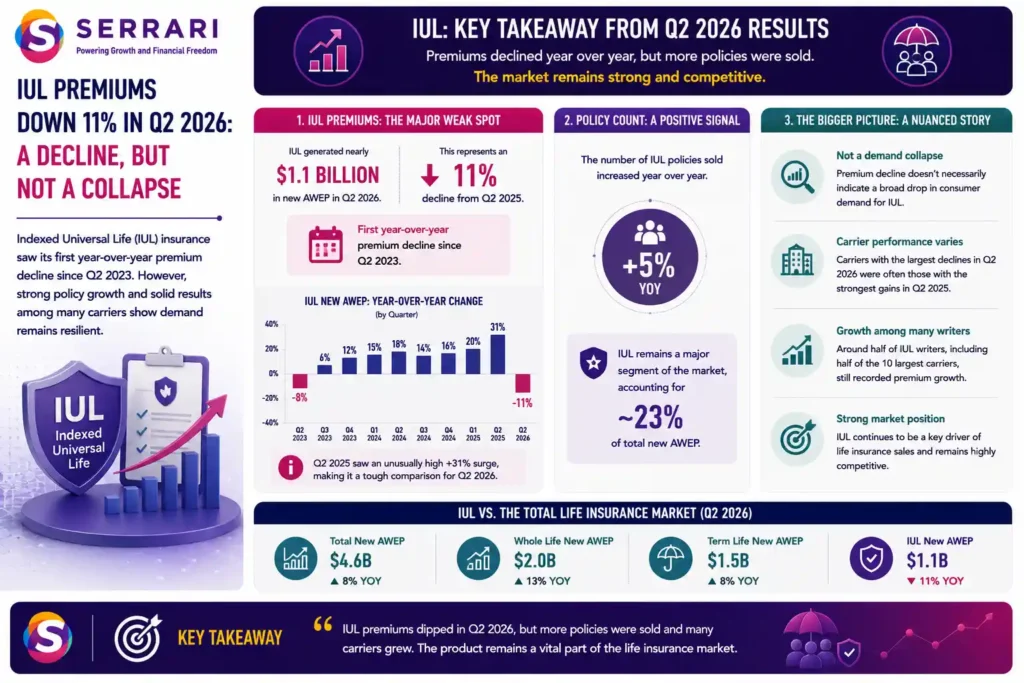
IUL generated nearly $1.1 billion in new AWEP during the second quarter, but that represented an 11% decline from the corresponding period of 2025.
It was the product’s first year-over-year premium decline since the second quarter of 2023.
However, the underlying numbers reveal a more nuanced picture.
The number of IUL policies sold actually increased 5% year over year. IUL also remained a major segment of the market, accounting for approximately 23% of total new AWEP.
The premium decline therefore does not necessarily indicate a broad collapse in consumer demand.
Instead, LIMRA noted that Q2 2025 created an unusually difficult comparison because the IUL premium had surged 31% during that quarter. Carriers reporting some of the largest declines in 2026 were generally among those that recorded particularly strong gains one year earlier.
Around half of IUL writers, including half of the 10 largest carriers, still recorded premium growth.
Fixed Universal Life Retains Smaller Market Share
Fixed universal life remains a considerably smaller segment of the U.S. individual life market.
The category accounted for approximately 5% of new premium.
At least half of fixed UL writers reported premium growth, including eight of the 10 largest providers.
Relatively elevated interest rates may be providing some support for the category.
Interest-rate conditions can influence the economics of permanent life products because insurers invest premiums across fixed-income portfolios and other assets to support long-term policy obligations.
The outlook for monetary policy therefore remains relevant to parts of the insurance industry, even though consumer protection needs and demographic factors remain fundamental drivers of demand.
Policy Growth Provides a Broader Market Signal
One of the most important Q2 developments was the 8% increase in overall policy count.
Premium growth can sometimes be concentrated among affluent households purchasing high-value policies. An increase in policy count provides evidence of broader customer participation.
That distinction matters when evaluating the underlying strength of the individual life insurance market.
Whole life policy sales rose 11%, term increased 6% and IUL policy sales advanced 5%. Even IUL therefore added policies despite recording lower total premiums.
At the same time, the U.S. continues to face a substantial life insurance awareness gap.
LIMRA estimates that at least 59% of U.S. adults have some form of life insurance coverage, while only about 51% report that they have coverage.
Employer-provided benefits appear to contribute significantly to this discrepancy. Some workers may have group life insurance through their employers without fully understanding or remembering the coverage.
This suggests that increasing insurance ownership alone does not automatically translate into greater consumer understanding of financial protection.
Annuity Market Adds to Broader Insurance Momentum
The strength of life insurance comes alongside historically elevated activity in the U.S. annuity market.
LIMRA projected U.S. retail annuity sales above $460 billion in 2025, extending a multi-year period of record demand.
Product innovation has played a significant role.
Registered index-linked annuity sales expanded dramatically from $24 billion in 2020 to $65 billion in 2024, with LIMRA projecting sales above $75 billion in both 2025 and 2026.
Fixed indexed annuities have also experienced substantial growth, reaching approximately $126 billion in 2024.
While annuities and life insurance serve different purposes, their recent performance illustrates broader consumer demand for products addressing retirement income, investment uncertainty and long-term financial security.
US Insurance Market Outlook Remains Positive
The second-quarter figures show a US insurance market that continues to expand, although individual products are following different trajectories.
Whole life has emerged as the clearest growth leader in terms of both premium and policy sales, while VUL is benefiting from larger premiums despite relatively flat policy volumes.
Term life continues to provide steady growth, while IUL’s premium decline needs to be viewed against exceptionally strong results a year earlier.
The 8% overall increase in policy sales may ultimately be the most encouraging indicator. It suggests the industry’s Q2 growth was supported by an expanding number of policies rather than premium increases alone.
With demographic demand, product innovation and continued interest in long-term financial protection supporting the market, US life insurance sales enter the second half of 2026 with positive momentum despite significant differences between product categories.
FAQs
How much did US life insurance sales reach in Q2 2026?
New individual life insurance AWEP reached approximately $4.7 billion, representing a 3% increase from Q2 2025.
Which life insurance product recorded the strongest sales?
Whole life was the largest category, generating $1.78 billion in new AWEP. Premium increased 9%, while policy sales rose 11%.
How did term life insurance perform?
Term life generated approximately $829 million in new AWEP, up 7% year over year, while the number of policies sold increased 6%.
Why did indexed universal life sales decline?
IUL premium declined 11% to nearly $1.1 billion, partly because Q2 2025 provided a difficult comparison after premium surged 31% that year. Policy count still increased 5%, indicating that demand did not decline uniformly.
Your financial future isn’t something you wait for—it’s something you build.
The real question is: when do you begin?
Move beyond simply staying informed.
Navigate the markets with clarity—track trends through the Serrari Group Market Index, uncover opportunities in the Serrari Marketplace, and build practical knowledge with our Curated Wealth Builder Platform.
Stay connected to what truly matters.
Get daily insights on macro trends and financial movements across Kenya, Africa, and global markets—delivered through the Serrari Newsletter.
Growth opens doors.
Advance your career through professional programs including ACCA, HESI A2, ATI TEAS 7 , HESI EXIT , NCLEX – RN and NCLEX – PN, Financial Literacy!🌟—designed to move you forward with confidence.
See where money is flowing—clearly and in real time.
Track Money Market Funds, Treasury Bills, Treasury Bonds, Green Bonds, and Fixed Deposits, alongside global and African indexes, key economic indicators, and the evolving Crypto and stablecoin landscape—all within Serrari’s Market Index.