The proposed Kenya Chinese bond issuance could mark the country’s first entry into China’s domestic bond market. Kenya is considering raising $300 million through a Panda bond as part of a wider financing strategy that also includes an $815 million Eurobond and more than $500 million from the Japanese market. The government is diversifying its borrowing sources as it finances a fiscal deficit equivalent to 5.5% of GDP while seeking to reduce expensive external debt.
LIVEKenya bond yields: Average yield 11.93% across 58 bonds · 16 OctSee yields →Key Overview
Kenya is considering its first Panda bond, targeting approximately $300 million from the Chinese bond market.
The government also plans an $815 million Eurobond and more than $500 million in Japanese-market financing, potentially including a Samurai bond.
Net external financing is projected at KSh247.2 billion, or about $1.9 billion, during the current fiscal year.
Kenya also intends to retire at least $500 million of expensive external debt to lower debt-servicing costs.
Kenya Chinese Bond Issuance Opens New Funding Market
Kenya is considering issuing its first bond in China’s domestic debt market as the government searches for additional financing to cover its budget deficit.
According to the National Treasury’s annual borrowing plan, the government could raise approximately $300 million through an inaugural Panda bond.
Panda bonds are renminbi-denominated securities issued in mainland China by foreign governments, companies or international institutions. Entering this market would give Kenya access to a new pool of institutional investors beyond its traditional domestic and international funding sources.
Kenya has historically relied on domestic Treasury securities, multilateral loans and international Eurobonds. Adding Chinese investors could therefore broaden the government’s financing options.
However, accessing another market does not automatically mean cheaper financing. The ultimate benefit will depend on the bond’s interest rate, maturity, issuance costs and currency arrangements.
Context is everything. Stay ahead of shifting trends with today’s market updates, and uncover emerging opportunities using the Serrari Group Market Index and Marketplace. Then, take control of your own financial future by exploring our Money & Life Reset Transformation Blueprint ™ to build stronger habits, create better systems, and design a path toward lasting wealth.
Kenya Plans $815 Million Eurobond
The proposed Panda bond forms part of a much larger government borrowing programme.
Kenya plans to issue an approximately $815 million Eurobond during the second quarter of the financial year. It is also considering more than $500 million in financing from Japan, including a possible Samurai bond.
Samurai bonds are yen-denominated securities issued in Japan by foreign borrowers.
Using Panda, Samurai and Eurobond markets could allow Kenya to spread its external borrowing across different currencies and groups of investors rather than relying heavily on dollar-denominated sovereign bonds.
The government’s borrowing plan also identifies Sukuk bonds, sustainability-linked bonds, diaspora bonds and debt swaps among potential financing instruments.
This broader approach could provide the Treasury with more flexibility to choose markets offering relatively favourable conditions.
Budget Deficit Drives Financing Requirements
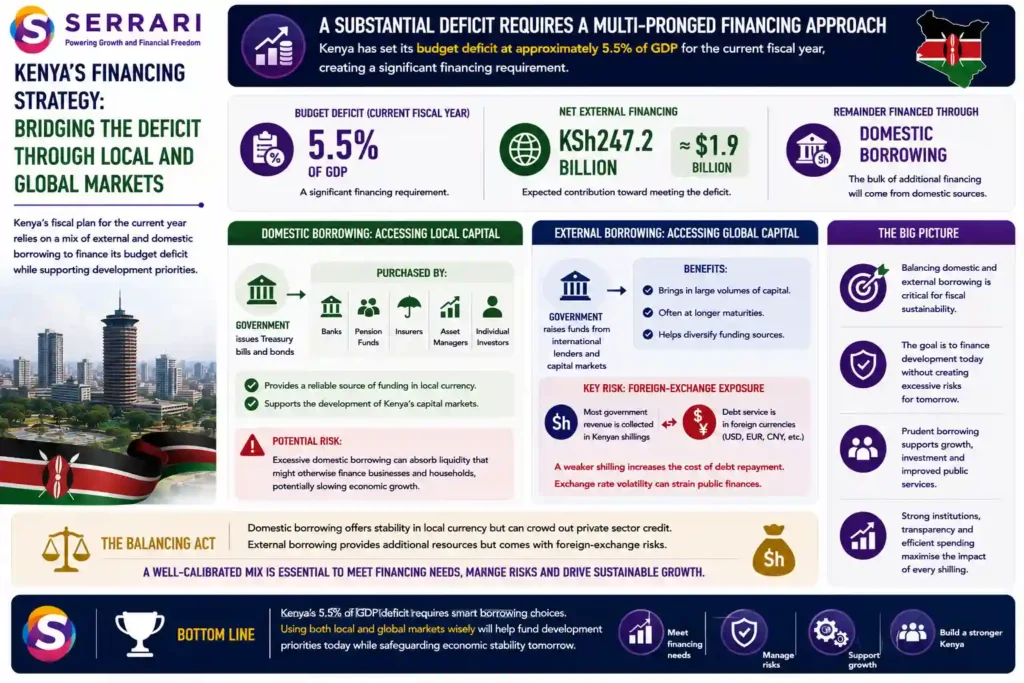
Kenya has set its budget deficit at approximately 5.5% of GDP for the current fiscal year, creating a substantial financing requirement.
Net external financing is expected to contribute around KSh247.2 billion, equivalent to $1.9 billion, toward meeting the deficit. The remainder will largely come from domestic borrowing.
Borrowing domestically allows the government to raise money through Treasury bills and bonds purchased by banks, pension funds, insurers, asset managers and individual investors.
However, excessive domestic borrowing can absorb liquidity that might otherwise finance businesses and households.
External borrowing provides another source of capital but introduces foreign-exchange risks because the government collects most of its revenue in Kenyan shillings while servicing foreign debt in other currencies.
Panda Bond Could Diversify Kenya Public Debt
The proposed Kenya Chinese bond issuance could help diversify the currency and investor composition of Kenya public debt.
A Panda bond would introduce renminbi-denominated borrowing alongside Kenya’s existing foreign-currency obligations.
Diversification can reduce dependence on individual markets, particularly when borrowing conditions deteriorate in one region.
However, currency diversification also creates new risks. If the Kenyan shilling weakens against the renminbi, the shilling cost of servicing Chinese debt could increase unless the government uses hedging or other risk-management arrangements.
Investors should therefore consider the effective borrowing cost rather than focusing only on the Panda bond’s headline interest rate.
Kenya Plans to Retire Expensive External Debt
Kenya is simultaneously seeking to improve its existing debt profile.
LIVEKenya bond yields: Average yield 11.93% across 58 bonds · 16 OctSee yields →The government plans to retire at least $500 million of expensive external debt during the financial year to reduce servicing costs and improve debt sustainability.
Replacing expensive obligations with cheaper or longer-term financing can reduce refinancing pressure, particularly when significant repayments are approaching.
But refinancing only improves the debt position when the replacement financing offers better terms.
The success of Kenya’s strategy will therefore depend on whether new borrowing lowers costs, extends maturities or reduces refinancing risks rather than simply increasing total debt.
Debt Swap Adds to Financing Strategy
Kenya also intends to proceed with a $1 billion debt-for-food security swap involving the U.S. International Development Finance Corporation.
The initiative illustrates how the government is exploring financing arrangements beyond conventional bonds.
Kenya is also expected to receive foreign financing from institutions and partners including the World Bank, African Development Bank and the Italian government.
Multilateral and bilateral financing can sometimes offer longer repayment periods and more favourable terms than commercial capital markets, making them an important component of the country’s overall borrowing strategy.
What Investors Should Watch
Pricing will be one of the most important factors if Kenya proceeds with the Panda bond.
The effective cost should be compared with Kenya’s Eurobonds, domestic Treasury bonds and alternative international financing.
Currency exposure will also matter because borrowing in renminbi creates an obligation that must eventually be serviced using foreign currency.
Investor demand will provide another important signal. Strong participation from Chinese institutional investors could establish Panda bonds as a repeat funding channel for Kenya rather than a one-off transaction.
Maturity will also matter. Longer-term debt could reduce near-term refinancing pressure, although investors may require higher yields for longer commitments.
Outlook for Kenya Chinese Bond Issuance
The proposed Kenya Chinese bond issuance reflects a wider attempt to diversify the country’s external financing as fiscal pressures remain elevated.
A $300 million Panda bond would give Kenya access to the Chinese domestic debt market for the first time, complementing planned Eurobond and Japanese-market borrowing.
The strategy could expand Kenya’s investor base and reduce reliance on individual international markets. However, diversification should not be mistaken for debt reduction.
The key question is whether the government can secure financing at sustainable costs while controlling currency and refinancing risks.
If successful, the Panda bond could establish China as an additional long-term source of sovereign financing for Kenya.
FAQs
What is the Kenya Chinese bond issuance?
The Kenya Chinese bond issuance refers to the government’s consideration of its first Panda bond in China’s domestic capital market. Kenya could raise approximately $300 million through the proposed transaction.
What is a Panda bond?
A Panda bond is a renminbi-denominated bond issued in mainland China by a foreign government, company or international institution. It allows foreign borrowers to raise financing directly from investors in the Chinese domestic bond market.
Why does Kenya want to issue a Panda bond?
Kenya wants to diversify its borrowing sources, expand its investor base and help finance its budget deficit. Accessing China could complement existing financing from Eurobonds, domestic securities, Japan and multilateral institutions.
How much external financing does Kenya need?
Kenya expects approximately KSh247.2 billion, or $1.9 billion, in net external financing during the current fiscal year. The government plans to combine market borrowing with multilateral, bilateral and other financing sources.
Sources: Reuters, Zawya, Cnbc Africa, China Global South, Africa.com
Your financial future isn’t something you wait for—it’s something you build.
The real question is: when do you begin?
Move beyond simply staying informed.
Navigate the markets with clarity—track trends through the Serrari Group Market Index, uncover opportunities in the Serrari Marketplace, and build practical knowledge with our Curated Wealth Builder Platform.
Stay connected to what truly matters.
Get daily insights on macro trends and financial movements across Kenya, Africa, and global markets—delivered through the Serrari Newsletter.
Growth opens doors.
Advance your career through professional programs including ACCA, HESI A2, ATI TEAS 7 , HESI EXIT , NCLEX – RN and NCLEX – PN, Financial Literacy!🌟—designed to move you forward with confidence.
See where money is flowing—clearly and in real time.
Track Money Market Funds, Treasury Bills, Treasury Bonds, Green Bonds, and Fixed Deposits, alongside global and African indexes, key economic indicators, and the evolving Crypto and stablecoin landscape—all within Serrari’s Market Index.