
US equity funds attracted a net $2.58 billion in the week through August 12, reversing $1.36 billion of withdrawals in the previous week as softer employment and inflation data reduced expectations of another Federal Reserve rate hike. Growth funds recorded their strongest weekly demand since November 2024, attracting $8.78 billion, while value funds received $1.79 billion. However, investor caution remained visible beneath the headline numbers, with technology funds losing $4.62 billion and investors simultaneously directing substantial capital toward bonds and money market funds.
Key Overview
Investors added a net $2.58 billion to US equity funds during the week through August 12, reversing the previous week’s $1.36 billion outflow.
Growth funds attracted $8.78 billion, their largest weekly inflow since November 2024, while value funds received $1.79 billion.
Technology funds recorded $4.62 billion in withdrawals following six consecutive weeks of inflows, contributing to $3.78 billion of overall sector fund outflows.
Bond funds attracted $9.4 billion, while money market funds received $13.92 billion, indicating investors continued balancing risk-taking with more defensive allocations.
US Equity Funds Return to Inflows
Investors returned to US equity funds during the week through August 12 as economic data helped ease concerns that the Federal Reserve could raise interest rates again.
According to LSEG Lipper data, investors purchased a net $2.58 billion of US equity funds during the week. The inflows more than reversed the $1.36 billion withdrawn during the previous week.
The change in flows coincided with economic data that reduced some of the pressure on financial markets.
A softer-than-expected US payrolls report and relatively benign inflation readings strengthened expectations that the Federal Reserve could leave interest rates unchanged rather than tightening monetary policy further.
That prospect helped improve investor sentiment toward risk assets, particularly equities.
S&P 500 Reaches Record High
The improvement in investment flows occurred alongside another milestone for the stock market.
The S&P 500 reached a record 7,816.70 on Thursday after US producer price data showed prices were unchanged in July. The reading reinforced expectations that inflationary pressures may be sufficiently contained for the Federal Reserve to maintain current interest rates.
The index has gained approximately 4.13% during August, supported not only by monetary policy expectations but also by strong corporate earnings.
About 85% of the 456 S&P 500 companies with available LSEG data reported quarterly earnings above analysts’ expectations.
That earnings performance provides an important fundamental backdrop to the market rally. Expectations around interest rates can influence valuations, but sustained earnings growth is critical if elevated stock prices are to remain supported over the longer term.
Context is everything. Stay ahead of shifting trends with today’s market updates, and uncover emerging opportunities using the Serrari Group Market Index and Marketplace. Then, take control of your own financial future by exploring our Money & Life Reset Transformation Blueprint ™ to build stronger habits, create better systems, and design a path toward lasting wealth.
Growth Funds Attract $8.78 Billion
Growth-oriented funds were the clearest beneficiaries of renewed demand for US equities.
Investors allocated a net $8.78 billion to US equity growth funds during the week, representing their largest weekly inflow since November 2024.
Growth funds typically have significant exposure to companies expected to expand earnings faster than the wider market. Technology and other innovation-driven businesses frequently account for substantial portions of these portfolios.
The prospect of stable interest rates can support growth-stock valuations because lower expected borrowing costs increase the present value investors place on future corporate earnings.
Value funds also recorded positive flows, attracting approximately $1.79 billion.
The simultaneous inflows into both categories indicate that demand was not exclusively concentrated in one investment style, although the scale of growth-fund purchases was considerably larger.
Technology Funds Record $4.62 Billion Outflow
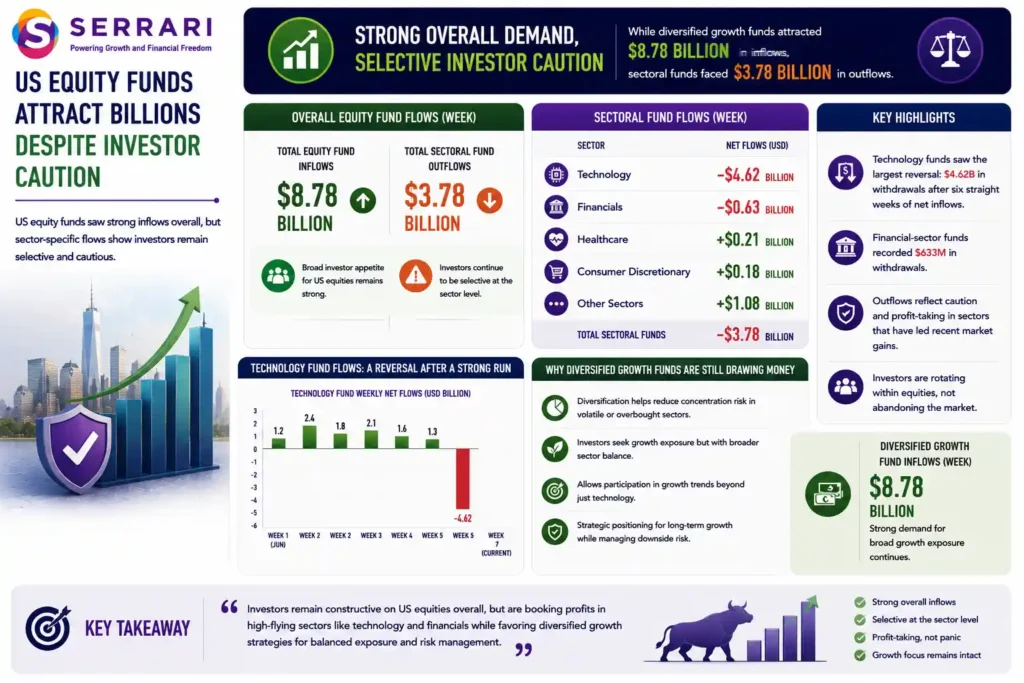
Despite strong overall growth-fund demand, sector-specific flows reveal that investor caution has not disappeared.
Investors withdrew a net $3.78 billion from sectoral funds during the week.
Technology funds experienced the largest reversal, recording approximately $4.62 billion in withdrawals after six consecutive weeks of net purchases.
Financial-sector funds also recorded approximately $633 million in withdrawals.
The technology outflows are particularly noteworthy because technology shares have been an important driver of US equity market performance.
They may indicate profit-taking after recent gains rather than a wholesale rejection of growth stocks. The simultaneous $8.78 billion inflow into diversified growth funds suggests investors remain interested in growth exposure but may be reducing concentrated allocations to individual sectors.
Strong Earnings Support Equity Markets
Corporate earnings have provided another source of support for equity markets.
With roughly 85% of reporting S&P 500 companies exceeding analyst earnings expectations, corporate performance has generally remained stronger than markets anticipated.
Strong earnings can support stock valuations by demonstrating that companies are generating sufficient profits even amid relatively elevated borrowing costs and economic uncertainty.
This may partly explain why investors returned to equities despite continuing concerns surrounding interest rates, geopolitical developments and market volatility.
However, record index levels can also increase sensitivity to disappointing economic or earnings data. When valuations rise substantially, investors may demand increasingly strong corporate performance to justify additional gains.
Bond Funds Receive $9.4 Billion
The week’s investment flows show that investors were not simply abandoning defensive assets to buy stocks.
Bond funds attracted $9.4 billion, their strongest weekly inflow in four weeks.
Investors directed approximately $2.98 billion into short-to-intermediate investment-grade funds and $2.07 billion into general domestic taxable fixed-income funds.
Another $1.92 billion flowed into short-to-intermediate government and Treasury funds.
The scale of these purchases suggests investors continue seeking fixed-income exposure even while increasing allocations to equities.
If investors increasingly believe the Federal Reserve has reached the end of its tightening cycle, bonds can become more attractive because existing yields may provide income while bond prices could benefit if interest rates eventually decline.
Money Market Funds Attract $13.92 Billion
Money market funds also recorded their second consecutive week of inflows, attracting approximately $13.92 billion.
That amount substantially exceeded the $2.58 billion directed into equity funds.
Money market products are generally used by investors seeking liquidity and relatively low volatility while earning short-term interest income.
Continued inflows therefore reinforce the idea that the improvement in equity demand should not be interpreted as an unrestricted return to risk-taking.
Instead, investors appear to be spreading capital across stocks, bonds and cash-like instruments.
For institutional investors and households alike, this approach can provide participation in rising markets while retaining liquidity if economic or monetary conditions change.
What the Fund Flows Signal for Markets
The latest numbers present a more nuanced picture than the headline equity inflow alone suggests.
Investors are returning to US stocks, particularly diversified growth strategies, as inflation and employment data reduce fears of another immediate Federal Reserve rate increase.
Strong corporate earnings provide additional support.
At the same time, significant allocations to bonds and money market funds show that investors are maintaining defensive positions rather than betting entirely on a sustained equity rally.
Technology-sector withdrawals provide another warning against interpreting record stock indices as evidence of uniformly bullish positioning.
The result is a market in which risk appetite is improving, but caution remains an important part of portfolio allocation.
For US equity funds, continued inflows may depend on whether inflation remains contained, corporate earnings remain resilient and the Federal Reserve avoids delivering a more hawkish policy outlook than markets currently expect.
FAQs
How much money flowed into US equity funds?
Investors purchased a net $2.58 billion of US equity funds during the week through August 12. The inflow reversed the previous week’s $1.36 billion in net withdrawals, indicating renewed demand for US stocks as concerns about another Federal Reserve rate increase eased.
Which US equity funds attracted the most money?
Growth funds recorded the strongest demand, attracting approximately $8.78 billion, their largest weekly net inflow since November 2024. Value-oriented equity funds also attracted investors, recording approximately $1.79 billion in net purchases during the week.
Why did technology funds experience outflows?
Technology funds recorded approximately $4.62 billion in withdrawals after six consecutive weeks of inflows. The reversal could reflect profit-taking and efforts to reduce concentrated technology exposure following strong market performance rather than a complete retreat from growth investments.
Did investors also put money into bonds and money market funds?
Yes. Bond funds attracted approximately $9.4 billion, their highest weekly inflow in four weeks, while money market funds received another $13.92 billion. These substantial allocations suggest investors remain cautious and are balancing equity exposure with fixed-income and highly liquid investments.
Your financial future isn’t something you wait for—it’s something you build.
The real question is: when do you begin?
Move beyond simply staying informed.
Navigate the markets with clarity—track trends through the Serrari Group Market Index, uncover opportunities in the Serrari Marketplace, and build practical knowledge with our Curated Wealth Builder Platform.
Stay connected to what truly matters.
Get daily insights on macro trends and financial movements across Kenya, Africa, and global markets—delivered through the Serrari Newsletter.
Growth opens doors.
Advance your career through professional programs including ACCA, HESI A2, ATI TEAS 7 , HESI EXIT , NCLEX – RN and NCLEX – PN, Financial Literacy!🌟—designed to move you forward with confidence.
See where money is flowing—clearly and in real time.
Track Money Market Funds, Treasury Bills, Treasury Bonds, Green Bonds, and Fixed Deposits, alongside global and African indexes, key economic indicators, and the evolving Crypto and stablecoin landscape—all within Serrari’s Market Index.