Lannebo Sustainable Corporate Bond gained 0.2% in July, matching its benchmark’s monthly performance, according to the latest report from fund managers Carl Johan Lagercrantz and Julia Stålbro. Since the beginning of 2026, the fund has returned 1.8%, slightly below the benchmark’s 1.9% gain. The portfolio remained heavily concentrated in Sweden, while European Energy, Balder and Arjo were its three largest holdings. Developments including stronger corporate fundamentals and credit rating upgrades across the Nordic credit market provided additional signals for investors assessing credit quality and fixed-income opportunities.
Key Overview
Lannebo Sustainable Corporate Bond A returned 0.2% in July, matching the fund’s benchmark for the month.
Year-to-date, the fund has gained 1.8%, slightly underperforming the benchmark’s 1.9% return.
European Energy was the largest holding at 4.1%, followed by Balder at 3.2% and Arjo at 2.9%.
Sweden represented 66.3% of the portfolio, making the fund predominantly exposed to Swedish corporate credit.
Lannebo Sustainable Corporate Bond Matches Benchmark
The Lannebo Sustainable Corporate Bond fund recorded a positive but modest performance in July, rising 0.2%.
The result was exactly in line with its benchmark index, which also advanced 0.2% during the month.
Performance over the full year has been similarly close. Since the beginning of 2026, the fund has generated a return of 1.8%, compared with a 1.9% increase for its benchmark.
The 0.1 percentage point gap represents only modest underperformance, but it illustrates how closely the fund has tracked broader movements in its relevant bond market during the year.
For investors, monthly returns provide only one measure of performance. Credit quality, interest-rate sensitivity, portfolio diversification and sustainability criteria are also important when evaluating corporate bond funds.
Context is everything. Stay ahead of shifting trends with today’s market updates, and uncover emerging opportunities using the Serrari Group Market Index and Marketplace. Then, take control of your own financial future by exploring our Money & Life Reset Transformation Blueprint ™ to build stronger habits, create better systems, and design a path toward lasting wealth.
European Energy Remains Largest Holding
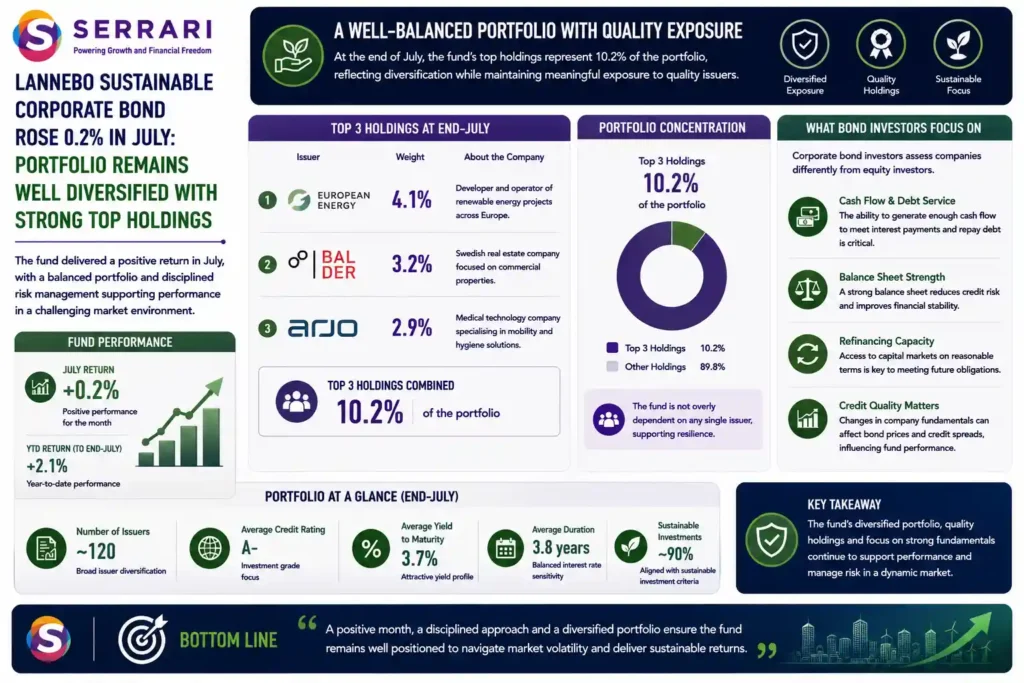
At the end of July, European Energy represented the largest individual position in the portfolio, accounting for 4.1% of the fund.
Balder was the second-largest holding with a 3.2% weighting, while Arjo accounted for 2.9%.
Together, the three largest holdings represented 10.2% of the portfolio.
The allocation demonstrates that the bond fund is not overwhelmingly dependent on a single issuer. Nevertheless, developments affecting major holdings can influence performance, particularly when changes in company fundamentals affect bond prices or credit spreads.
Corporate bond investors generally monitor companies differently from equity investors. While shareholders may focus heavily on earnings growth and rising valuations, bondholders are particularly interested in whether companies can generate sufficient cash flow to meet interest payments and repay debt.
Balance-sheet strength and refinancing capacity therefore become central considerations.
Sweden Dominates Geographic Exposure
The fund maintained substantial exposure to Sweden at the end of July.
Swedish securities accounted for approximately 66.3% of the portfolio, making Sweden by far its largest geographic market.
Norway represented 16.6%, while Finland accounted for another 6.3%.
The allocation gives the fund a strong Nordic orientation, particularly toward Swedish issuers. This means economic conditions, corporate fundamentals and developments in Scandinavian fixed income markets can have a meaningful impact on overall performance.
Geographic concentration can provide advantages when managers have deep knowledge of companies within a particular market. However, it can also increase sensitivity to regional economic conditions.
Investors therefore need to consider the geographic composition alongside individual issuer diversification.
Corporate Credit Fundamentals Remain Important
Corporate performance during the period offered several signals for credit investors.
Skanska continued to demonstrate strong profitability, a healthy financial position and a substantial order book.
For bondholders, these characteristics can be particularly important. Strong profitability supports cash generation, while a solid balance sheet can reduce concerns about an issuer’s ability to service debt.
A substantial order book can also provide greater visibility into future revenue, although it does not guarantee that projects will ultimately deliver expected margins.
Husqvarna similarly reported improvements in efficiency alongside a gradual normalization of inventory levels.
Lower or better-managed inventories can release working capital and improve cash flow, potentially strengthening the company’s financial flexibility.
These developments helped reinforce confidence in the company’s cash-flow generation and overall credit profile.
Why Credit Ratings Matter to Corporate Bonds
Changes in credit ratings can have a direct impact on corporate borrowing costs and investor demand.
Rating agencies assess an issuer’s ability to meet its financial obligations. A higher rating generally indicates lower perceived default risk, although ratings should not be treated as guarantees.
For companies such as SSAB, credit rating upgrades can potentially broaden the pool of investors able to purchase their bonds.
This is particularly important when an issuer moves further into the investment-grade bonds universe because many pension funds, insurers and institutional portfolios operate under mandates that restrict exposure to lower-rated securities.
An upgrade can therefore increase demand for an issuer’s bonds and potentially reduce the credit spread investors require to hold them.
Conversely, downgrades can increase financing costs and place downward pressure on bond prices.
Sustainable Investing Meets Credit Analysis
The fund’s strategy also illustrates how sustainable investing and traditional credit analysis increasingly overlap.
Sustainability-focused corporate bond funds must consider environmental and social characteristics while still evaluating the fundamental ability of borrowers to repay their obligations.
A company may have ambitious sustainability targets, but those objectives do not eliminate credit risk. Investors must still assess leverage, liquidity, profitability, cash flow and refinancing requirements.
Likewise, financially strong companies may face longer-term risks if environmental regulation, technological changes or shifting consumer preferences undermine their business models.
Sustainable corporate bond investing therefore requires both financial and non-financial analysis rather than treating environmental considerations as substitutes for conventional credit assessment.
What July’s Performance Means for Investors
The fund’s 0.2% July gain indicates a relatively stable month rather than a major change in performance.
Matching the benchmark during July while trailing it by only 0.1 percentage point year-to-date suggests that the fund has remained broadly aligned with its relevant corporate credit market.
The underlying portfolio also contains several signals worth monitoring.
European Energy, Balder and Arjo remain the largest positions, while Sweden continues to dominate geographic exposure. Meanwhile, improving fundamentals at companies such as Skanska and Husqvarna can support confidence in corporate credit quality.
Developments involving SSAB and other issuers receiving stronger credit assessments are also important because upgrades can affect borrowing costs, bond valuations and institutional demand.
For the remainder of 2026, fund performance will likely depend on a combination of interest-rate movements, credit spreads and company-specific developments.
The Lannebo Sustainable Corporate Bond fund’s July result therefore reflects a relatively steady period for the portfolio, with its 0.2% return keeping monthly performance level with the benchmark while leaving only a narrow year-to-date performance gap.
FAQs
How did Lannebo Sustainable Corporate Bond perform in July?
The Lannebo Sustainable Corporate Bond A fund gained 0.2% in July, exactly matching the 0.2% return recorded by its benchmark index. Since the beginning of 2026, the fund has returned 1.8%, slightly below the benchmark’s 1.9% gain.
What are the largest holdings in Lannebo Sustainable Corporate Bond?
At the end of July, European Energy was the fund’s largest holding at 4.1%, followed by Balder at 3.2% and Arjo at 2.9%. Combined, these three holdings represented approximately 10.2% of the portfolio.
Which countries have the largest weighting in the fund?
Sweden dominates the portfolio with a 66.3% weighting. Norway is the second-largest geographic exposure at 16.6%, while Finland represents 6.3%. The allocation means the fund remains heavily exposed to developments in Swedish and broader Nordic corporate credit markets.
Why are credit rating upgrades important for corporate bond investors?
A credit rating upgrade generally indicates that a rating agency believes an issuer’s capacity to meet its debt obligations has improved. Upgrades can increase investor demand, reduce perceived credit risk and potentially lower borrowing costs. They can be particularly significant when companies strengthen their position within the investment-grade market.
Your financial future isn’t something you wait for—it’s something you build.
The real question is: when do you begin?
Move beyond simply staying informed.
Navigate the markets with clarity—track trends through the Serrari Group Market Index, uncover opportunities in the Serrari Marketplace, and build practical knowledge with our Curated Wealth Builder Platform.
Stay connected to what truly matters.
Get daily insights on macro trends and financial movements across Kenya, Africa, and global markets—delivered through the Serrari Newsletter.
Growth opens doors.
Advance your career through professional programs including ACCA, HESI A2, ATI TEAS 7 , HESI EXIT , NCLEX – RN and NCLEX – PN, Financial Literacy!🌟—designed to move you forward with confidence.
See where money is flowing—clearly and in real time.
Track Money Market Funds, Treasury Bills, Treasury Bonds, Green Bonds, and Fixed Deposits, alongside global and African indexes, key economic indicators, and the evolving Crypto and stablecoin landscape—all within Serrari’s Market Index.