Nigeria is offering ₦1.1 trillion of reopened Federal Government bonds at its August 17 auction across three maturities.
The securities carry existing coupons ranging from 15.45% to 22.60%, but those rates should not be confused with today’s auction yields. Investors will bid at prices corresponding to the yields they require, with successful bidders also paying accrued interest.
July’s auction attracted ₦1.74 trillion of subscriptions against ₦1.2 trillion offered, making today’s demand and clearing yields an important test of institutional appetite for Nigerian government debt.
Key Overview
- Total offered: ₦1.10 trillion.
- January 2035: ₦250 billion at 22.60% coupon.
- April 2037: ₦100 billion at 16.2499% coupon.
- June 2038: ₦750 billion at 15.45% coupon.
- Auction: August 17.
- Settlement: August 19.
- Interest payments: semi-annual.
- Auction results were not yet available at the time of writing.
Nigeria FGN Bond Auction Tests ₦1.1tn Investor Demand
Nigeria’s government debt market faces another large funding test as investors bid for reopened Federal Government bonds on August 17.
The Debt Management Office’s ₦1.1 trillion August auction is spread across three existing securities rather than newly created bonds.
The current offer comprises a ₦250 billion January bond carrying a 22.60% coupon January 2035, a ₦100 billion April bond carrying a 16.2499% coupon April 2037, and a much larger ₦750 billion June bond carrying a 15.45% coupon June 2038.
The biggest investor question is not which bond has the highest coupon.
It is what yield investors will require to buy each maturity today.
Coupon Is Not Auction Yield
Because these securities are reopenings, their coupon rates are already fixed.
Investors instead submit bids based on price and yield to maturity.
If investors demand a yield above a bond’s coupon, they will generally need to purchase it below par. If required yield is below the coupon, its price can move above par.
Successful bidders also pay accrued interest because the bonds are being reopened between coupon-payment dates.
That distinction explains why the headline coupon rate alone cannot tell investors whether one of these bonds offers attractive value.
July Sets a High Bar
The previous auction showed substantial appetite for government securities.
July attracted ₦1.74 trillion investor subscriptions against ₦1.2 trillion bonds offered, equivalent to roughly 45% oversubscription.
That makes August particularly informative.
If investors again submit bids well above the amount offered while accepting lower yields, it could suggest strong liquidity and confidence in long-dated sovereign paper.
Strong subscriptions accompanied by stubbornly high clearing yields would send a different message: investors want the bonds, but only at substantial compensation.
Context is everything. Stay ahead of shifting trends with today’s market updates, and uncover emerging opportunities using the Serrari Group Market Index and Marketplace. Then, take control of your own financial future by exploring our Money & Life Reset Transformation Blueprint ™ to build stronger habits, create better systems, and design a path toward lasting wealth.
Why the 2038 Bond Matters
The June 2038 security accounts for ₦750 billion of supply, making it by far the largest part of the auction.
Its demand will therefore provide a useful signal of how willing banks, pension funds, insurers and other institutions are to extend duration.
Long bonds can provide substantial recurring income, but they also carry more interest-rate sensitivity.
If market yields rise after purchase, the secondary-market price of a long-duration bond can fall substantially.
Holding to maturity reduces the relevance of daily price movements for investors who can genuinely wait, but it does not eliminate inflation or opportunity-cost risk.
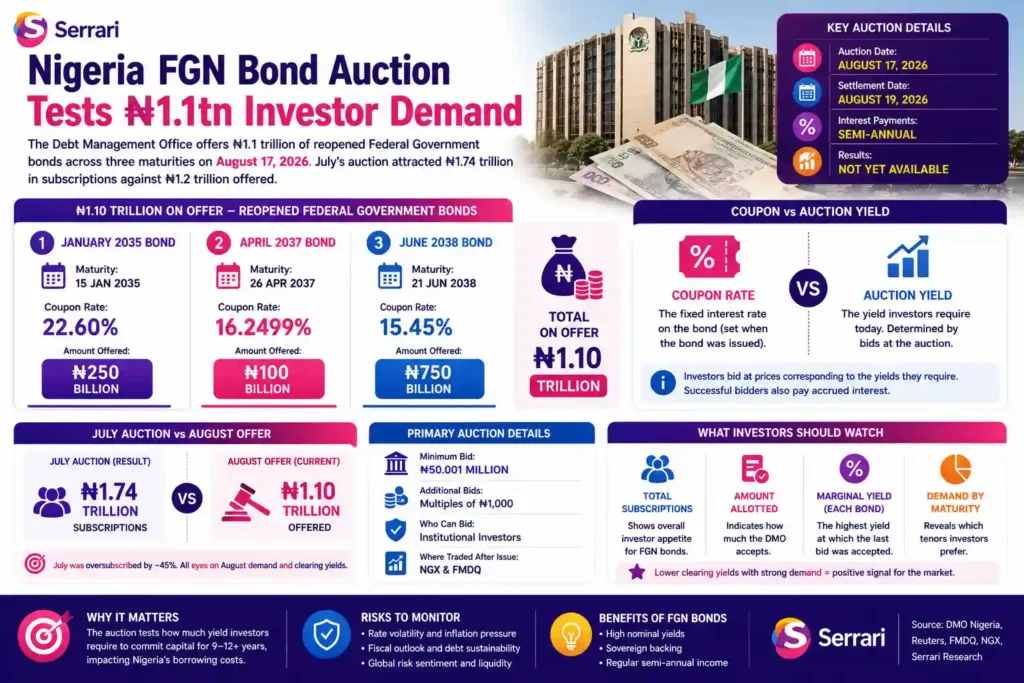
Nigeria’s ₦1.1 trillion August bond auction is split between ₦250 billion of January 2035 bonds at a 22.60% coupon, ₦100 billion of April 2037 bonds at 16.2499%, and ₦750 billion of June 2038 bonds at 15.45%. The graphic separates coupon from auction yield and compares July demand with the new August offer.
The Minimum Bid Is Institutional
The DMO circular sets the primary-auction minimum at ₦50.001 million per subscription, with additional amounts in multiples of ₦1,000.
That makes the primary auction primarily institutional rather than a small-retail-investor product.
The bonds themselves are subsequently listed on NGX and FMDQ, giving investors secondary-market routes to buy and sell them after issuance.
Settlement is scheduled for August 19 after auction.
What Investors Should Watch
Once DMO publishes the results, four numbers matter most:
- Total subscriptions;
- Amount allotted;
- Marginal yield for each bond; and
- Demand by maturity.
The strongest signal would be heavy demand accompanied by lower clearing yields.
If demand weakens or investors insist on higher yields, the auction would indicate that government borrowing costs remain under pressure.
Conclusion
Nigeria’s ₦1.1 trillion auction is more than another large sovereign-debt sale.
It is a live test of how much yield investors require to commit capital for roughly another decade or more.
July showed that demand for FGN bonds can remain substantial even when nominal returns are elevated.
August will show whether that appetite is strong enough to push borrowing costs lower—or whether investors still require high yields before extending duration.
FAQs
1. Is the 22.60% rate today’s auction yield?
No. It is the existing coupon on the January 2035 bond. The auction determines the price and yield to maturity accepted from bidders.
2. How much is Nigeria offering?
The total August offer is ₦1.1 trillion across three reopened bonds maturing in 2035, 2037 and 2038.
3. Why reopen existing bonds?
Reopenings increase the amount outstanding in existing securities, which can improve market liquidity and price discovery instead of creating many small bond lines.
4. When will investors know the actual yields?
The DMO publishes the marginal rates, subscriptions and allotments after the auction. Those results were not yet available at the time this article was prepared.
Sources: Debt Management Office Nigeria; Vanguard; Nairametrics; GTI Research; APA News.
Your financial future isn’t something you wait for—it’s something you build.
The real question is: when do you begin?
Move beyond simply staying informed.
Navigate the markets with clarity—track trends through the Serrari Group Market Index, uncover opportunities in the Serrari Marketplace, and build practical knowledge with our Curated Wealth Builder Platform.
Stay connected to what truly matters.
Get daily insights on macro trends and financial movements across Kenya, Africa, and global markets—delivered through the Serrari Newsletter.
Growth opens doors.
Advance your career through professional programs including ACCA, HESI A2, ATI TEAS 7 , HESI EXIT , NCLEX – RN and NCLEX – PN, Financial Literacy!🌟—designed to move you forward with confidence.
See where money is flowing—clearly and in real time.
Track Money Market Funds, Treasury Bills, Treasury Bonds, Green Bonds, and Fixed Deposits, alongside global and African indexes, key economic indicators, and the evolving Crypto and stablecoin landscape—all within Serrari’s Market Index.