The Lagos real estate industry is set to take centre stage as property professionals, investors and other built-environment stakeholders converge for the Africa Real Estate Innovation Summit of Excellence (ARISE Africa) 2026. The summit comes as Nigeria faces a housing deficit estimated at more than 28 million units, high construction costs, limited mortgage financing and rapid urbanisation. Organisers say discussions will focus on real estate investment, innovation, financing, sustainability and partnerships capable of expanding housing delivery across Africa.
Key Overview
ARISE Africa 2026 is bringing together leading real estate stakeholders to discuss solutions for Africa’s rapidly changing property sector.
Nigeria’s housing deficit is estimated at more than 28 million units, while approximately 700,000 additional homes are needed annually to narrow the gap.
Current housing delivery is estimated at only about 100,000 units per year, leaving a substantial supply shortfall.
Mortgage penetration remains below 1% of Nigeria’s housing stock, making access to affordable long-term financing one of the industry’s biggest constraints.
Lagos Real Estate Industry Takes Focus at ARISE Africa
Stakeholders across Africa’s built environment are converging on Lagos to explore strategies that could reshape the continent’s property ecosystem.
The Africa Real Estate Innovation Summit of Excellence brings together developers, investors, realtors and other industry participants to discuss opportunities and challenges facing the Lagos real estate industry and the wider African market.
The summit forms part of activities marking the 10th anniversary of Billionaires Realtors Group Network, an organisation involved in training and developing real estate professionals across Africa.
Emmanuel Abikoye, president of BRG Network, said Africa’s continued development is increasing the need for meaningful industry conversations, strategic partnerships, innovative solutions and investment opportunities capable of supporting sustainable growth.
The summit therefore extends beyond individual property transactions. Its broader focus is how Africa can develop the financing, technology, infrastructure and regulatory environment needed to support a rapidly urbanising population.
Housing Deficit Creates Pressure on Nigeria’s Property Market
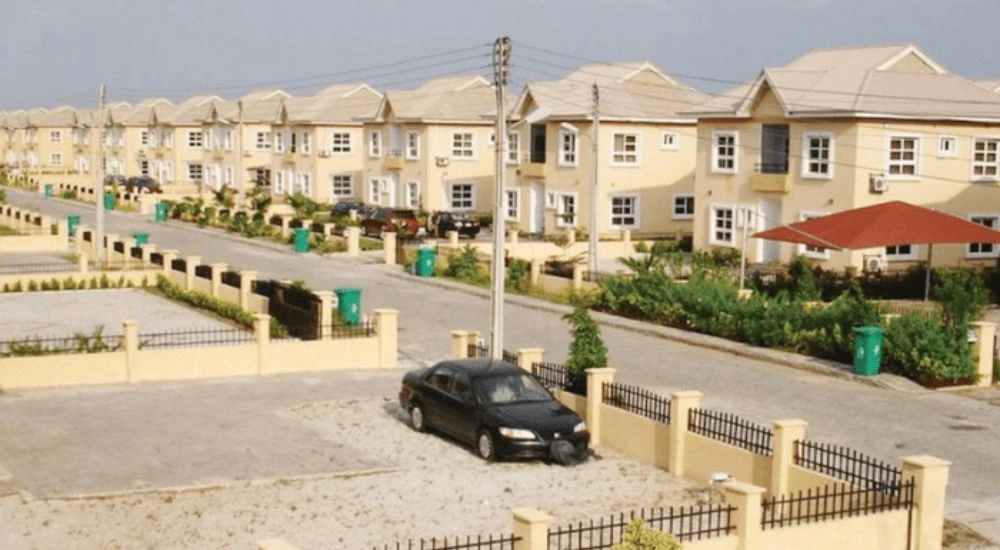
One of the most significant challenges confronting the Nigerian property sector is the country’s housing shortage.
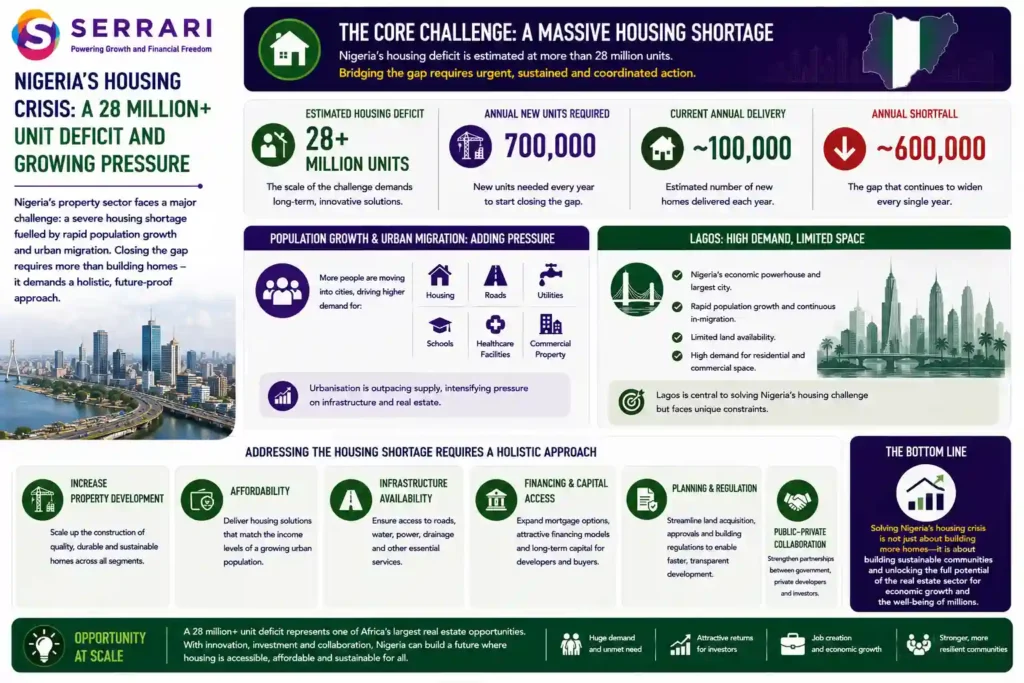
Nigeria’s deficit is estimated at more than 28 million housing units. Around 700,000 new units are reportedly required every year to begin closing the gap, while current annual delivery is estimated at approximately 100,000 units.
That leaves a potential annual shortfall of roughly 600,000 homes.
Population growth and urban migration are adding further pressure. As more people move into major cities, demand increases not only for housing but also for roads, utilities, schools, healthcare facilities and commercial property.
Lagos is particularly important because it combines rapid population growth with limited land availability and substantial demand for residential and commercial space.
Consequently, addressing the housing shortage requires more than simply increasing property development. Developers must also consider affordability, infrastructure availability, financing and planning regulations.
Mortgage Financing Remains a Major Constraint
Financing is another structural challenge facing Nigeria’s housing sector.
Less than 1% of the country’s housing stock is estimated to be financed through formal mortgages. That compares poorly with markets where long-term mortgage financing plays a much larger role in home ownership.
Many prospective Nigerian buyers instead rely on personal savings, incremental construction or relatively expensive short-term borrowing.
With lending rates potentially exceeding 30%, financing a property purchase can become prohibitively expensive for middle-income households.
This creates problems on both sides of the market.
Homebuyers struggle to access sufficient capital, while developers face a smaller pool of customers capable of purchasing completed properties. Weak mortgage penetration can therefore reduce market liquidity and make it harder for developers to convert housing demand into actual sales.
Expanding affordable long-term financing could consequently be as important as increasing housing supply.
Context is everything. Stay ahead of shifting trends with today’s market updates, and uncover emerging opportunities using the Serrari Group Market Index and Marketplace. Then, take control of your own financial future by exploring our Money & Life Reset Transformation Blueprint ™ to build stronger habits, create better systems, and design a path toward lasting wealth.
Construction Costs Challenge Housing Development
Inflation and rising building-material prices represent another obstacle to housing development.
Developers must account for land acquisition, cement, steel, labour, energy, transportation, financing and regulatory expenses. When these costs increase rapidly, projects become more expensive to complete.
Developers can attempt to pass those costs on through higher property prices, but household incomes may not rise at the same rate.
That creates an affordability problem.
Nigeria may have enormous underlying housing demand, but demand does not automatically translate into effective purchasing power. A household needing a home is not necessarily able to purchase one at prevailing market prices.
Future housing strategies therefore need to address both supply and affordability.
Real Estate Investment Could Benefit From Diaspora Capital
Nigeria’s diaspora represents another potentially important source of real estate investment.
Nigerians living abroad reportedly remitted more than $20 billion in 2025, with property remaining an important destination for some of that capital.
However, title disputes, fraud concerns and difficulties verifying property ownership can discourage investment.
Improving land-registration systems could therefore help unlock more diaspora and institutional capital.
Industry stakeholders have supported greater digitisation of property-related processes, including the possibility of unified digital platforms that could simplify verification and administrative procedures.
Such reforms could reduce transaction friction and increase transparency across the property market.
However, digitisation alone would not solve every problem. Effective reforms would also require reliable land records, regulatory enforcement and coordination among relevant government agencies.
Sustainable Real Estate Gains Importance
The summit also places sustainable real estate within the broader conversation about Africa’s urban future.
Rapid urbanisation creates significant opportunities for developers, but poorly planned expansion can increase congestion, infrastructure pressure and environmental risks.
Future developments increasingly need to consider energy efficiency, water use, transport access and climate resilience alongside construction costs and expected investment returns.
This is particularly relevant for large African cities, where today’s development decisions could influence urban conditions for decades.
Sustainable construction can involve higher upfront investment in some cases, but lower operating costs and improved resource efficiency can potentially generate longer-term benefits for occupants and property owners.
Real Estate Innovation Could Reshape the Sector
Technology represents another important part of the industry’s evolution.
Real estate innovation can improve property searches, land verification, payments, building management, construction processes and investment access.
Digital platforms may also reduce information gaps between developers, buyers and investors.
But technology should not be treated as a substitute for structural reforms. Nigeria’s housing shortage ultimately involves land availability, infrastructure, financing, construction capacity and household affordability.
Innovation will have the greatest impact when it helps address those underlying constraints rather than merely digitising existing processes.
Outlook for the Lagos Real Estate Industry
ARISE Africa 2026 arrives at a critical point for the Lagos real estate industry.
Nigeria possesses enormous housing demand, a growing urban population and significant potential investment capital. At the same time, expensive financing, construction inflation, land administration challenges and limited mortgage penetration continue to constrain development.
Closing a housing deficit exceeding 28 million units will require significantly greater annual construction alongside reforms that make homes financially accessible.
For investors and developers, this creates both opportunity and risk. Persistent undersupply supports the long-term case for residential development, but high financing and construction costs can undermine project economics.
The challenge for stakeholders gathering in Lagos is therefore not simply identifying demand. It is developing practical financing, regulatory and construction solutions capable of converting that demand into sustainable housing supply.
FAQs
What is ARISE Africa 2026?
The Africa Real Estate Innovation Summit of Excellence (ARISE Africa) 2026 is a gathering of real estate and built-environment stakeholders focused on investment, innovation, housing, financing and sustainable urban development across Africa.
How large is Nigeria’s housing deficit?
Nigeria’s housing deficit is estimated at more than 28 million units. The country reportedly needs approximately 700,000 new homes annually to reduce the shortage, while current housing delivery is estimated at around 100,000 units per year.
Why is mortgage financing a problem in Nigeria?
Formal mortgage penetration is estimated at less than 1% of Nigeria’s housing stock. High interest rates and limited access to long-term financing make homeownership difficult for many households and can constrain demand for newly developed properties.
What could drive growth in the Lagos real estate industry?
Growth could be supported by stronger mortgage financing, streamlined land administration, increased private and diaspora investment, digital property systems, sustainable construction and greater housing supply. However, high construction costs and affordability constraints remain major challenges.
Sources: Streamline feed, The Guardian, Business Day Nigeria
Your financial future isn’t something you wait for—it’s something you build.
The real question is: when do you begin?
Move beyond simply staying informed.
Navigate the markets with clarity—track trends through the Serrari Group Market Index, uncover opportunities in the Serrari Marketplace, and build practical knowledge with our Curated Wealth Builder Platform.
Stay connected to what truly matters.
Get daily insights on macro trends and financial movements across Kenya, Africa, and global markets—delivered through the Serrari Newsletter.
Growth opens doors.
Advance your career through professional programs including ACCA, HESI A2, ATI TEAS 7 , HESI EXIT , NCLEX – RN and NCLEX – PN, Financial Literacy!🌟—designed to move you forward with confidence.
See where money is flowing—clearly and in real time.
Track Money Market Funds, Treasury Bills, Treasury Bonds, Green Bonds, and Fixed Deposits, alongside global and African indexes, key economic indicators, and the evolving Crypto and stablecoin landscape—all within Serrari’s Market Index.