Money market rates ended the week on a mixed note after the Central Bank of Nigeria (CBN) absorbed approximately ₦1.4 trillion from the banking system through Open Market Operations (OMO). Despite the liquidity withdrawal, money market liquidity remained comfortable, supported by large Treasury bill and OMO maturities, while short-term rates reflected only modest changes.
Key Overview
- Money market rates closed mixed during the week.
- Banking system liquidity opened with a ₦7.0 trillion surplus.
- The CBN absorbed approximately ₦1.4 trillion through an OMO auction.
- System liquidity declined to ₦2.87 trillion by week-end.
- Overnight NIBOR rose slightly to 22.30%.
- Treasury bill yields increased to 18.65%.
- Liquidity is expected to remain comfortable due to upcoming maturities.
Money Market Rates Mixed as CBN Liquidity Mop-Up Tightens Short-Term Funding
Money market rates ended the week on a mixed note as the Central Bank of Nigeria (CBN) continued its efforts to manage excess liquidity through aggressive Open Market Operations (OMO).
Although the banking system began the week with abundant liquidity, the central bank’s liquidity absorption strategy moderated surplus cash balances while leaving overall funding conditions relatively stable.
The developments reflect the CBN’s continued focus on supporting its monetary policy objectives while maintaining orderly conditions in Nigeria’s short-term funding markets.
Banking System Opened With Strong Liquidity
The Nigerian banking system entered the week with a substantial ₦7.0 trillion net liquidity surplus.
According to Cowry Asset Limited, the surplus was supported by approximately ₦102.7 billion in inflows from primary market repayments.
Commercial banks also continued placing excess funds through the Standing Deposit Facility (SDF), helping maintain comfortable liquidity conditions in the absence of significant funding pressures.
The strong liquidity environment provided banks with sufficient short-term funding before the central bank intervened through open market operations.
Context is everything. Stay ahead of shifting trends with today’s market updates, and uncover emerging opportunities using the Serrari Group Market Index and Marketplace. Then, take control of your own financial future by exploring our Money & Life Reset Transformation Blueprint ™ to build stronger habits, create better systems, and design a path toward lasting wealth.
CBN Conducts ₦1.4 Trillion OMO Auction
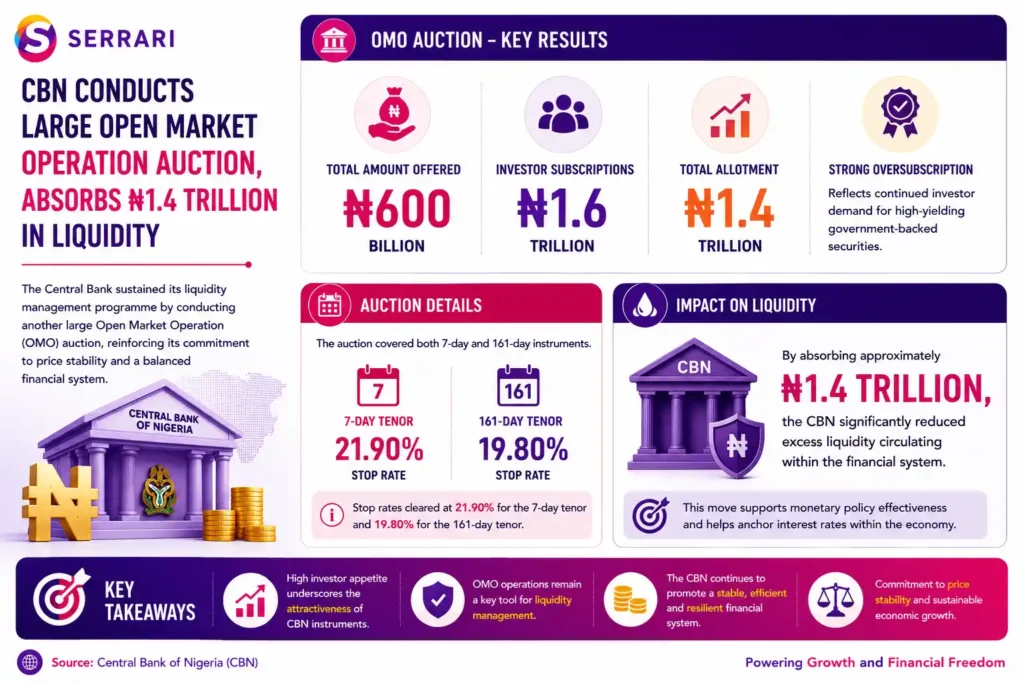
The Central Bank sustained its liquidity management programme by conducting another large Open Market Operation auction.
During the exercise:
- Total amount offered: ₦600 billion
- Investor subscriptions: ₦1.6 trillion
- Total allotment: ₦1.4 trillion
The auction covered both 7-day and 161-day instruments.
Stop rates cleared at:
- 21.90% for the 7-day tenor.
- 19.80% for the 161-day tenor.
The strong oversubscription highlighted continued investor demand for high-yielding government-backed securities.
By absorbing approximately ₦1.4 trillion, the CBN significantly reduced excess liquidity circulating within the financial system.
Liquidity Conditions Remained Comfortable
Following the OMO operation, overall money market liquidity moderated considerably.
Banking system liquidity declined from ₦7.0 trillion to approximately ₦2.87 trillion by the end of the week.
Despite this reduction, liquidity remained firmly in surplus, indicating that banks continued to hold ample short-term funds.
The central bank’s actions demonstrate its ongoing strategy of balancing financial system liquidity while managing inflationary pressures through monetary tightening.
Interbank Rates Show Mixed Performance
Nigeria’s key interbank rates reflected only modest movements during the week despite the liquidity withdrawal.
Key market indicators included:
| Indicator | Weekly Movement | Closing Level |
| Overnight NIBOR | +2 basis points | 22.30% |
| Overnight (OVN) Rate | -5 basis points | 22.18% |
| Open Repo Rate (OPR) | Unchanged | Stable |
The slight increase in the Nigerian Interbank Offered Rate (NIBOR) suggested marginal tightening in short-term funding conditions.
Meanwhile, the small decline in the Overnight Rate indicated that overall liquidity remained sufficient to prevent significant funding stress across the banking sector.
Treasury Bill Market Remained Subdued
Activity in Nigeria’s secondary Treasury bill market remained relatively quiet during the week.
Selling pressure across both short- and medium-term maturities pushed the average Treasury bill yield 6 basis points higher to 18.65%.
The rise in yields reflected investor positioning following the CBN’s liquidity absorption exercise and expectations that elevated short-term interest rates may persist.
Strong demand for OMO securities also demonstrated continued investor preference for attractive risk-free returns amid Nigeria’s high-interest-rate environment.
Upcoming Maturities Could Support Liquidity
Market participants expect liquidity conditions to remain relatively comfortable over the coming weeks.
According to Cowry Asset Limited, the financial system is expected to receive substantial inflows from upcoming government security maturities, including:
- ₦269.36 billion in Treasury bill maturities.
- Approximately ₦3.92 trillion in OMO maturities.
These repayments are expected to inject fresh liquidity back into the banking system, partially offsetting the CBN’s recent liquidity sterilisation efforts.
Future liquidity conditions will largely depend on whether the central bank conducts additional OMO auctions to absorb part of these incoming funds.
What the Mixed Money Market Rates Mean
The week’s developments illustrate the balance the CBN is attempting to achieve between maintaining adequate liquidity and controlling inflation.
Although the central bank successfully reduced excess liquidity through OMO operations, funding conditions remained broadly stable due to the sizable surplus already present within the banking system.
For banks, stable liquidity helps support lending activity while allowing participation in government securities offering relatively attractive yields.
For investors, elevated Treasury bill and OMO rates continue to provide appealing opportunities within Nigeria’s short-term fixed-income market.
Conclusion
Money market rates ended the week mixed as the Central Bank of Nigeria absorbed approximately ₦1.4 trillion through Open Market Operations while maintaining overall financial system stability. Although liquidity declined from ₦7.0 trillion to ₦2.87 trillion, funding conditions remained comfortable, with only modest changes in short-term rates and interbank rates.
Looking ahead, sizable Treasury bill and OMO maturities are expected to replenish liquidity, although future CBN interventions will remain a key factor influencing money market conditions and short-term interest rates.
FAQs
1. Why did money market rates close on a mixed note?
Money market rates showed mixed performance because the Central Bank of Nigeria withdrew a significant amount of liquidity through its Open Market Operations while the banking system continued to maintain a sizable liquidity surplus. This combination caused some short-term funding rates, such as the Nigerian Interbank Offered Rate (NIBOR), to edge slightly higher, while other rates, including the Overnight Rate, moved lower as liquidity conditions remained generally comfortable.
2. What is the purpose of the Central Bank’s Open Market Operations?
Open Market Operations (OMO) are one of the Central Bank’s primary monetary policy tools used to regulate the amount of money circulating within the financial system. By selling government securities to banks and investors, the CBN absorbs excess liquidity, helping control inflation, stabilise interest rates and support broader monetary policy objectives. Conversely, when securities mature, liquidity is injected back into the banking system.
3. Why are interbank rates important?
Interbank rates measure the cost at which banks lend money to one another over short periods and provide an indication of overall liquidity conditions within the financial system. Rising interbank rates typically suggest tighter funding conditions, while lower rates often indicate abundant liquidity. Investors, financial institutions and policymakers closely monitor these rates because they influence borrowing costs, money market activity and the effectiveness of monetary policy.
4. What could influence Nigeria’s money market in the coming weeks?
Money market conditions will largely depend on the interaction between incoming liquidity from maturing government securities and future Central Bank liquidity management operations. Large Treasury bills and OMO maturities are expected to inject substantial funds into the banking system, supporting liquidity. However, if the CBN continues conducting sizable OMO auctions to absorb excess cash, short-term interest rates and money market conditions could remain relatively tight despite the inflows.
Your financial future isn’t something you wait for—it’s something you build.
The real question is: when do you begin?
Move beyond simply staying informed.
Navigate the markets with clarity—track trends through the Serrari Group Market Index, uncover opportunities in the Serrari Marketplace, and build practical knowledge with our Curated Wealth Builder Platform.
Stay connected to what truly matters.
Get daily insights on macro trends and financial movements across Kenya, Africa, and global markets—delivered through the Serrari Newsletter.
Growth opens doors.
Advance your career through professional programs including ACCA, HESI A2, ATI TEAS 7 , HESI EXIT , NCLEX – RN and NCLEX – PN, Financial Literacy!🌟—designed to move you forward with confidence.
See where money is flowing—clearly and in real time.
Track Money Market Funds, Treasury Bills, Treasury Bonds, Green Bonds, and Fixed Deposits, alongside global and African indexes, key economic indicators, and the evolving Crypto and stablecoin landscape—all within Serrari’s Market Index.