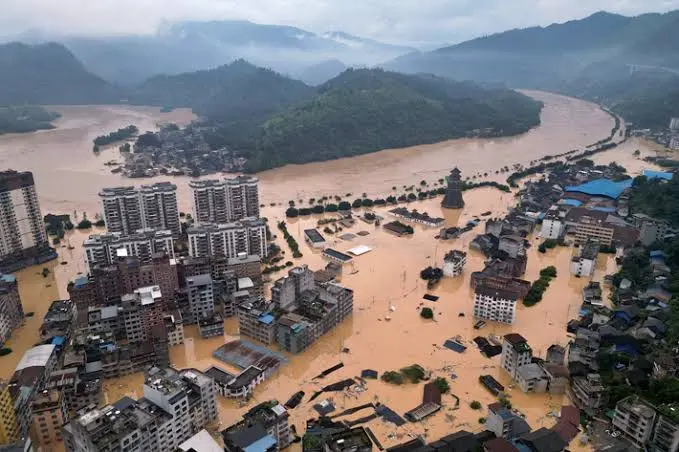
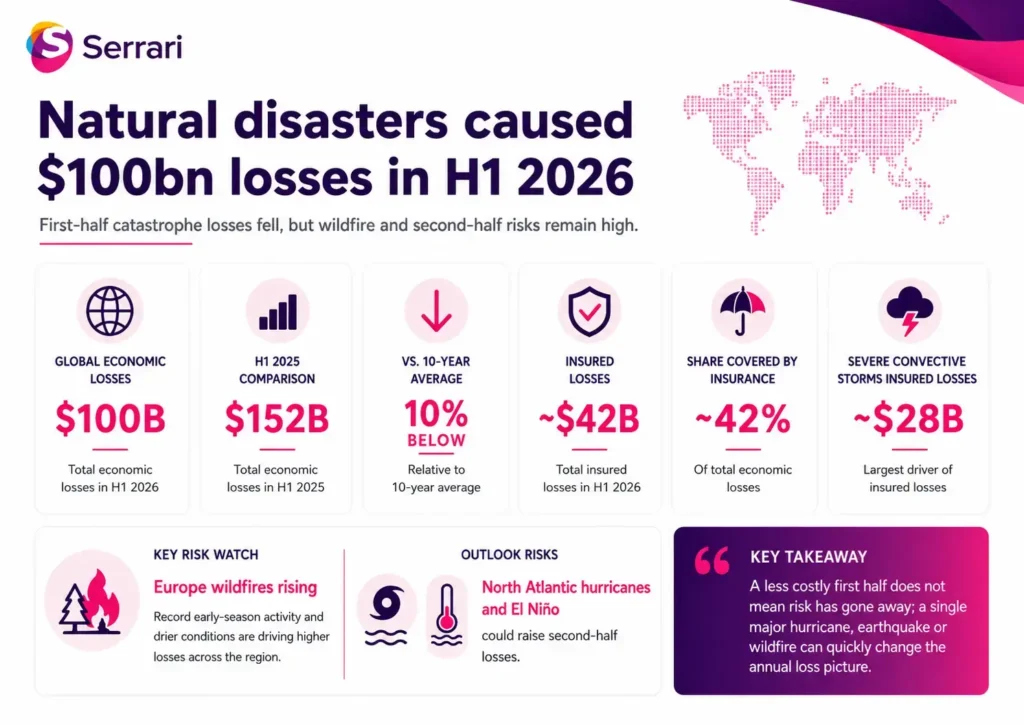
Economic losses from natural catastrophes reached an estimated $100 billion globally in the first half of 2026, falling sharply from $152 billion during the same period in 2025. The total was also around 10% below the 10-year average, making the first six months of the year comparatively less costly despite major storms, earthquakes and other disasters.
However, Swiss Re’s first-half catastrophe assessment shows that a lower first-half total does not mean the underlying risk has disappeared. Insured natural catastrophe losses reached approximately $42 billion, while the historically more active second half of the year still carries significant hurricane, wildfire and weather-related risks.
Key Overview
- Global natural catastrophe economic losses reached $100 billion in H1 2026.
- This was down from $152 billion in H1 2025 and around 10% below the 10-year average.
- Insured natural catastrophe losses were approximately $42 billion.
- Insurance covered about 42% of overall economic losses during the period.
- Severe convective storms generated approximately $28 billion in insured losses.
- The second half of the year historically accounts for a larger share of annual catastrophe losses.
- European wildfire losses are rising rapidly as heat and drought intensify fire conditions.
- El Niño could influence tropical cyclones, floods, wildfires and other weather extremes during the remainder of 2026.
Insured Losses Fall as Overall Damage Declines
The fall in global economic losses was also reflected in insurance claims. Insured losses from natural catastrophes were estimated at around $42 billion during the first six months of 2026, significantly below the exceptionally costly first half of 2025.
Severe convective storms remained one of the most important insured-loss drivers. Thunderstorms, tornadoes, hail and strong winds generated approximately $28 billion in insured losses, with the United States again accounting for a substantial portion of global storm-related claims.
The difference between total economic losses and insured losses also highlights the continuing global insurance protection gap. Even when natural disasters cause tens of billions of dollars in damage, large portions of those losses can remain uninsured, particularly in emerging and developing economies where insurance penetration remains relatively low.
That gap becomes particularly important following earthquakes, floods and other catastrophes capable of destroying homes, businesses and infrastructure while leaving governments, companies and households responsible for much of the rebuilding cost.
Wildfires Become a Faster-Growing Catastrophe Risk
Wildfires remain a comparatively smaller contributor to Europe’s insured catastrophe losses than storms or floods, but their financial significance is increasing.
Severe heat across parts of Europe since June has contributed to an early wildfire season, with France and Spain among the countries experiencing heightened fire conditions. Swiss Re warned that wildfire is now among the fastest-growing weather-related insurance perils globally.
After adjusting for inflation and other factors, insured wildfire losses in Europe have risen by an estimated 8% to 11% annually since 1970.
The financial consequences are being amplified by the expansion of residential and commercial development into areas exposed to wildfire. Higher property values, more infrastructure and rising reconstruction costs mean that fires can produce larger economic losses even without an equivalent increase in the physical size of affected areas.
This combination of increasing hazard exposure and rising replacement costs is becoming an increasingly important issue for insurers, property owners and governments.
Context is everything. Stay ahead of shifting trends with today’s market updates, and uncover emerging opportunities using the Serrari Group Market Index and Marketplace. Then, take control of your own financial future by exploring our Money & Life Reset Transformation Blueprint ™ to build stronger habits, create better systems, and design a path toward lasting wealth.
Second Half Could Quickly Reverse the Improvement
A relatively less costly first half does not necessarily mean that 2026 will finish below historical catastrophe-loss averages.
Natural catastrophe losses often rise during the second half of the year, particularly as the North Atlantic hurricane season reaches its most active period. A single major hurricane, earthquake or wildfire affecting a densely populated or highly insured region can add tens of billions of dollars to annual losses.
Swiss Re has therefore cautioned that the first-half decline should not be interpreted as a reduction in global catastrophe risk. The underlying drivers of losses remain intact, including growing concentrations of people and assets in hazard-prone locations and increasing reconstruction costs.
The developing El Niño climate pattern adds another layer of uncertainty. Climate monitoring indicates that El Niño conditions can affect weather patterns across multiple regions, influencing tropical cyclone behaviour in the Pacific as well as the probability of droughts, floods, heatwaves and wildfires elsewhere.
While El Niño can sometimes suppress Atlantic hurricane activity by increasing wind shear, it does not remove the possibility of destructive storms making landfall.
Rising Exposure Keeps Long-Term Losses Elevated
Beyond short-term changes in weather patterns, structural factors continue to push catastrophe losses higher over time.
Urban expansion has placed more homes, businesses and infrastructure in coastal areas, flood plains, wildfire zones and other locations exposed to natural hazards. At the same time, higher construction expenses and increasingly valuable buildings mean the cost of rebuilding after a disaster continues to rise.
These trends help explain why natural catastrophe losses have increased over the long term even when the number or intensity of individual events varies significantly from year to year.
The $100 billion economic loss recorded in H1 2026 therefore represents a comparatively moderate first half rather than evidence that global disaster exposure is declining.
For insurers, governments and businesses, the remainder of 2026 will depend heavily on hurricane activity, wildfire severity and other major natural events. The first six months may have delivered lower losses than last year, but the financial risk from extreme events remains substantial.
Sources
Swiss Re Institute / Channels Television / NOAA Climate Prediction Center
Your financial future isn’t something you wait for—it’s something you build.
The real question is: when do you begin?
Move beyond simply staying informed.
Navigate the markets with clarity—track trends through the Serrari Group Market Index, uncover opportunities in the Serrari Marketplace, and build practical knowledge with our Curated Wealth Builder Platform.
Stay connected to what truly matters.
Get daily insights on macro trends and financial movements across Kenya, Africa, and global markets—delivered through the Serrari Newsletter.
Growth opens doors.
Advance your career through professional programs including ACCA, HESI A2, ATI TEAS 7 , HESI EXIT , NCLEX – RN and NCLEX – PN, Financial Literacy!🌟—designed to move you forward with confidence.
See where money is flowing—clearly and in real time.
Track Money Market Funds, Treasury Bills, Treasury Bonds, Green Bonds, and Fixed Deposits, alongside global and African indexes, key economic indicators, and the evolving Crypto and stablecoin landscape—all within Serrari’s Market Index.